Enzo Ferrari was 49 years old when he sold his first car. Not when he started his company, not when he won his first race as a team owner. When he made his first sale. The man who would build the most recognized automotive brand in human history had never once handed a customer a set of keys until 1948, and by then he had already spent decades constructing the myth that would make those keys worth everything. That is the paradox at the center of Ferrari: a company that sells roughly 14,000 cars a year, fewer than Toyota moves in ten hours, yet commands a higher market capitalization than Ford, Volkswagen, Honda, Stellantis, and Mercedes-Benz combined. Understanding how that happened requires going all the way back to a bombed-out factory in a small Italian town and the particular genius of a man who described himself not as an engineer or a designer but as, in his own words, ‘an agitator of men.’
The stable that became a legend
Enzo was born in 1898 in Modena, Italy, the younger of two sons in a family where his older brother Dino was the golden child expected to inherit the metalworking business. World War I erased that plan entirely. His father died of pneumonia. His brother Dino enlisted and also died of pneumonia. Enzo himself was drafted, came down with pneumonia, and nearly died. He was the one who survived, a fact that weighed on him for the rest of his life. He later wrote, ‘I feel alone after a life crowded by so many events and almost guilty of having survived.’
With no discernible skills and a family business in ruins, Enzo had one thing left: a teenage dream of becoming a racing driver. He scratched his way into the Italian motor racing world, joined Alfa Romeo as a driver, then quietly maneuvered himself into a position of running a semi-official Alfa racing team he named the Scuderia Ferrari, scuderia being Italian for stables. He chose a logo given to him by a grieving countess whose son, Italy’s most celebrated World War I fighter ace, had painted a black prancing horse on his airplane before he was killed in combat. The countess pressed a photograph of her son onto Enzo with an inscription: use this symbol. He placed the horse on a yellow shield, yellow being the city color of Modena, with the Italian tricolor above. The stable, the national hero, the battle shield. Every element was deliberate.
Luca Cordero di Montezemolo, the man who would later run Ferrari for decades, confirmed in conversation during research for the Acquired podcast that the popular myth about Enzo being indifferent to business is completely false. ‘Enzo was a natural-born entrepreneur and marketer,’ Montezemolo said. ‘He really was Italy’s Steve Jobs in every aspect.’
What you are actually buying when you buy a Ferrari
Ferrari’s first road car sale came in 1948 with the 166 Barchetta, introduced at the Turin Motor Show. Fewer than a hundred were ever made. Two of the very first went to American clients through a former Alfa Romeo mechanic named Luigi Chinetti: one to a Cadillac dealer in Los Angeles and one to a Procter and Gamble heir. Gianni Agnelli, patriarch of the Agnelli family that owned Fiat, was also among the first buyers. The funnel was narrow by design from day one. Ferrari’s own internal philosophy, articulated by Enzo and carried through every generation since, is to deliver one car fewer than the market demands.
Today that philosophy generates 50 percent gross margins on average, against Ford’s 7 percent and even Porsche’s 15 to 25 percent. The average selling price of a Ferrari is roughly 500,000 dollars, up from 350,000 in 2022. Their current supercar, the F80, carries an estimated average selling price of around 4 million dollars across 799 examples, all sold out before the car was publicly announced. Ferrari’s revenue in 2025 was 8.2 billion dollars with an EBITDA margin of 38.8 percent. Approximately 81 percent of new Ferraris in that period were sold to existing clients, and 48 percent went to customers who already owned multiple Ferraris.
Ben Gilbert, co-host of the Acquired podcast, put the underlying logic plainly: ‘Ferrari is both a luxury brand and a giant international sports team.’ The Formula 1 operation is not a marketing expense. It is a profit center. Title sponsorship alone from HP is rumored to be around 100 million dollars a year, and Forbes values the Ferrari F1 team at approximately 6.5 billion dollars. As Gilbert framed it, Ferrari is ‘Hermes and Manchester United smashed together,’ a combination that functions as a business cheat code because it pairs the exclusivity of an apex luxury brand with the mass emotional pull of a sports franchise that hundreds of millions of people follow even though almost none of them will ever own the product.
The company knows the name of every owner of every one of the roughly 330,000 Ferraris ever built. Over 90 percent of those cars remain on the road today. Nobody scraps a Ferrari.
The prancing horse nobody could ride away with
Luca Cordero di Montezemolo returned to Ferrari in 1991 after the post-Enzo years had allowed production to balloon to 4,500 cars annually and a Honda NSX was outperforming Ferrari’s own test drivers around the track. His first act was to buy a Ferrari 348, the flagship at the time, and attempt to drag race other cars off the line at stoplights. He was, in his words, ‘getting beaten off the line by Volkswagen Golfs in a Ferrari.’ Within two years he cut production to 2,300. Production would not eclipse the 1991 peak again until 2006. He rebuilt the Formula 1 team around Niki Lauda in his earlier tenure and later around Michael Schumacher, Jean Todt, and Ross Brawn, producing five consecutive drivers and constructors championships from 2000 through 2004. He introduced waitlists, delivery ceremonies, and custom luxury luggage fitted precisely to each car’s interior. He is the person who looked at what Jean-Louis Dumas was doing at Hermes and decided Ferrari needed to run the same playbook.
The Icona series, priced at around 2.3 million dollars per car, exists in part to smooth the profit curves between supercar launch cycles that come roughly once a decade. The Purosangue, Ferrari’s utility vehicle, is capped at 20 percent of total production volume to ensure a Ferrari on the road remains a rare event. Ferrari today launches approximately four new model names per year and discontinues them within four to five years, a pace made possible only by a manufacturing process in which raw aluminum ingots arrive by truck, entire engines are cast on site in 700-degree-Celsius furnaces, seat leather is stitched on the same plot of land in Maranello, and every car is built to order after customization. The only automated step is windshield installation, mandated by safety requirements.
The man who never left Maranello
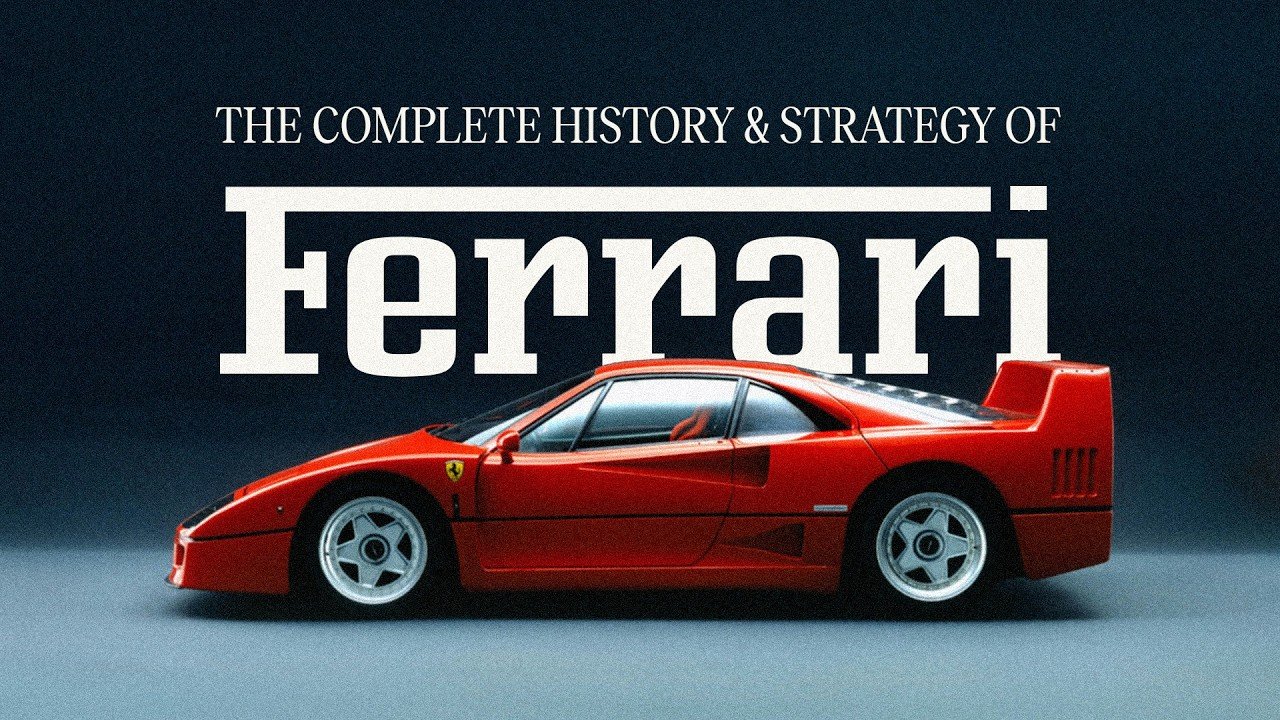
Enzo Ferrari died in the summer of 1988 at age 90. Ferrari had been valued at 192 million dollars that year. As of recent trading, the company’s market capitalization sits around 55 billion dollars after pulling back from a peak near 90 billion. The F40, the last car Enzo personally launched, named for the fortieth anniversary of the modern Ferrari’s founding, has a door handle made of string.
That detail, a string where a door handle could have been, on a car that the market will pay millions for at auction, is a small piece of what Ferrari actually sells. It is not transportation. It is not even quite a car. It is, as CEO Benedetto Vigna said in conversation before recording, a dream. The string is part of the dream.