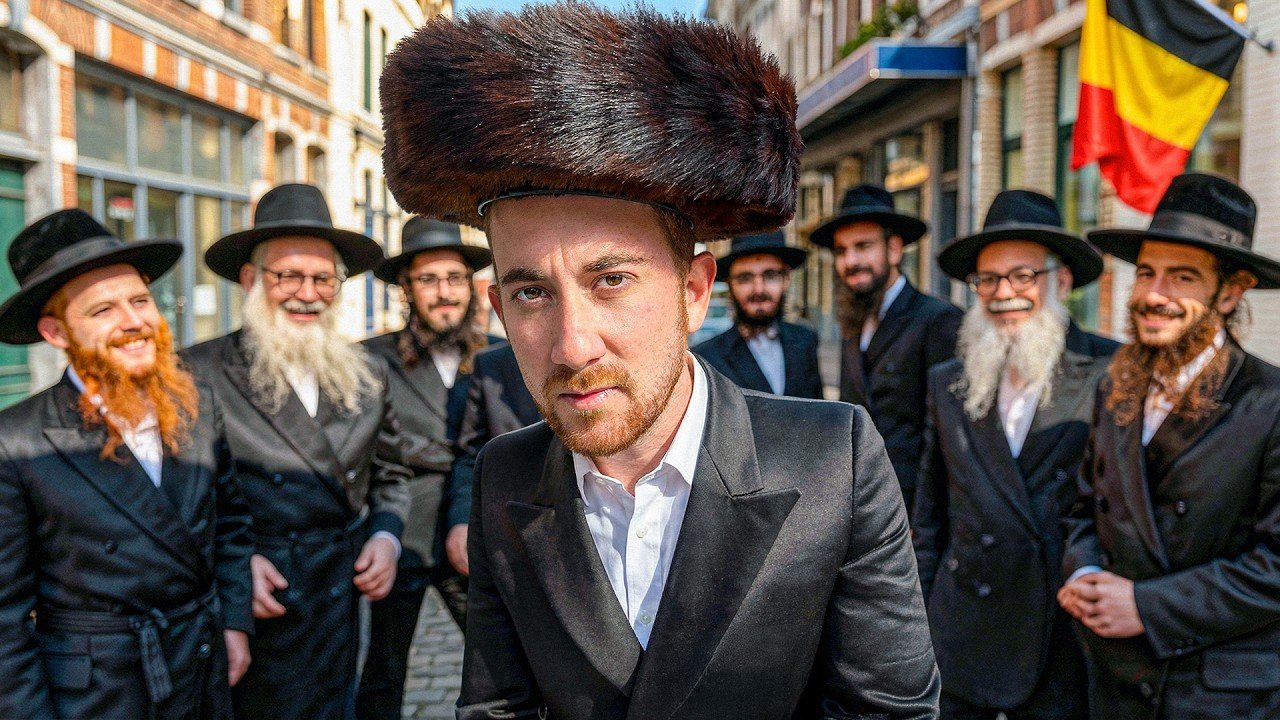
Raphael walked Drew Binsky through a cordoned street in Antwerp’s Diamond Square Mile, four police cars parked nose-to-tail outside a centuries-old Portuguese synagogue, and explained, with the calm of someone who grew up here, that the building has been sealed off to the public ever since a terrorist attack in 1980. That history, and the community still thriving inside it, is the real reason to pay attention to Antwerp: roughly 30,000 Hasidic Jews live woven into the fabric of a modern European city, following traditions so strict they predate electricity, yet navigating contemporary cobblestones on scooters and bicycles in a way that no other Hasidic community on earth quite replicates. Raphael, a member of the community whose family traces its Hasidic lineage back two generations, was the guide who made entry into that world possible.
How a diamond trade rebuilt an entire community after the war
Antwerp’s role as a global diamond hub stretches back to the 15th century, built on its position as a port city at the center of major trade routes. The Nazi occupation shattered that industry along with most of the Jewish population, but Hasidic Jews returning after World War II rebuilt Antwerp into what became the most important diamond center on earth. Today the city exports over 12 billion dollars worth of diamonds per year.
Binsky was granted rare access to a heavily secured vault where a third-generation diamond dealer walked him through the full chain: rough stones arriving in shipments from mines in Botswana, Namibia, South Africa, and Canada, sent to Surat, India, for polishing over one to two months, then returning as finished goods sold wholesale to brands including Tiffany’s. A bag of polished stones sitting on a counter ran to about a thousand carats and one million dollars at a thousand dollars a carat wholesale. The single most striking object in the room was a 10-carat fancy intense pink diamond, priced at 15 million dollars. ‘You take a stone, 15 million,’ the dealer said, ‘you put it in your pocket and you move to a different country. It’s been like this historically and it might happen again.’ He noted that where nearly 100 percent of Antwerp’s Jewish community once worked in diamonds, today the figure is roughly one to two percent, with Indian trading houses now the dominant competition.
The people keeping the neighborhood alive, one blueberry bun at a time
The texture of daily life came through in smaller encounters. Daniel, Raphael’s son, led a scooter tour past a park where German wartime bunkers still sit buried under planted bushes, too expensive to remove when the British arrived on the 4th of September 1944. He explained the Radomsk Hasidic line his family carries, a branch so reduced by the war that the remaining families gather just once a year in Poland. Chef Toli, a private kosher chef who spent 35 years running an advertising agency before switching careers, became a local celebrity through a ten-part Belgian television program about Jewish life in Antwerp that ranked as the second most-watched program in Belgium that year. He now describes his role as ambassador between communities, cooking Jewish-style food for non-Jewish Belgian clients and navigating questions about Israel and Gaza with a deliberate refusal to take sweeping positions: ‘I don’t even support my own government in everything they do. Why would I support a government 2,000 miles away?’
At what Chef Toli called the best kosher bakery in Europe, a blueberry bun made only during fresh blueberry season stopped the walk cold. It arrived oozing, crunchy-crusted, and sweet enough that Binsky admitted he had never had anything quite like it.
At a restaurant mid-afternoon, Binsky found himself sitting beside Regina Sluszny, a Belgian Holocaust survivor born in 1939, who was turning 86 in two weeks. She remembered German soldiers fleeing as American liberators approached Antwerp, and the fury of residents who had endured four years of occupation. She still receives hate mail. ‘I’m sitting here in Antwerp and I’m killing them in Gaza. That’s what they write.’ Her advice, offered without self-pity: ‘You have to be optimistic and believe in life, because if you don’t believe it, they will kill you very quickly.’
A 19-year-old who has not missed a mikvah in 13 months
Outside a large Satmar synagogue, Binsky met a 19-year-old traveler who reroutes flights specifically to reach a ritual bath, a mikvah, every single day, changing a planned Dublin connection to Brussels when he could not confirm access. He had kept the streak unbroken for 13 months.
Antwerp’s streets carry their own reminders of what that persistence costs when it is absent. Small brass plaques set into the cobblestones record the names of Jewish residents, the dates they were taken from their homes, and the concentration camps where they were sent. Raphael walked past one and described a ‘weird little cold feeling’ that does not entirely go away, even after years of stepping over them.
Back at the Diamond Square Mile, with diamond storefronts occupying nearly every corner and Hasidic families rolling past on bicycles in full traditional dress, the city presents something genuinely unusual: a community that has chosen modernity’s geography and rejected most of its habits, building a parallel world that is, block for block, thoroughly Antwerp.