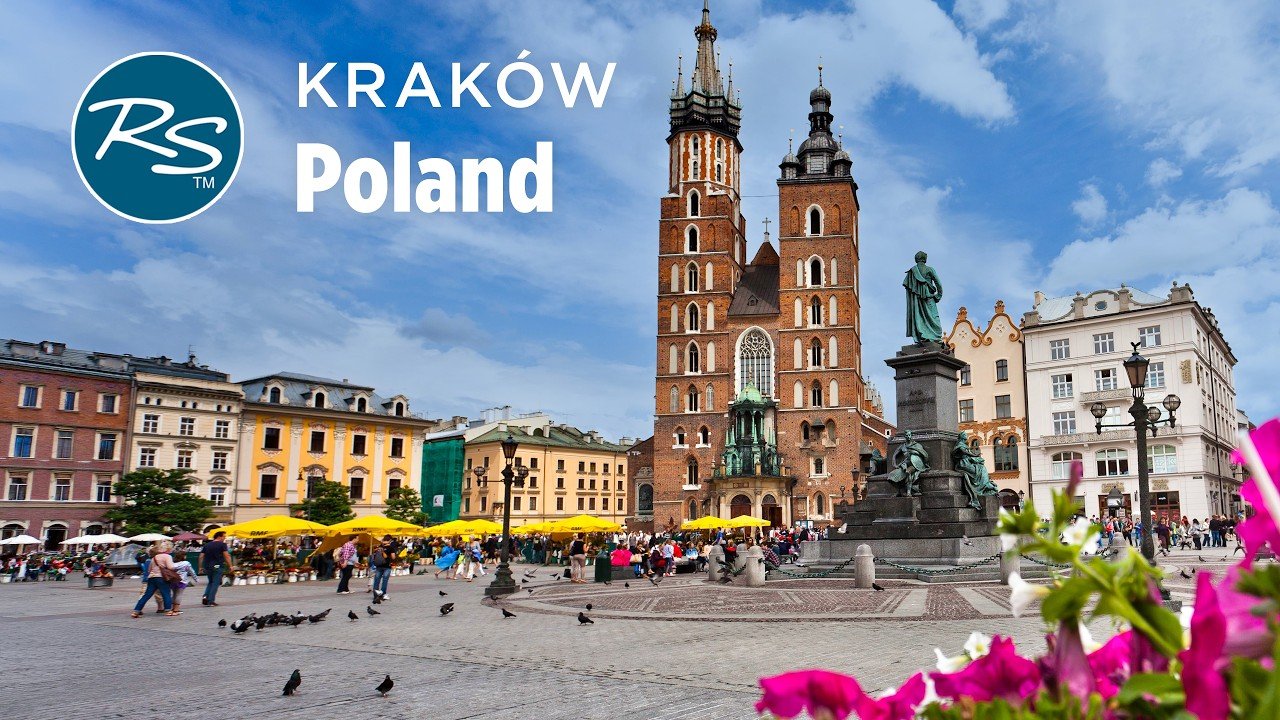
At the top of every hour, around the clock, a fireman climbs to the window of St. Mary’s Church tower above Krakow’s Main Market Square and raises a trumpet. The tune plays, then stops mid-phrase, cut short by the same moment that silenced a medieval watchman centuries ago when an enemy arrow pierced his throat. That abrupt, unresolved note still rings out over one of Europe‘s most alive public squares, and it sets the tone for a city that carries its past without apology.
Krakow is, by almost any measure, a city that refused to be erased. Poland itself disappeared from European maps in the late 1700s, partitioned by its powerful neighbors, and did not reappear until after World War I. It then spent decades inside communist Eastern Europe before reemerging as one of Central Europe’s leading countries. Through all of it, Krakow held its place as Poland’s historic, cultural, and intellectual capital, a sprawling city of a million people built around a delightful Old Town.
Everything converges on one extraordinary square
The Main Market Square pulls people in the way few public spaces can. Families out for a stroll, fairy-tale horse-drawn carriages, cafes spilling onto the pavement, and what feels like half the tourists in Poland on any given afternoon all share this open expanse without it ever feeling cramped. At its center stands the Cloth Hall, a long, low structure that once served as a marketplace for cloth merchants and today shelters souvenir stalls selling painted wooden plates from mountain forests, colorful hand-stitched embroidery, hand-painted pottery from Silesia, and amber jewelry from the Baltic coast.
Inside St. Mary’s Church, midday brings its own ritual. A nun swings open the doors to reveal a Gothic triptych with hinged panels carved in the late 1400s by Veit Stoss. The altarpiece depicts the Virgin Mary’s ascent to heaven with a fluidity of motion that was rare in Gothic art of the period, and it remains one of the most impressive medieval wood carvings in Europe.
The city rebuilt itself smarter after invasion
After invaders destroyed Krakow in the 13th century, residents rebuilt using a near-perfect grid plan that still makes the Old Town easy to navigate on foot. They also encircled the city with walls, ramparts, and towers, including a large round freestanding barbican that guarded the main gate. Most of that wall came down later, but the moat was filled in and replaced with a circular green belt called the Planty, which today is a favorite of locals for cycling and walking. Along the Vistula riverbank, boaters idle past picnickers, a playful pedestrian bridge invites a crossing, and outdoor chess tables attract a specific kind of confident challenger.
Rick Steves captured the square’s pull with characteristic directness: ‘It’s hard not to be drawn to this square.’
The trumpet that stops before the last note
The trumpet player at St. Mary’s tower, a working fireman on rotation, performs the same truncated call every hour of every day, including through the night. The legend behind that cut-off ending, a watchman struck mid-warning, has been built into the daily life of the city for centuries.
From the Planty’s shaded paths to the amber stalls inside the Cloth Hall, Krakow moves between its medieval bones and its present-day energy without seam. The chess players by the riverbank are still there, and the standing invitation, if you think you are good enough to sit down across from one of them, has not changed.