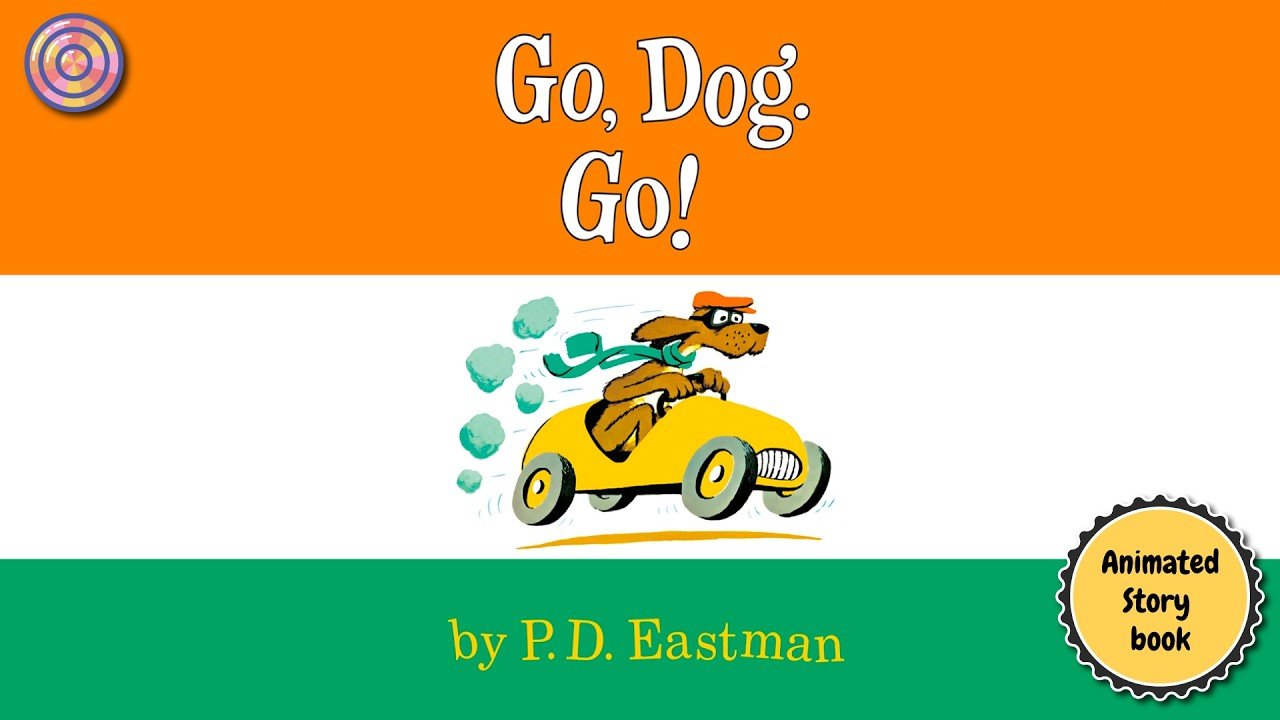
At the top of a very big tree, every dog in the book has finally arrived: big dogs and little dogs, red dogs and blue dogs, black dogs and white dogs, all gathered for one enormous party. Philip D. Eastman’s ‘Go, Dog. Go!’ has been making children laugh at that payoff for generations, and hearing it read aloud with animated warmth makes the journey to that treetop feel brand new every single time.
A hat, a question, and the joke that keeps coming back
The book opens simply, with a big dog and a little dog, a black dog and a white dog, and a cheerful hello exchanged on the page. Then comes the running thread that children immediately lock onto: one dog asks another, ‘Do you like my hat?’ The answer, every single time, is a flat ‘I do not,’ followed by a polite goodbye. It happens once, then again, then again, the same question and the same cool rejection, until the very last page, when the hat has changed and the answer finally changes with it. That small, patient comedy is Eastman at his best: a joke a two-year-old can follow and a four-year-old can anticipate.
In between those hat encounters, the story moves through opposites and positions with the easy confidence of a book that knows exactly what early readers need. Dogs go up and dogs go down. The green dog is up; the yellow dog is down. The blue dog is in; the red dog is out. A dog travels over the water and another travels under it. Two dogs share a house on a boat. The color contrasts are loud on purpose: a red dog on a blue tree, a blue dog on a red tree, a green dog on a yellow tree, each pairing drilling the words into memory without feeling like a lesson at all.
The race across every page to that treetop finish
The story’s energy shifts when the cars appear. Dogs pile in and speed off, and the book starts asking questions in the reader’s own voice: why are they going so fast? Where are those dogs going? The red light stops them and the green light sends them flying again, and then the destination becomes clear. Every car is aimed at one enormous tree. Every dog climbs up. And at the top sits the party that the whole book was quietly building toward, with every dog from every page finally in the same place at once.
The hat, naturally, makes its last appearance right there. This time it is a party hat, and this time the answer is ‘I do. What a hat. I like it.’ The payoff is small and completely satisfying, the kind of ending a child can see coming and still cheer for.
The dog who kept getting told ‘I do not’
The patient dog with the hat never stops asking. Through sun and night, through cars and boats, through work and sleep and a traffic light stop, the question goes out and the same answer comes back. It is not discouragement the book is modeling. It is persistence delivered as pure comedy, and the party hat at the top of the tree is its reward.
All those dogs are asleep now, resting until the sun comes back up and it is time, once again, to go.