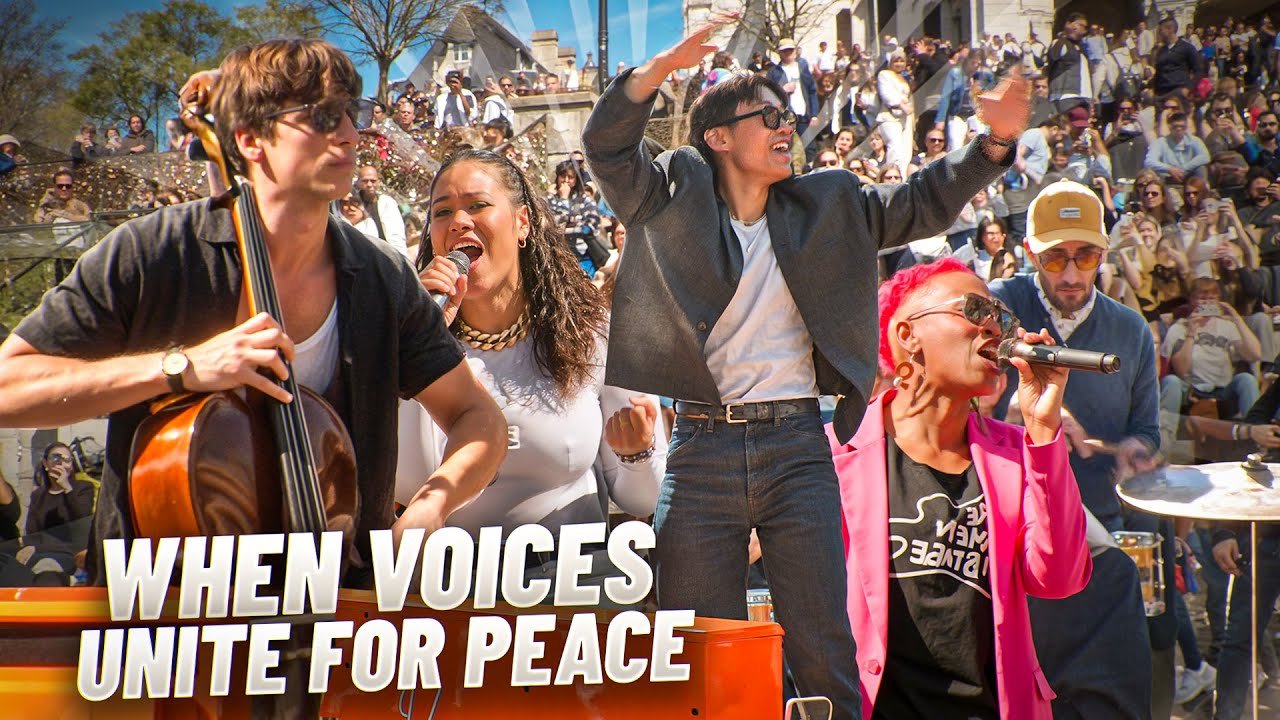
It started with a single question. Somewhere in a public space, a person turned to a musician and asked, simply, if he knew a song about peace. The musician paused for barely a second before answering: ‘Yeah. This one.’ What followed was not a solo performance but something rarer, a spontaneous, full-throated chorus of ‘We Are the World’ and ‘Heal the World’ that pulled in voices from the crowd around them, building from one exchange into something that felt genuinely shared.
Unprompted, unrehearsed public singing carries a specific kind of weight. It surfaces without a ticket price or a stage, and it asks nothing of the people who find themselves inside it except to stay and listen, or to join.
When the answer to a question becomes a performance
The exchange was disarmingly simple. ‘Do you know a song about peace?’ The musician’s reply came without hesitation: ‘Uh, yeah. Uh, this one. Exactly. This one I was thinking about.’ Then the questioner said something that shifted the whole moment. ‘You want to sing?’ ‘I want to sing.’ ‘Of course.’
From that brief back-and-forth, the music opened up. The familiar opening verses of ‘We Are the World’ moved through the crowd, the lines landing with a directness that studio recordings rarely carry: ‘There comes a time when we heed a certain call, when the world must come together as one.’ The performance was unpolished in the best sense, voices overlapping, the melody shared rather than owned.
The transition into Michael Jackson’s ‘Heal the World’ came organically, the crowd sustaining the same energy through the chorus: ‘Heal the world we live in, save it for our children.’ The applause at the close was immediate.
Two songs that still land without introduction
Both pieces were written decades ago and both were designed for exactly this kind of moment, not for arenas but for rooms and streets and anywhere people happened to be standing. What the performance captured was the durability of that design. Neither song required context. The musician put it plainly in those first few seconds: when someone asks for a song about peace, these are the ones that come to mind first.
The crowd’s applause at the end was not polite. It was the sound of people who had not expected to be moved and were.
The moment just before the music started
The musician, still holding his instrument, looking at the person who had asked the question.
The invitation hung in the air for a breath before anyone sang a word.
That pause, just before ‘There comes a time,’ is where the whole thing lived.