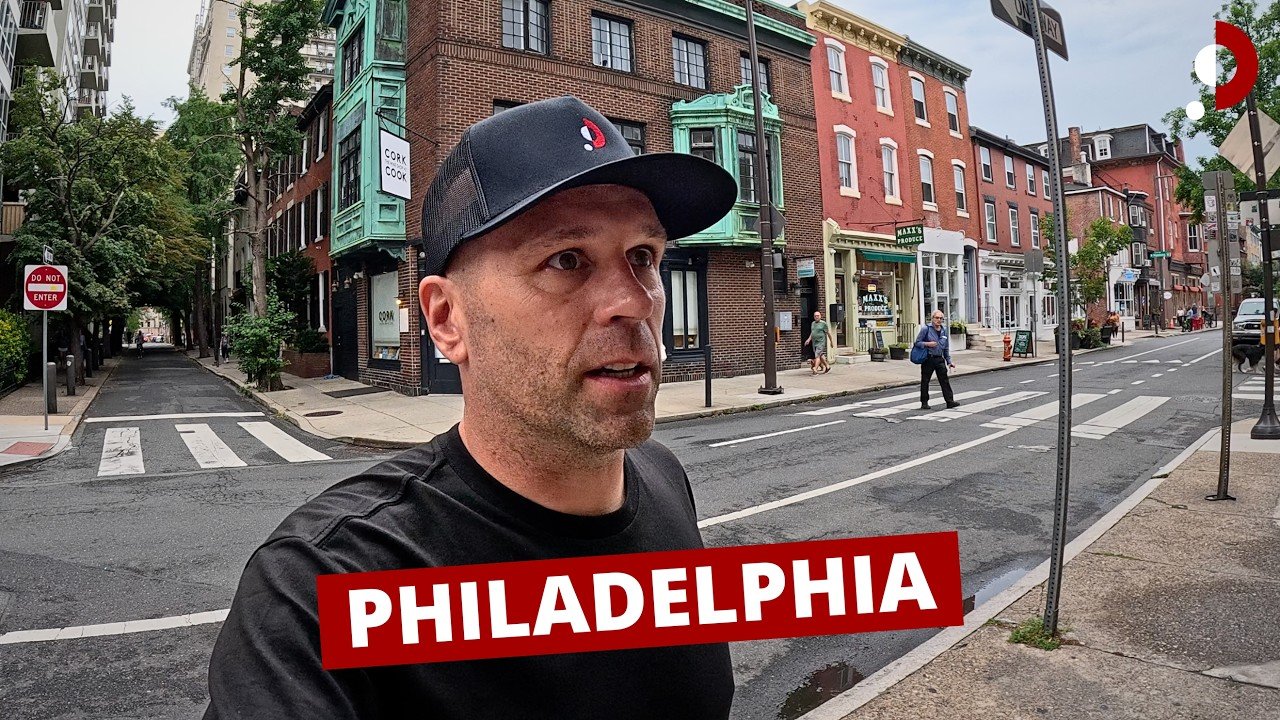
Peter Santenello was standing outside Independence Hall on the morning of the Fourth of July when the park ranger pulled him aside to explain the security queue just to get into the square. Philadelphia had turned 250 years into a full-on spectacle, and the city’s contradictions were already stacking up before he even reached the Liberty Bell. For anyone trying to understand what the United States actually looks like in its 250th year, the answer is complicated, warm, gutting, and delicious, sometimes within the same city block. Santenello spent the entire day moving across every stratum of the city, from the old money gardens of Rittenhouse Square to the block parties of Port Richmond to the fentanyl crisis on Kensington Avenue, letting the people he met carry the story.
Where old Philly still holds its ground
Rittenhouse Square surprised him immediately. Old-order Amish vendors had set up their stalls in the park, bonnets and all, selling blueberries, plums, strawberries, and pies in a neighborhood of generational wealth and cobblestoned storefronts. One of the Amish farmers, working steadily and willing to talk as long as he did not have to pose, described the whole arrangement simply: ‘Just love it. Bringing the joy to the city.’ A local named Juan, who described his relationship with Philadelphia as love and hate, offered the philosophical frame for the whole day when asked how he keeps going: ‘You going to ball into a corner or you going to keep moving forward?’
The Reading Terminal Market came next, a converted train station now packed with family-run food stalls, some of them operating for generations. A vendor at the first ginger shop in Philadelphia since 1776, selling cold-pressed beverages with 20 grams or more of brewed ginger per bottle, summed up the city’s stubborn energy: ‘The economy is still down. Yet in a city like Philadelphia, we still continue to put our best foot forward.’
Port Richmond and the block party that runs on loyalty
Santenello’s Uber driver for the afternoon turned out to be Malcolm, a born-and-raised North Philly native building a luxury organic cotton fashion brand called Savage Series 8, with New York Fashion Week on his calendar for September. Malcolm gave the day’s sharpest line on survival in a hard city: ‘Coming from a city like Philly where so much could seem like crabs in a barrel mentality, you got to have positivity, because that’s what keeps you going.’
Malcolm directed him toward Port Richmond, where a block party had overtaken the street for a four-year-old’s birthday. A resident who had lived on the block for 60 years, sharing a house with his mother until she passed away the previous November, stood in the rain explaining why he would never leave. A neighbor who had moved in just four months earlier was already folded in. The woman who welcomed him explained the neighborhood’s unwritten code: ‘Don’t be an animal to your neighbors. Don’t be ignorant. Look out for each other.’ Property taxes on these row homes had climbed from around 600 dollars annually to 4,000 dollars, and several neighbors described being pushed out of three different Philadelphia neighborhoods over the years as prices followed the renovation wave inward from the waterfront.
Kensington and a cheesesteak at the end of the day
Kensington Avenue was the hardest stop. Santenello had filmed there almost two years earlier and returned to find nothing changed: needles between the train tracks, people in wheelchairs in front of a health center, fentanyl use in open view of the street. A young woman who lived in the neighborhood delivered the most direct political statement of the day, aimed squarely at city leadership, demanding the streets be cleaned with the same resources being spent in other parts of the city.
The day ended in Fishtown, where Malcolm ordered from a cheesesteak spot he called his personal favorite. The order: Cooper Sharp cheese, light onion, seeded roll made in-house. Santenello called it the best cheesesteak he had eaten, rating it above the one from his previous trip.
A pallet of books in a warehouse on the Fourth
Mid-afternoon, before Kensington, there was a stop at the Simon and Schuster warehouse where Santenello’s book ‘Your Fellow Americans’ had arrived on Thursday. Standing in front of pallets stacked with copies, he ran his thumb across the cover to check the spelling, then held it up and noted the texture of it: ‘Goose bumps. Little bit of that action. Haven’t got those in a while.’
By evening, Croatian players were boarding buses outside the stadium and the streets had filled with World Cup fans, Ghana shirts and Croatia jerseys moving in the same crowd. A father and son were still working the sidewalk looking for tickets to a sold-out match.
Philadelphia, Santenello concluded at the end of the day, is ‘not an easy place to define,’ but also ‘beautiful, interesting, vibrant, delicious, sad, gritty.’ He estimated he had seen perhaps three percent of it.