
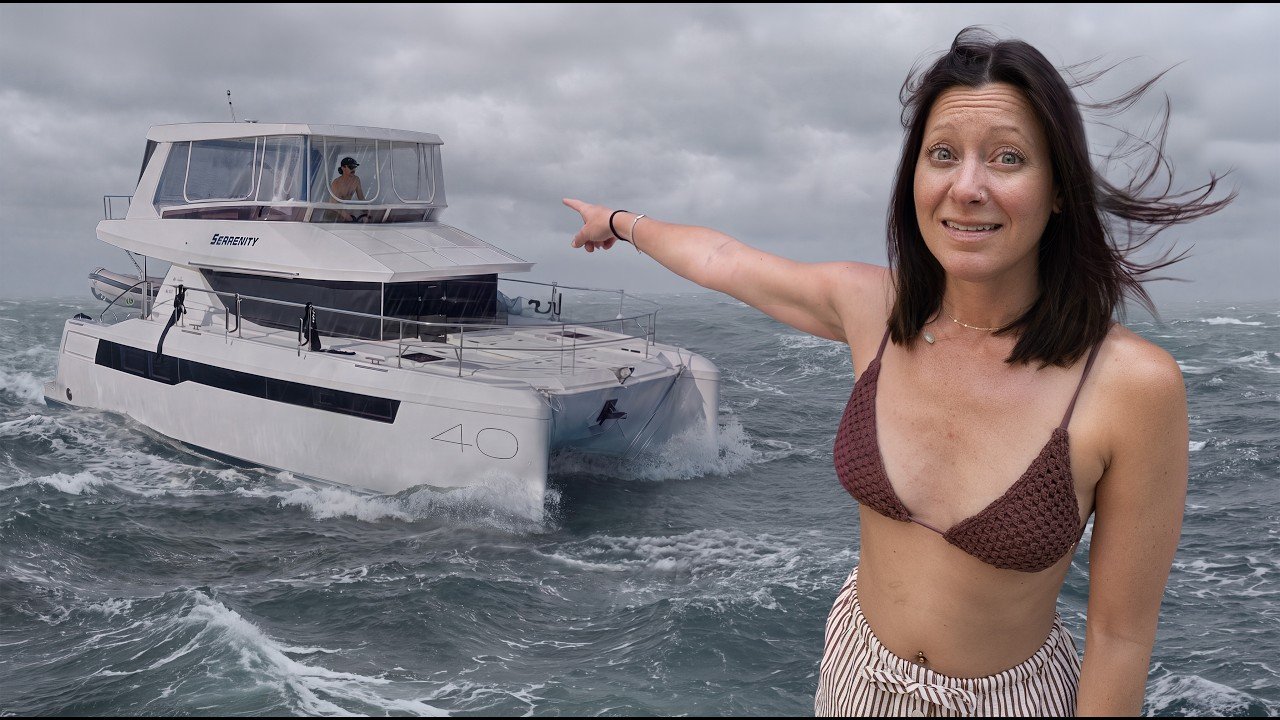
Nate stood at the helm of a 40-foot catamaran, somewhere in the Whitsunday Islands off the coast of Eastern Australia, holding the steering wheel with both hands while three-foot swells rolled under the hull and everyone below decks grabbed whatever was bolted down. The stakes were straightforward: a half-million-dollar yacht, open-ocean crossings under high-wind warnings, and a crew of six people who had never captained a boat before in their lives. What followed across seven days was equal parts terrifying and genuinely life-changing, the kind of trip that turns a bucket list item into a permanent obsession.
Nate had signed the charter documents and accepted legal responsibility for the vessel before the reality of that decision fully landed. ‘This was supposed to be like, I’ve just finished this big race, let’s go celebrate,’ he admitted to the crew on the way to the marina. ‘And now it’s feeling like a massive life or death adventure.’ His traveling companion Dusty, along with friends Cara and Sarah, made up the original four. They had arrived straight from a backyard ultra race in which Nate ran 150 miles over 36 hours, which made the idea of a relaxing sailing holiday feel somewhat optimistic from the start.
Four hours of training, then the open ocean
The charter company, Whitsunday Escape, handed over the keys after a morning that began at 8 a.m. and ended at 1 p.m., covering navigation rules, radio protocol, mooring technique, anchoring, and how to empty the holding tanks at sea. Their instructor Dave walked them through a 90-page safety manual, one of two on board. By early afternoon the boat was theirs, and by the following morning they were crossing the Whitsunday Passage in winds above 25 knots with a high-wind warning in effect.
The crossing through the open passage was the trip’s first honest reckoning. The bow slammed into swells rather than slicing through them. The fridge door kept flying open despite the strap meant to hold it. Produce scattered across the galley floor. Cara, the only crew member immune to seasickness, stationed herself next to the refrigerator between waves to stop the drawers from launching across the cabin. ‘Got to do what you got to do,’ she said, holding the door shut with one hand and bracing against the counter with the other. The TV came loose from its mount and started swinging toward the window.
Friends Max and Grace joined for the middle stretch of the trip, which brought the crew to six and the energy considerably higher. Max, an Australian, was in the water snorkeling within minutes of arriving at Butterfly Bay while the Americans ate lunch first. The group hiked a mile and a half with 1,500 feet of climbing to the highest point in the Whitsundays at Cid Harbour, spotted what appeared to be a snake on the trail that David had warned them could be a death adder, and anchored overnight in a bay with shark warning buoys bobbing at the entrance.
The night the anchor dragged into open water
The trip’s most serious moment came at Happy Bay on their own, late at night, when Nate noticed the boats in front of them appeared to be drifting further away. A depth check confirmed it: the reading had jumped from 11 meters to 25 meters. The anchor had dragged and the catamaran was slowly being pulled out toward open water in the dark. Cara was below with no clothes on when the alarm went out. Sarah grabbed headlamps left over from the ultra race. Dusty moved to the bow to guide anchoring while Nate worked the engines, steering toward boat lights he could see but not the actual boats behind them. ‘The freakiest thing is I can see the lights on the boat, but you can’t actually see the boat,’ Nate said. ‘It’s like driving toward a street light.’
It took four attempts to set the anchor and two calls to the Whitsunday Escape emergency line before it held. The on-call team walked them through switching the GPS to night mode, cutting the upstairs lights to improve visibility, and slowing the boat to near-zero to let the anchor catch rather than dragging it. The whole ordeal ran two hours. Nate stayed up checking the chart until well past midnight.
By the final day, high-wind warnings had been in effect every single day of the trip, which meant the eastern side of Whitsunday Island remained closed throughout. White Haven Beach, the swirling white sand that had first put the islands on their radar, stayed out of reach. The rental company sent a crew member to dock the catamaran, which turned out to involve squeezing the 40-foot hull through roughly five feet of clearance on either side between neighboring boats. Watching from the deck, Nate said he trusted himself to have figured it out. He also said it was very nice that nobody required him to.
A grounding fact from the last morning aboard
On their final night, the boat ran completely out of fresh water. Nate filled a pot with ice from the cooler to have enough to make coffee in the morning.
The catamaran sat in its slip at Coral Sea Marina, back in someone else’s hands, while the crew gathered their bags and tried to remember what land felt like. It was also, quietly, Nate and Cara’s 13th wedding anniversary. They had been married in Gallatin in 2013. Neither of them, 13 years earlier, could have told you where the Whitsunday Islands were.