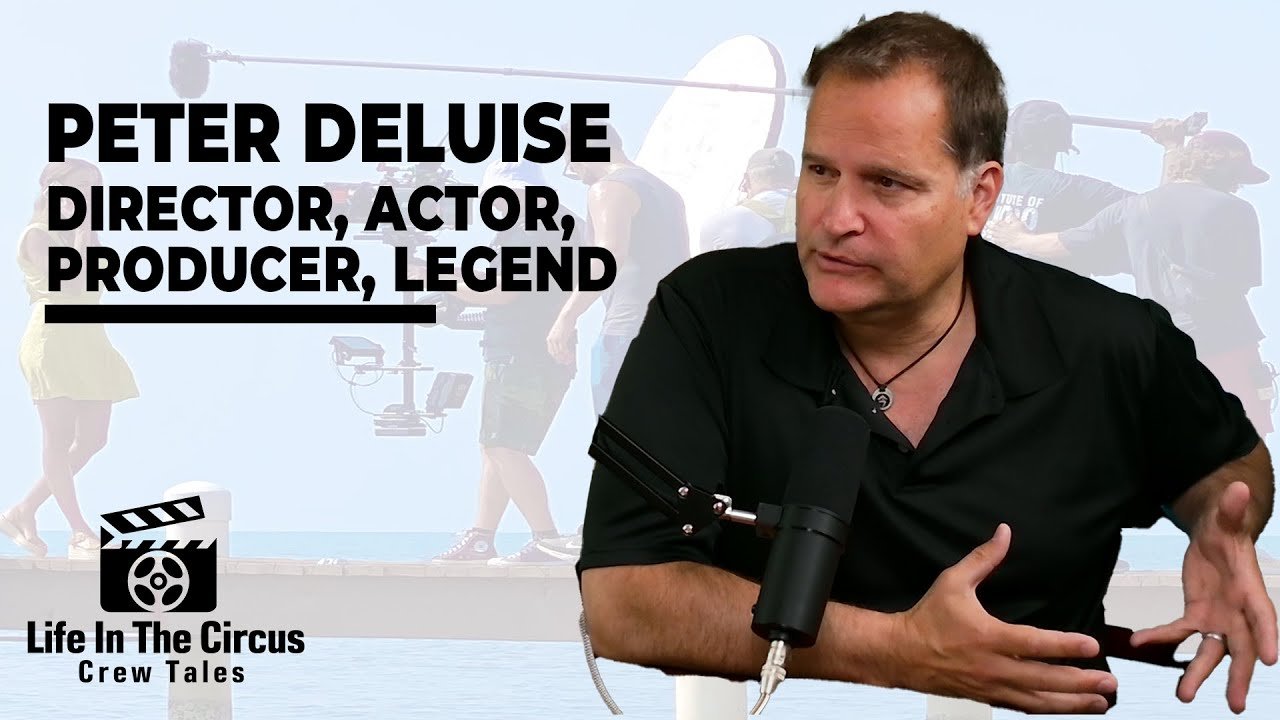
Peter DeLuise grew up pointing at the television and telling his father he knew exactly where that door led. Dom DeLuise would retell the story to anyone who would listen: his small son, gesturing at the front door and then at the screen, had already worked out the whole equation. That early certainty never really left. Decades later, Peter has written, produced, and directed across some of science fiction’s most durable franchises, and the logic he applies to every set still traces back to that same instinct: a story has a destination, and everything else is in service of getting there.
The scariest eyeball in the room
On a Stargate SG-1 production, the team needed to establish a genuinely menacing villain without what Peter called ‘a mustache to twirl.’ The conversation about contact lens colors was going nowhere until he stopped it. George Lucas, he reminded the room, had spent far longer than any television schedule allows deciding what the most frightening eye in cinema looked like. The result was Darth Maul: orange, yellow, red, a tiny black center. ‘The French call it homage,’ Peter said, ‘and Americans call it ripoff.’ The Stargate production went with the Darth Maul eye, called it an Easter egg, and moved on.
The same logic shaped how he approached creature sequences. James Cameron’s water creature in ‘The Abyss’ runs for roughly two minutes on screen, but Peter noticed that only about 15 to 20 seconds of that runtime shows the creature itself moving. The rest is the creature’s point of view: other actors looking directly into the lens, reacting to something the audience is imagining. Spielberg had done the same thing on ‘Jaws’ out of mechanical necessity when the shark kept failing. Peter applied the principle on Stargate whenever the CGI budget ran short. Let the audience’s imagination supply the best possible version of the monster.
When the destination disappears from the map
The difference between Stargate and some of the later work Peter describes is essentially a planning problem. On Stargate, the writers’ room established where the season would end before the scripts were written. MGM was largely hands-off, Brad Wright and Robert Cooper held the map, and every episode’s smaller decisions made sense in relation to a known finish line.
On ‘When Calls the Heart,’ the situation could be reversed. Network executives sometimes could not agree on the intended destination early enough for the writing room to build toward it coherently. The result, as Peter laid it out, is a kind of mutual concealment: writers hide the destination because they fear it will be rejected, executives cannot approve a path they have not been shown, and the audience eventually watches a swerve that has no satisfying explanation.
His most vivid piece of on-set direction came from that same show. A script called for a major character’s assassination to unfold inside a four-walled office interior. Peter pushed it outside, into rain, with period Model T headlights cutting through the dark, staging it directly after rewatching the scene in ‘Boardwalk Empire’ where Nucky Thompson kills Jimmy Darmody. The production used that rainy exterior footage as the anchor for an entire season of flashbacks. ‘I just knew,’ he said, ‘that’s a great way to shoot a guy. In the rain, at night, with the headlights on.’
For anyone trying to learn the craft now, Peter’s shortlist is specific: William Goldman’s ‘Adventures in the Screen Trade,’ Stephen King’s ‘On Writing,’ and Blake Snyder’s ‘Save the Cat’ for story structure. Beyond those, he offered one rule that covers most situations: if you are going to break the rules, know which rules you are breaking.
The two takes, both printed
Somewhere in the middle of the Stargate years, a production supervisor noticed Peter’s printed-take count running unusually high. Peter’s defense was arithmetic: two takes, both printed, set cleared early, overtime saved. He had learned it from watching Burt Reynolds and Dom DeLuise simply let the camera roll rather than calling cut after a flubbed line. The blooper reels from those productions existed because nobody stopped them.
The final paragraph of any script, Peter said, is where the writer leaves you with what the whole thing was actually about. The theme lives in the last scene, not the first.
The rain gear for the next ‘When Calls the Heart’ block is already on the list.