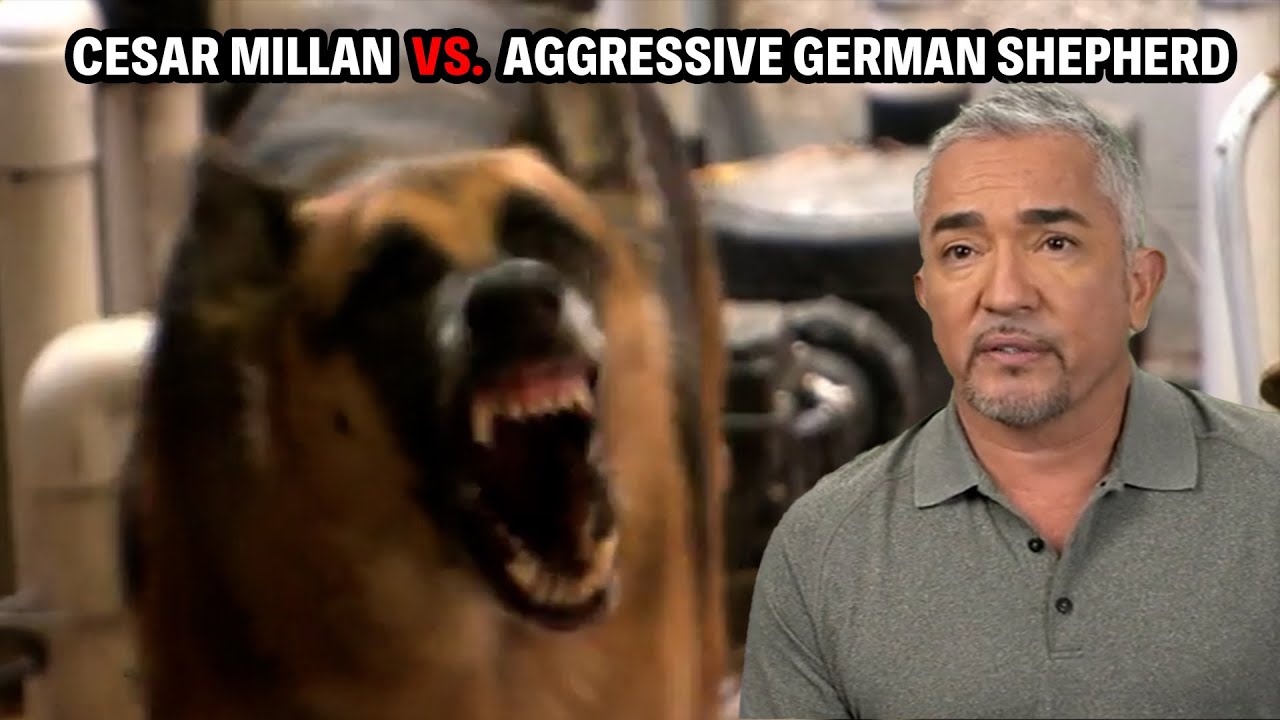
Trisha already knew the moment her sister screamed from the side yard that everything had gone wrong. Oetkin, her six-year-old German Shepherd, had torn through the gap between the properties and attacked Debbie, leaving wounds so deep the surgeons had to stitch from the inside out before closing the skin. Thirty stitches in total, across the inner thigh, outer thigh, inner calf, and wrist. What happens next matters for anyone who has ever watched a beloved animal and a beloved family pull in opposite directions, each one threatening to swallow the other. That collision was already well underway when Cesar Millan got the call.
A house divided by a guest who never asked permission
Debbie and Gary had welcomed Trish from Chicago and set her up in the backyard guest house, expecting sisterhood. What arrived instead were two dogs, a half-German Shepherd named Tahoe, and Oetkin, a full-bred German Shepherd who had been running the household since he was six months old. Back in Chicago, Trish had quietly adapted her entire life around him. No visitors. Doors locked. A retired woman on a fixed income who simply stopped letting people in. She never told her sister the full picture before the move because, as she put it, everything was already planned and she hoped California would sort itself out.
By the time Millan arrived, the two families were effectively barricaded. Signs on doors. A no-man’s-land between the main house and the guest house. Oetkin was not a nuisance; he was a territorial sentinel who charged anyone who entered his claimed space, and Debbie had the scars to prove it. Millan was direct about his level of concern going in: ‘Nine out of ten phone calls I get, people think they have an aggressive dog and I am not quite concerned. But this consultation I am very concerned about the family.’
His first assessment, watching from inside the house as Oetkin charged the fence line, was clinical. Territorial. Classic charge pattern. And critically, the owner’s energy was the fuel.
Tennis rackets, vinegar, and a boxing gym in East Los Angeles
Millan’s opening move was unconventional even by his own standards. He had paper towels soaked in vinegar placed around the backyard perimeter, attempting to create a scent barrier that would register to Oetkin as a competing territorial claim. It did not work. The concentration was too low. He came back with more, then added a tennis racket as a physical shield and walked into the yard himself while Trish sat in a chair with her eyes closed. His reasoning was precise: her visible anxiety was signaling submission to a dog that needed to believe its owner was in charge. With her eyes shut and her breathing regulated, she was temporarily removed from the equation. Oetkin calmed enough to respond to a single firm command, ‘enough,’ and that tiny window was enough for Millan to extract him the following day using his own pack of dominant dogs and an assistant named Mercer with a broom.
Oetkin spent several days at the Dog Psychology Center. The transformation in structured conditions was remarkable. He moved calmly among crew members, sheep, and other dogs. But when Trish arrived and came within range, every hour of work unraveled in seconds. Her scent, her emotion, her visible relief at seeing him: all of it fired his protective instincts back to full. Millan put the muzzle back on and made a decision. He enrolled Trish in boxing lessons with a trainer named Carrie.
The logic was not about punching. It was about what boxing requires physically: claiming space, moving forward, holding a boundary with the body rather than the voice. After several sessions, Trish came back to the house, walked into the backyard, and for the first time used her body to hold Oetkin back without flinching. Millan watched and then said what he had not been willing to say before: ‘He is ready to come back.’
One command Trish could not quite land
At the Dog Psychology Center reunion, when Millan tried to teach Trish the shoulder-touch technique, a light press meant to interrupt a dog’s nervous energy and signal calm authority, she could not complete it. She tried twice. Oetkin felt her hesitation before she showed it. Millan did not sugarcoat the moment: ‘I am not going to take the muscle off today, not unless you leave.’
That afternoon in the DPC parking area, Trish standing outside a gate she had not yet earned the right to walk through, was the emotional center of the whole case.
The day Gary and Debbie walked back into their own yard
A week later Millan returned to the main house with Oetkin off-muzzle, his pack, and his crew, walking through the backyard in what he called a victory run. Gary and Debbie watched from inside. Gary, who had called Oetkin a killer dog and spent months afraid of his own property, looked out the window at a dog trotting loose among strangers and said simply: ‘I really cannot believe he is not in attack mode.’
Millan brought Oetkin inside the house. Debbie sat across from him, the same animal that had sent her to the emergency room, and watched him sit quietly while Millan held the leash. She admitted she had never expected to use the words ‘calm’ and ‘Oetkin’ in the same sentence.
The muzzle stays on for now during any contact with Debbie and Gary, and Millan was clear that trust closes in small increments, not in a single reunion scene. Trish, for her part, said she was ready to keep working. Whether that is the boxing stance talking or something that took root in a Chicago apartment years ago, the answer belongs to the next session.
Oetkin sat at Trish’s side at the end, the same posture he had held since he was four months old, only this time she was the one deciding what happened next.