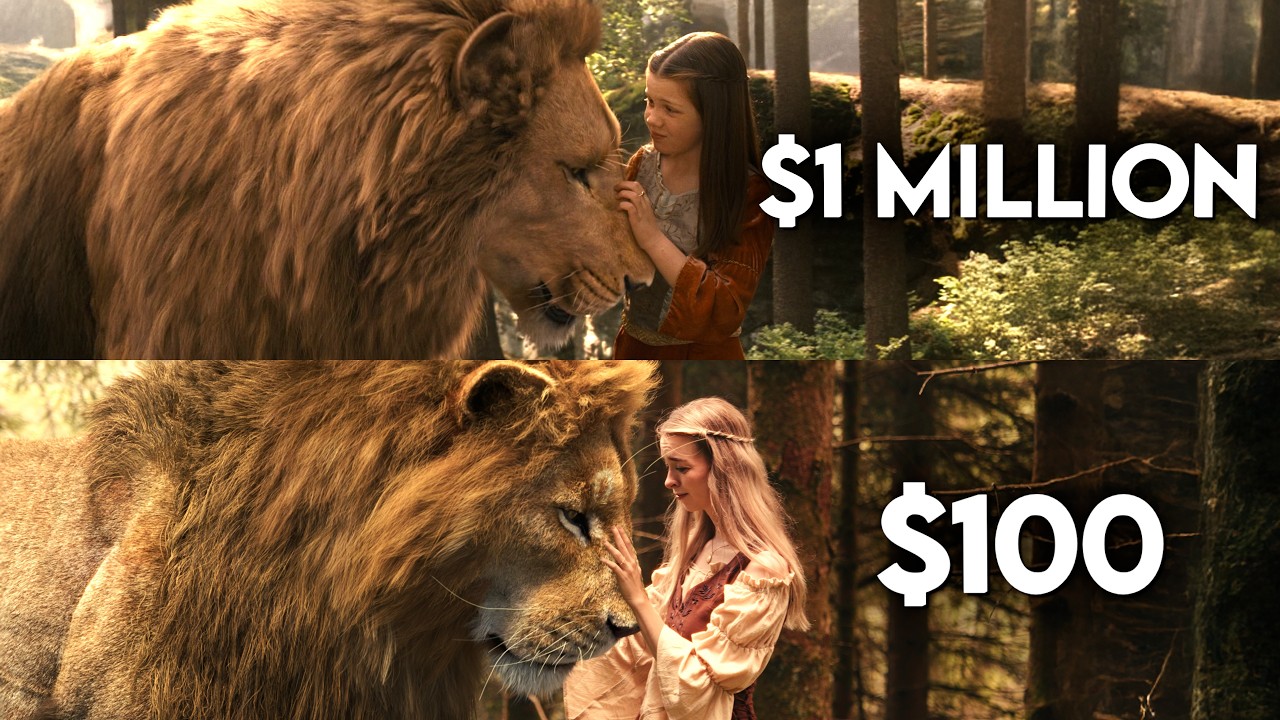
Maria Kallevik’s dog Lucy bolted through grass so tall it swallowed her whole, which is exactly the wrong kind of forest floor for a barefoot medieval dress shoot in rural Norway. That small comedic disaster captures everything about what it actually takes to bring a beloved fantasy world back to life: the gap between the scene in your head and the very wet, very swampy reality underfoot. For anyone who grew up with the Narnia films and felt a strange pull toward that world they could never quite name, what Maria built over the course of one month is something close to an answer.
Three hours of swamp before a single frame
The first task was finding a location that looked even remotely like the Prince Caspian forest, and it resisted her. Some spots had trees packed so tight the light died before it reached the ground. Others were open but waterlogged. Maria, her dad, and the dog named after Lucy Pevensie searched for three hours before landing on a patch of dry ground with spaced-out trees, genuine ferns, and a narrow path cutting through. It was perfect, and it almost did not exist.
The dress hunt was its own ordeal. The signature white dress she had worn in previous recreations simply did not fit the red medieval silhouette Lucy wears in Prince Caspian. A full day of scrolling through sold-out listings and interminable shipping windows led her, finally, to a Norwegian maker of fantasy clothing whose work stopped the search cold.
Filming itself ran on borrowed afternoon light because the soft, dreamy quality of the scene required it, which meant roughly 20 shots had to be captured before the sun dropped. Norway offered one warm, sunny day after days of rain, and Maria sprinted at it. Four hours of barefoot walking on forest ground later, she had the first location wrapped. She described it plainly: ‘This hurts so much.’
A lion skeleton, 5.2 million hairs, and one carnival costume
The visual effects work split into three distinct problems. The leaf woman required building a full geometry system that mapped foliage onto the curvature of a human figure, a technical puzzle that consumed days of research before it clicked. A disappearing-leaves bug surfaced after the system was complete. After an entire day hunting it with no answer, Maria decided it was invisible enough to ignore and moved forward.
The trees needed 3D models matched to real forest light, then animated with a noise modifier to give the leaves organic, unpredictable movement. The original Narnia production, she noticed, had a floating background tree with a noticeably fake texture in one of the very shots she was recreating. It was a useful reminder that imperfection in a supporting element does not collapse a scene.
Aslan was the hardest problem. The original production team spent two years building the character, constructed a full skeleton and muscle system beneath the fur so that every movement and wrinkle transferred to the surface, and added 5.2 million individual hairs matched to a lion’s rough, clumping texture. A single rendered frame took 10 hours. Rather than attempt her own model from scratch, Maria purchased one online and matched its coloring and lighting to her footage by temporarily substituting a human character to study how natural light fell on a figure in that specific spot.
For the interactive Aslan shots, she needed a physical stand-in for the actor reference the original production used. Her dad stepped in. The stand-in costume was her childhood carnival outfit from roughly age 8, and fitting a grown man into it produced a sequence of events she did not fully document but did not need to.
The C.S. Lewis quote that explains why any of this matters
Partway through the project, Maria paused the technical walkthrough to read from C.S. Lewis’s ‘The Weight of Glory’: ‘They are not the thing itself. They are only the scent of a flower we have not found. The echo of a tune we have not heard. News from a country we have never yet visited.’ She described the Narnia feeling as ‘a kind of homesickness for a world I’ve never actually seen,’ and the Lewis passage as the first thing that made that feeling make sense to her.
The compositing stage pulled everything together in DaVinci Resolve with color grading and sound replacement throughout. Light rays were added to the Aslan hug shot because without them, she said, the scene looked sad compared to the film. A grassy texture was used to make her hand look partially obscured by fur during the close contact shots. The transformation sequence, where leaves spread outward and then collapse back into the leaf woman’s form, took two full days of speed and flow experimentation on its own.
Her dad, still wearing the costume somewhere in the outtakes
A man in a child’s carnival lion costume standing in a Norwegian forest while a thunderstorm rolled in, trying to hold a pose long enough for a close-up shot.
The project was finished. The leaf woman moved. The trees breathed. Aslan turned his head. Maria’s barefoot forest walk, all four hours of it, was now something else entirely.