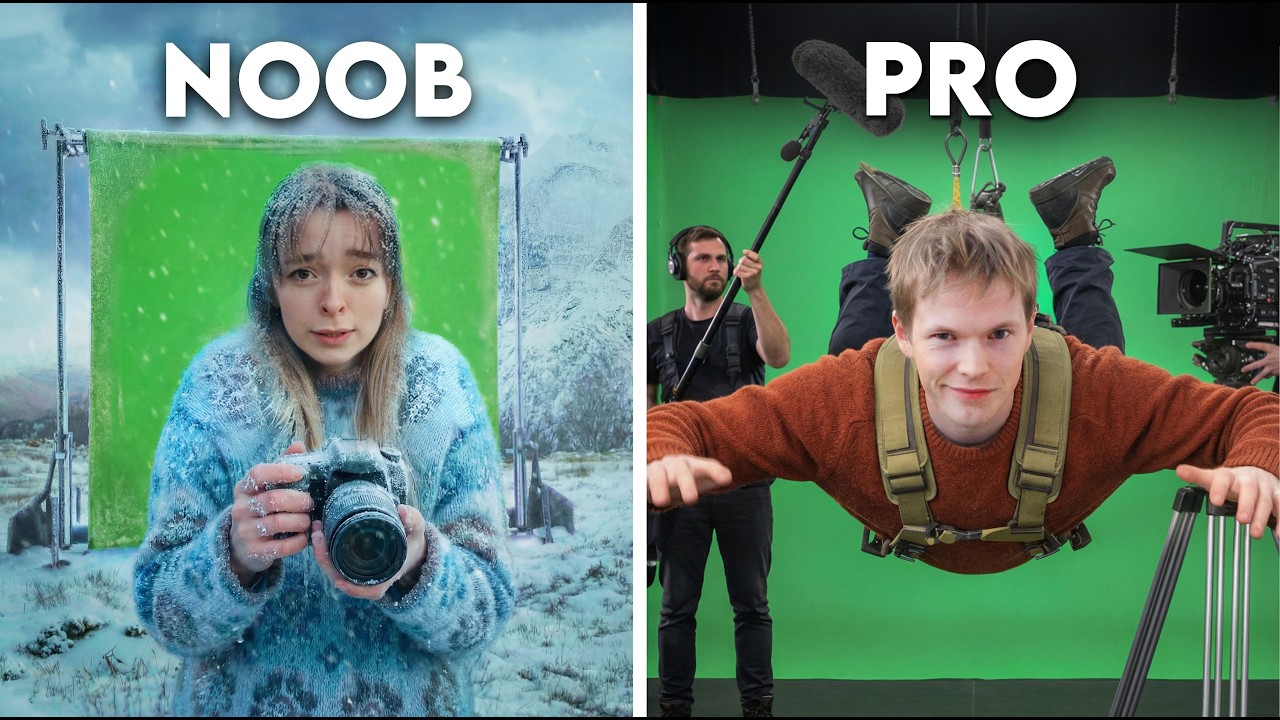
Maria Kallevik was standing on a freezing Norwegian mountain, about to throw herself backward onto an inflatable mattress in near-darkness, when she realized she might have taken on too much. She had one month, nearly 30 difficult shots, a broken drone wing, a six-year-old who needed bribing with candy, and a husband who was simultaneously her biggest competitor and her only crew member willing to show up. What she was building was a short VFX film representing Norway in an international creative competition tied to the FIFA World Cup 2026. What she got was something she did not expect.
A football, a mountain, and a broken drone
The premise of Maria’s piece was personal. A football erupts into a beam of light, which unfolds into a series of memories tracing the journey of the boy who once owned it. To represent Norway, she designed the memories to look like the northern lights, with a vast mountain range as the backdrop. She and Eric drove as far up as the road allowed, then walked the rest of the way to the location she had in mind.
Filming the central impact shot meant Maria had to be physically thrown backward by the force of the ball’s explosion. The mattress they brought for the stunt was only barely inflated, and the landing, as she put it plainly, ‘literally was me destroying myself on the ground.’ They got the shot in two jumps. Then came the drone sequence. Earlier that day, Maria had struggled to land the drone and handed it to Eric to try. That handoff snapped one of the wings. With the light fading and more than half the shoot still ahead, they had to improvise fast, running to a large flat rock to use as a launch surface instead. That solution worked until the rock did not. Maria stepped through the snow’s surface and fell into standing water underneath. ‘I think this is the worst trip I’ve ever been on,’ she said at the time, though she kept filming.
Building the northern lights from scratch
Back in post-production, Maria built the light effects layer by layer. She rotoscoped herself out of the impact shot, added shock waves using a dark asset she had sourced, then brightened both herself and the ground to react to the explosion. She bought a pack of light beam assets, selected her favorites, adjusted their timing and colors, and added a lens flare, lens dirt, and camera shake on top. For the bird’s-eye light trail sequence she had originally planned to shoot with the drone, she extended the frame in Photoshop using AI, tracked the footage in Nuke, built the trail geometry in Blender, and rendered it out.
The memory effects required their own logic. She cast her cousin Samuel, who is six years old and agreed to participate in exchange for a piece of candy, as the child in the first memory. To create the memory look, she rotoscoped him out, faded previous frames to build a ghost effect, used noise to warm the colors, and layered in chromatic aberration, glow, and light rays. For the sequence showing a full life lived through football, she also cast a stranger: a ten-year-old she spotted practicing alone on a nearby pitch, who turned out, as she noted with some disbelief, to be completely smashing it.
Before tackling that sequence, she spoke with Sasha Klesen, a footballer who spent 17 years playing at the highest level. He described receiving his first ball before he could walk: ‘My dad was obsessed with soccer and so I became obsessed with soccer and as soon as I could walk, I was dribbling with it.’ That conversation sent Maria back to her own family, to a grandfather with a shelf of old cameras and a great-grandfather whose photographs, she said, ‘are like windows into another world.’
The moment a competition stopped feeling like one
A month after the mountain shoot, Maria traveled to Mexico City to reveal the finished piece alongside three other international creators at a production set she described as far larger than she had imagined, with around 40 people there to document the reveal. Eric, watching from the audience, told her afterward: ‘You know, you could have made like a 20-second video and it would have been good.’
The results of the competition were left for the audience to decide. But Maria had already arrived at her own conclusion on the mountain, somewhere between the broken drone, the freezing water, and her mom standing in the dark holding a light to illuminate a VFX shot.
Samuel, age six, waiting for his candy
Maria’s cousin Samuel, the youngest cast member and the one who required the most negotiation, spent his afternoon on a cold Norwegian hillside being rotoscoped into a northern lights memory sequence for a global FIFA art competition, having agreed to the whole arrangement for a single piece of candy.
The competition that started on a freezing mountain ended in Mexico City, and what Maria carried back was not a trophy but a finished piece built from a broken wing, a mattress landing, a stranger’s kid on a practice pitch, and a family that showed up in the cold.