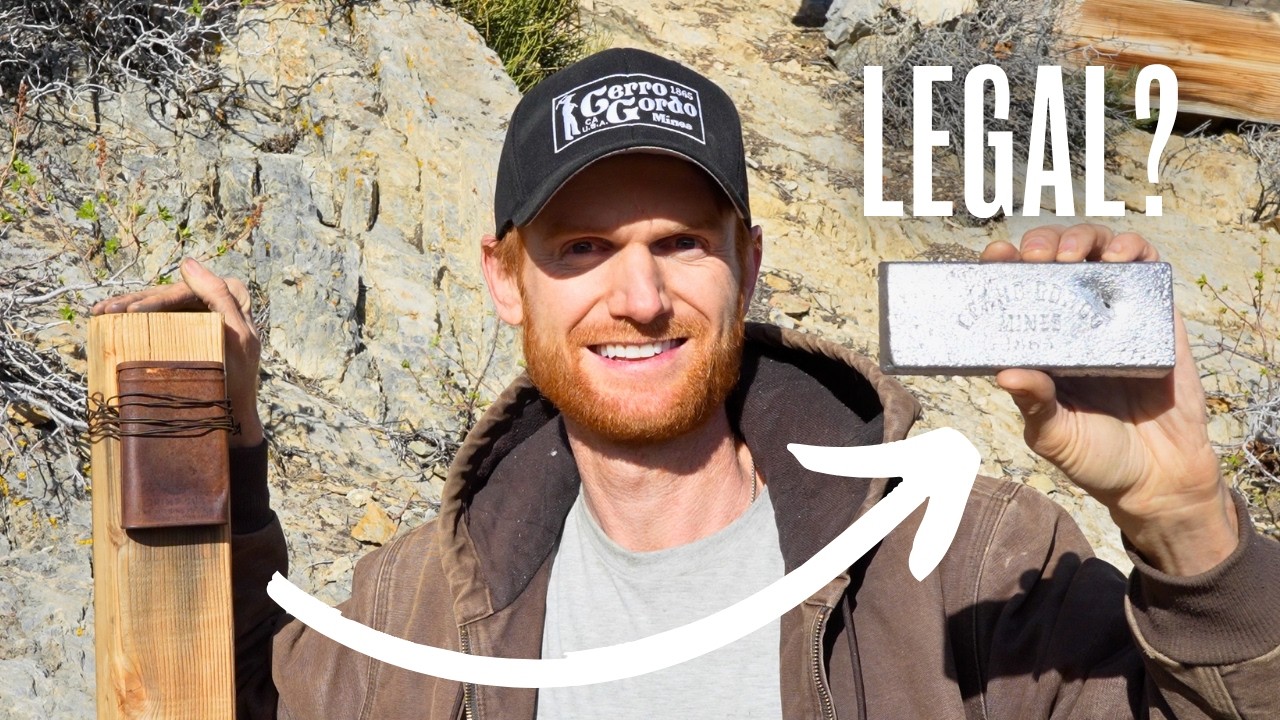
Brent held up a small bar of metal outside the abandoned mining town of Cerro Gordo, California, and said what most people would never expect to hear: the silver inside came from a hill that, just months earlier, belonged to the American public. Thanks to a 154-year-old law still on the books, any individual can stake a mineral claim on eligible public land, and Brent spent seven months doing exactly that from scratch. What follows is a step-by-step account of how a resident of one of California‘s most storied ghost towns filed a legal mining claim, hauled ore down a desert hillside in a coming thunderstorm, and smelted it down to find out what was actually inside.
Finding land that can actually be claimed
The process starts well before anyone picks up a wooden post. Not all open land in the American West qualifies for mineral claims. Private parcels, national parks, wilderness designations, and Bureau of Land Management tracts that have been withdrawn for reasons ranging from water protection to power-line corridors are all off the table. Most of the land surrounding Cerro Gordo, for instance, is BLM land but withdrawn because of the Los Angeles Department of Water and Power.
The BLM’s Mineral and Land Record System solves what once required trekking through valleys and digging through courthouse paperwork. Brent pulled up the real-time map, toggled on layers for land-use authorizations, active mining claims, withdrawals, the public land survey system, national monuments, and wilderness areas, then dropped in GPS coordinates from a mine he had driven past. The map flagged an active 20-acre claim nearby called the Silver Swan as a reference point, and confirmed that his chosen coordinates were managed by the BLM in Ridgecrest with no withdrawal flags. That parcel went on the list.
On-the-ground scouting followed. Working through eight or ten candidate mines in a single area, Brent spotted galena, the silver-bearing lead mineral that built Cerro Gordo, visible in quartz inside several shafts. One site had a direct connection to Robert, the old caretaker of Cerro Gordo, whose J&R Mining paperwork last recorded the claim in 2004. Before staking anything, the 1894 prudent man standard also had to be satisfied: a Supreme Court precedent requiring a demonstrable likelihood that valuable minerals exist. Brent crushed and panned samples from his preferred site on the spot, catching what looked like a small fleck of gold alongside the galena. ‘That’s good enough for me,’ he said. ‘We got gold in those hills.’
Staking the claim and making it official
The physical act of staking borrows its look directly from the 1870s. A four-by-four post roughly four feet tall, with the bottom foot supported by rocks, goes in at the discovery monument and at each corner of the claim. Attached to each post, inside an old tobacco tin, is a location notice listing the claim name, the claimant, the mineral rights being asserted, the PLSS coordinates, the acreage, the discovery date, and a signed certificate of compliance. A simple hand-drawn map showing the section, township, and range accompanies it, so the BLM and county can place the claim precisely on the earth.
From there, one signed copy stays at the monument. A second goes to the Inyo County Recorder in Independence, California, where Brent paid $989 to record the claim officially. The stamped copy then travels to the BLM, which processes it over several weeks. Seven months after filing, the claim still showed as filed rather than active, but under the General Mining Act of 1872 the legal rights begin at the moment of filing, not at final approval.
What the ore actually contained
Mining day brought a haul of several hundred pounds of ore, rich in galena and white quartz with streaks of visible heavy minerals. Back at Cerro Gordo, Brent ran it through a crusher and a sluice, collecting concentrates that weighed in at roughly three and a half pounds after the first pass. He smelted those with soda ash and borax flux, poured the result into cupels to oxidize away the lead, and consolidated four pucks down to two, then to one, before deciding that further cupellation on this scale was burning too much of the value in materials.
Instead he drove to Bishop to have the bar scanned by an XRF gun. The technician read the results aloud: 710,000 parts per million lead, followed by iron, copper, and zinc in descending order, then silver at 162,800 parts per million. The final count came to approximately 3.22 troy ounces of silver in a bar weighing about 26 troy ounces total. At silver’s all-time high, that amounts to roughly $300 to $500.
The tobacco tin nailed to a wooden post
Inside one of the corner-post tins Brent had found at Cerro Gordo before he began, a location notice from 1925 sat folded against the metal walls, its handwriting still legible after a century in the desert.
The bar Brent poured from his first legal claim is a door bar, close to refined but not quite finished, cast in a Cerro Gordo mold. It contains months of scouting, courthouse filings, a desert thunderstorm, and 3.22 troy ounces of silver pulled from a hill that was once everybody’s and is now, legally, his to mine.