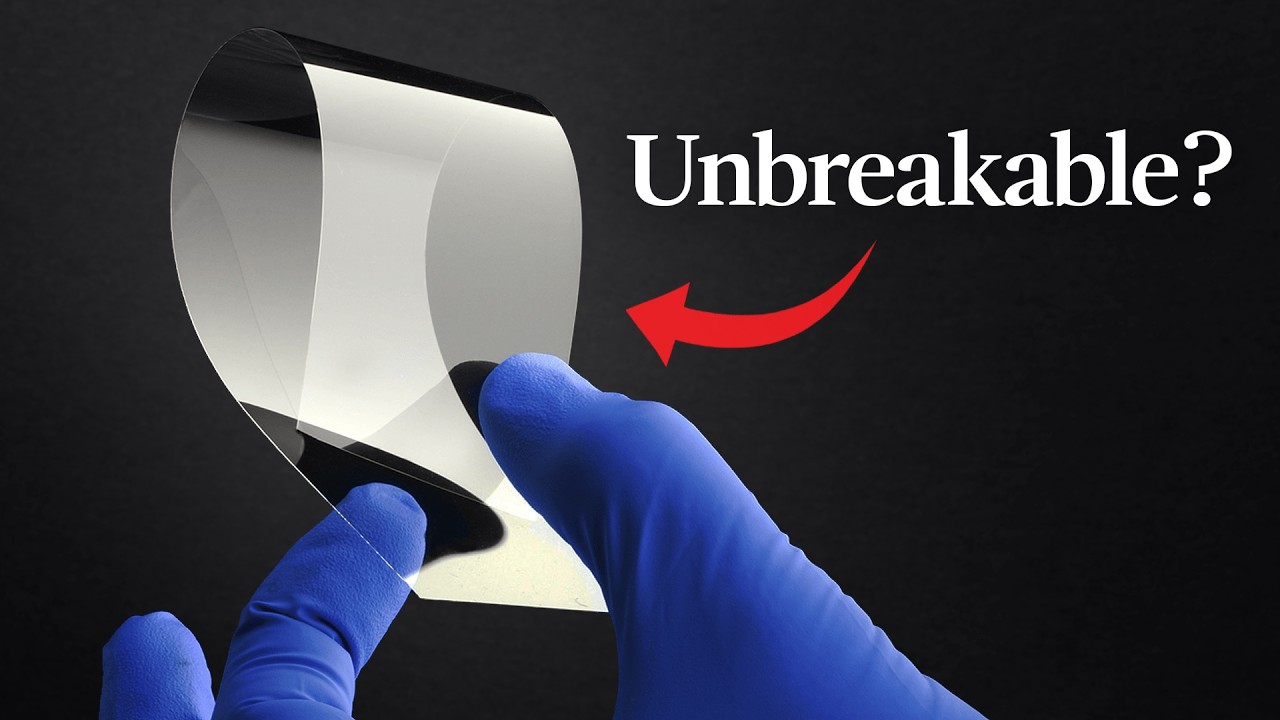
Petr, a producer at Veritasium, stood inside Corning’s research facility, pressing a stylus into a sandblasted circle of Gorilla Glass, fully expecting it to snap. It did not. He pressed harder. The stylus bent before the glass did. What felt like a party trick in a lab coat is actually the visible surface of one of the longest material stories in human history, a story that starts 1.2 million years ago and runs directly through the screen you are reading this on. Glass did not just make life more convenient. It made the microscope, the telescope, the optical fiber, and the lens that corrected the eyesight of the first generation of people who could suddenly afford books.
The story begins with obsidian, volcanic glass formed when lava cools too quickly for its atoms to settle into a crystal structure. Early humans discovered that striking it against another rock produced edges sharp enough to tip a spear. Some surgical scalpels still use obsidian tips today, ground to just three nanometers across, because no manufactured material yet beats it for surgical precision.
Humans began making their own glass only around 5,600 years ago, probably by accident, when sand drifted into a metalworking furnace and melted. The recipe is elegantly simple: silicon dioxide, the main ingredient in sand, heated to around 1,700 degrees Celsius and cooled fast enough that the atoms freeze in place before they can reorganize into a crystal lattice. The result is what scientists call an amorphous solid, disordered but rigid, not a slow-moving liquid as the old myth goes.
The island that changed what glass could do
For thousands of years, glass was useful but not transparent. It came in rich colors, carried impurities, and let in almost no light. The breakthrough arrived in the late fifteenth century on the island of Murano, off Venice, where the city had relocated all its glass makers in 1291 after they kept burning down their wooden neighbors. Working there, a glass maker named Angelo Barovier burned seaweed rich in potassium oxide and manganese into ash and folded that ash into his mixture. When it cooled, the glass was clear. The reason it works comes down to electron physics: visible light photons do not carry enough energy to knock electrons in pure glass up to a higher energy state, so they pass straight through rather than being absorbed.
That transparency set off a cascade. By the early 1300s, ground and polished glass discs, named lenses after their resemblance to lentil beans, were correcting farsightedness among monks. After the printing press drove literacy rates up around 1440, suddenly millions of people discovered they were farsighted, and a technology was already waiting for them. A few generations later, Hans and Zacharias Janssen stacked two lenses in line and built what was likely the first microscope. Antony Van Leeuwenhoek improved the grind until he could magnify 200 times, revealing human cells. In 1608, an eyeglass maker named Hans Lippershey pointed a similar arrangement at a battlefield as a spy tool. The following year, Galileo tilted his version toward Jupiter and saw four moons that were clearly orbiting the planet, not the Earth, dismantling the geocentric model of the universe.
Salt, pressure, and a stylus that bent first
The modern version of the story runs through a potassium salt bath at 420 degrees Celsius. After Gorilla Glass is formed from its base of silicon, aluminum, magnesium, and sodium, it is submerged in that solution for a few hours. Potassium atoms, chemically similar to sodium but physically larger, swap in and squeeze into the same space the smaller atoms occupied. The surface goes into compression. As Petr watched two identical-looking panes get hammered in the lab, one shattered immediately and one rang like metal. ‘You put it in a bunch of salt,’ he said, still processing it. ‘For a few hours, and voila.’
Corning’s team runs continuous drop tests, bending tests, and scratch tests on prototypes, including replica phones dropped from selfie height on sandpaper-rough surfaces designed to mimic an asphalt parking lot. The goal is always the next version, tougher than the one before. Glass optical fibers produced today are so transparent that a column as deep as the Mariana Trench would still let you see all the way to the bottom.
The cracked screen in the room
Back in the demonstration area, after Petr had failed to scratch the Gorilla Glass with a stylus, bent the stylus trying, and watched the mega-slap test land without a crack, the Veritasium host held up his own phone for the camera. Its screen was fractured. ‘It is not perfect yet,’ he said. ‘But it is constantly improving.’
The glass in Petr’s hands that afternoon, the same material in the phone that cracked in a parking lot last Tuesday, carries 1.2 million years of human problem-solving inside its compressed surface. That is not a metaphor. It is the supply chain.