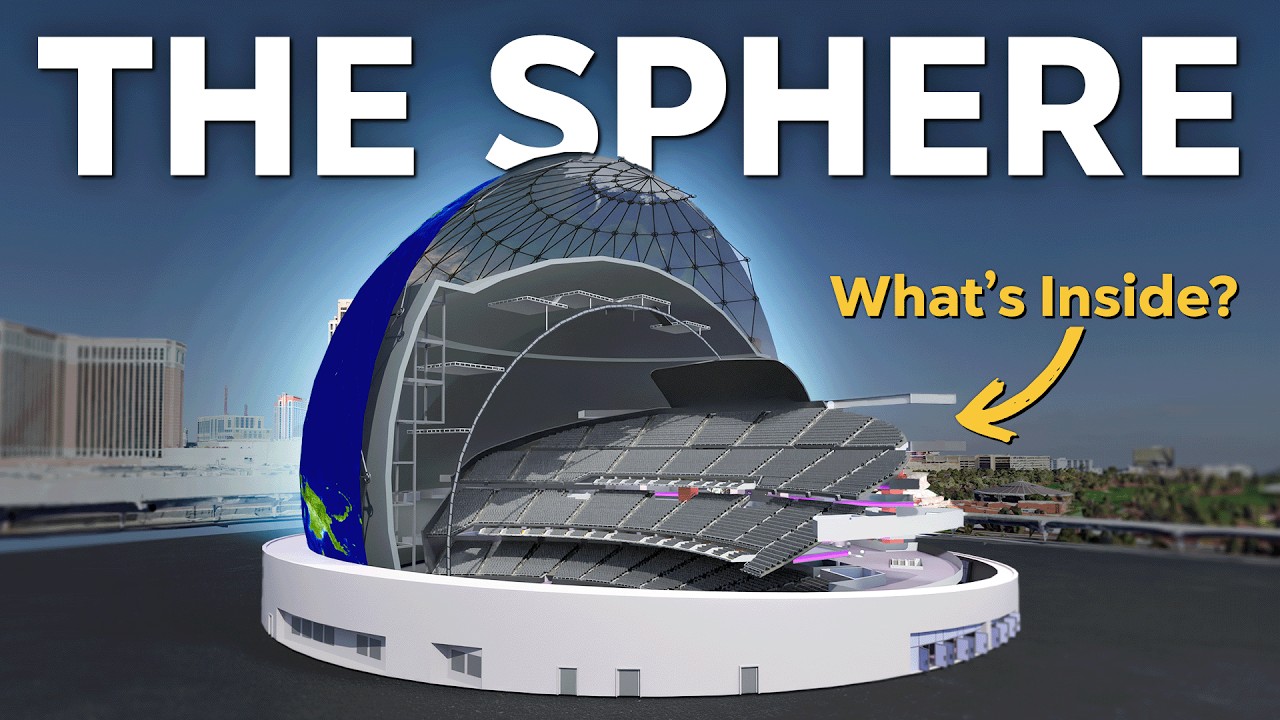
The Las Vegas Sphere opened in September 2023 and immediately made one thing clear: the $2.3 billion price tag was not an exaggeration. Every seat inside sits beneath a wrap-around screen twenty times larger than the biggest IMAX cinemas, while 167,000 speakers hidden behind its LED tiles calculate, in real time, exactly which sound waves reach which chair. The Sphere was designed to make an audience member feel like part of the film, and the technology required to pull that off rewrote several engineering records in the process. Here is how it actually works.
The outside screen is bigger than what is inside
Before anyone walks through the doors, the Exosphere stops them on the street. Designed and installed by SACO, the company that had just completed the media facade on the Burj Khalifa, the exterior screen is three and a half times larger than the interior one. It is covered in 1.2 million individual lights, each roughly the size of a hockey puck, and each puck contains a cluster of 48 separate LEDs. Up close the clusters look widely spaced and the image breaks apart, which is exactly how a television pixel grid behaves at too-close a range. Step back to the intended viewing distance and the lights blend into a single sharp image. The principle is identical to a home screen; the scale is simply incomprehensible.
Inside the Atrium, visitors encounter the Hypervsn Wall, a surface covered in hundreds of small rotors, each fitted with four LED-studded blades spinning at 670 rpm. The speed puts them beyond what the human eye can resolve, which turns the spinning blades into what appears to be a floating, three-dimensional display. Nearby stand five humanoid robots called Aura, built over fifteen years by a British company called Engineered Arts. The engineers describe Aura as ‘artificially intelligent’ rather than ‘an artificial intelligence,’ a distinction that matters to them because the robots run a combination of software including large-language models, voice recognition, and facial-recognition technology rather than a single unified system. They answer questions, give presentations on Sphere technology, and, according to the engineering team, already make jokes.
The camera that took 12 people and 10 patents to build
The interior screen measures 160,000 square feet and holds 256 million pixels, making it the highest-resolution screen in the world. At 3.33 pixels per inch it sounds underwhelming until you account for viewing distance: from the seats it reads as crystal clear, because optimum viewing distance is what determines perceived sharpness, not raw pixel density for its own sake.
Filming for a surface that shape and size had no existing solution. Sphere Studios, a new company created specifically for the project, first welded 11 cameras together and tried stitching the footage in post-production. That approach collapsed under its own complexity. So the team partnered with STMicroelectronics and built the Big Sky Camera System from scratch: a 316-megapixel camera that shoots 18K film at 120 frames per second, through a single lens one foot across that bulges outward like a fish-eye to achieve a 165-degree field of view. One second of Big Sky footage occupies 60 gigabytes of storage. The sensor is nearly square rather than rectangular, matched to the Sphere’s proportions rather than a conventional television format. The system generated 10 separate patents. Because checking the footage on a standard monitor is useless at that resolution, the crew monitors shots through a VR headset on location.
The first film shot on Big Sky is ‘Postcard from Earth,’ directed by Darren Aronofsky, which forms the centerpiece of the Sphere Immersive Experience. Tickets range from $79 to over $300.
Sound delivered like a laser, not a lightbulb
The audio system, designed by German engineers Holoplot, operates on a principle MegaBuilds described as ‘headset sound, without the headset.’ Behind the wrap-around screen sit 167,000 speakers, working out to 8.4 speakers per seat. The LED tiles had to be made thin enough for sound to pass through them without disruption, a property called Audio Transparency that required close coordination between Holoplot and SACO during construction.
Holoplot’s system uses constructive and destructive interference, the same physics behind noise-canceling headphones, but at a scale that lets the Sphere beam targeted audio to individual sections of the audience. The analogy the team uses is the difference between a lightbulb and a laser: a traditional speaker floods a room the way a bulb floods a space with light, while Holoplot’s calculations focus sound into a directed beam. The practical result is that different sections of the theater can receive different language tracks, different soundtracks, or entirely different audio experiences simultaneously.
Rounding out the sensory environment, 10,000 of the 18,600 seats carry haptic technology that vibrates at frequencies tied to the on-screen action, while wind machines produce anything from a gentle breeze to a strong gust, and the system can release scents and fog. The team says they are careful not to overload the senses.
The camera operator who cannot check a monitor
Operating Big Sky requires 12 people on set at any one time. Because the footage cannot be properly evaluated on a flat screen, the camera operator monitors the shot through a VR headset, standing next to a camera the size of a small vehicle, judging a 165-degree frame through a headset.
The Las Vegas Sphere’s engineering story is still unfinished. MSG has held talks with interested parties in Abu Dhabi, South Korea, and Saudi Arabia, though no confirmed projects have been announced. Sphere Studios has also stated plans to take Big Sky to the International Space Station to film a spacewalk in real dimensions for a future immersive experience.