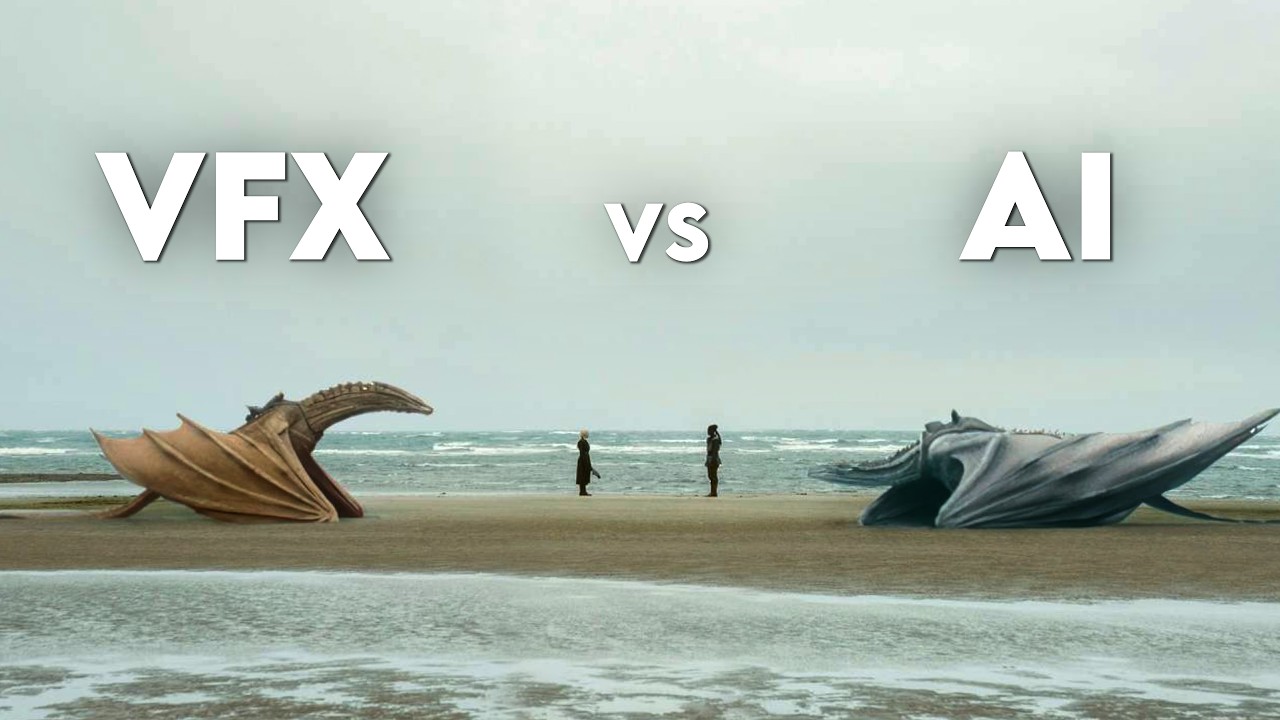
Erik arrived in Iceland with a plan ambitious enough to make most filmmakers nervous: jump off a cliff ledge above a waterfall, land on a computer-generated dragon, and ride it through the canyon below. Norway had been considered and dismissed. Iceland, where every ridge and lava field looks like something once ruled by fire-breathing creatures, was the only honest choice. What started as a personal VFX project turned into something much larger when an AI company called Haiksfield showed up, offered sponsorship with zero script control, and agreed in writing to let Erik run a fully open competition against his own work.
Why rendering a single frame still takes hours in 2025
Before any dragon could fly, Erik paused to answer a question that had been sitting in the back of every film fan’s mind. Toy Story, released 30 years ago, took an average of 7 hours to render a single frame. House of the Dragon, produced on hardware roughly a thousand times faster, still required 7 hours per frame. The reason comes down to a fundamental shift in technique. Toy Story’s renderer broke geometry into tiny pieces, read each one for color and shininess, and layered on a pre-computed shadow map, a method that faked light convincingly enough to fool audiences. Modern productions run full light simulations that bounce millions of rays around a scene to calculate how light actually behaves, exactly as it does in the physical world. That accuracy is computationally brutal. Monsters University took 29 hours per frame using this approach. Erik’s own render, completed at lower-than-theatrical quality, still ran for 12 hours.
The waterfall shot illustrated why. A real Icelandic waterfall sat in the frame, but Erik needed a second, entirely digital one so the dragon could interact with it. He built it from scratch: a sphere emitting particles outward, gravity applied, wind turbulence added, and then a density calculation that made dense particle clusters fall faster than lone floating ones. When the dragon passed through, he ran a smoke simulation using the dragon as a source, generating a flowing wind field that was then fed back into the particle system. The result was water that bent around the dragon’s body as though displaced by the air its wings pushed aside. His collaborator Rowan, the animator on the project, handled the dragon’s movement, and Erik put it plainly when the two watched the finished VFX cut together: ‘I put it all together and did the lighting and all that, but the animation and the model and all the help I had from really really good artists, yeah, it made this come to life.’
Where AI pulled ahead and where it came apart
Haiksfield received all of Erik’s Iceland footage, including a deliberate trap: a drone shot where the camera moved backward, making the waterfall appear to run in reverse. Erik’s fix required tracking the shot, stabilizing it, rotoscoping the waterfall out, reversing it, and then inverting the stabilization to restore the original camera motion. Haiksfield bypassed the entire process by extracting the first frame and prompting an image-to-video model to generate the motion from scratch, solving it almost instantly.
For the main dragon emergence, the AI team’s first attempt using a video-to-video model with a prompt written by Claude failed outright. They switched to image-to-video generation and ran repeated prompt iterations until the dragon’s look satisfied them, then stitched shots together in post. The resulting sequence had inconsistencies between cuts: the dragon shifted in apparent size, and the figure riding it looked oversized in one moment and shrunken in the next.
Haiksfield then introduced a second version that surprised both Erik and his friend Luke, who watched the comparison together. This one was generated entirely from prompts using Kami 2.5, with no Iceland footage involved at all. The sound design was strong, the acting from the AI-generated character was sharper than Erik’s own performance, and the overall production had a coherence the footage-matched version lacked. Luke, watching it, was reluctant but honest: ‘It’s pretty good.’ Erik agreed the fully generated version was stronger, then added the observation that mattered most to him: when Haiksfield was forced to match his specific vision, his specific location, and his specific shot list, they could not do it. When they were free to invent their own version, they produced something genuinely impressive but something that was, as he noted, still recognizably not human-made.
The cave shot that sent him outside
One shot required Erik to appear inside a cave with a dragon overhead. He set up a green screen, keyed himself out, and tried to composite a digital cave background behind him. The result was unconvincing, partly from uneven lighting during the original shoot and partly from the limits of his own compositing. He scrapped it and drove to a real cave to film the shot on location instead. The AI team, given the same real-cave footage, used a video-to-video model to replace Erik’s face with a different person entirely.
The ledge above the waterfall
The cliff edge in Iceland, where the whole sequence was designed to begin, still sits above that waterfall. The drone footage Luke captured in the valley below, using equipment that made Erik’s own drone look like a toy in his words, caught the canyon from an angle that neither a prompt nor a particle simulation fully replicated.
When both versions finished playing and the question of who won came up, Luke answered without hesitation. Erik’s VFX version held together because it held to a single consistent vision, carried through from a specific waterfall in a specific country to a 12-hour overnight render to a final color match. The AI version that matched his footage could not keep pace. The one that ignored his footage entirely came closer than either of them expected.