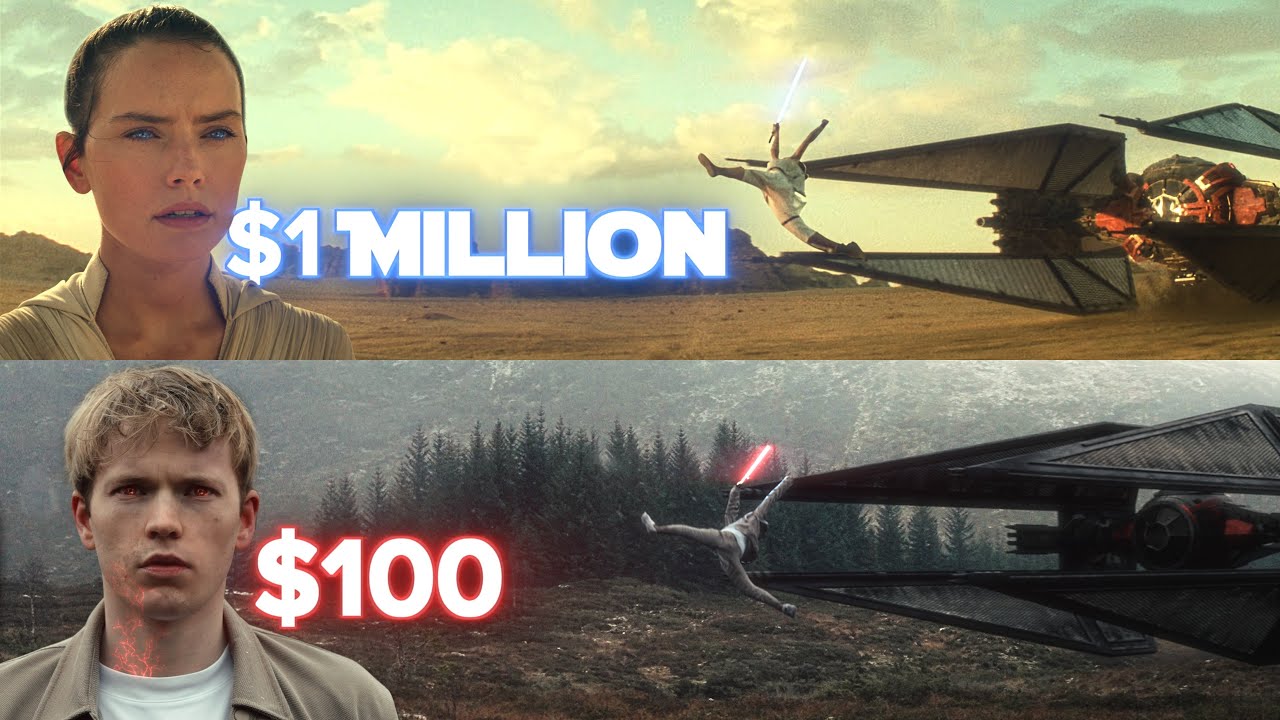
Erik stood in the middle of a Norwegian mountain range, lightsaber hilt in hand, snow beginning to fall, and decided the problem was actually a solution. He had set out to recreate one of the most technically demanding shots from the newer Star Wars films, a sequence involving a diving spacecraft, a mid-air backflip, and a lightsaber-assisted crash landing, and he had exactly one week to pull it off. The appeal is obvious: the VFX pipeline behind a scene like this normally involves entire studio departments, motion-capture rigs, and six-figure budgets. What happens when a solo creator in Norway strips it down to a drone, a lightsaber prop, and ingenuity?
When the snow started falling mid-shoot
The original plan called for a flat, desert-like location to match the film’s aesthetic. Norway offered neither. After genuinely attempting to find flat ground and coming up empty, Erik pivoted: the mountains stayed in. The shoot itself was physically brutal. Filming happened in freezing conditions, and the cold caused a small but meaningful on-set mistake: he forgot to bring the beam extension for the lightsaber prop, which forced him to track several shots manually in post rather than using the physical reference he had planned for.
The backflip presented its own category of problem. The film’s version involves a jump of roughly 20 feet, which no trampoline-free Norwegian hillside can replicate. Erik’s fix was a technique called a digital double, a 3D character built from a still image using a tool called PIFuHD. The tool refused to run during production, so he pulled a model he had built with it months earlier, warped a current reference image to match, projected his own texture onto the mesh, and layered a colored jacket model on top. The result was a ‘super cheap’ digital double, in his words, that he then animated by matching the key poses from the film’s original sequence frame by frame.
The crash landing that required 50 simulations
The hardest single shot was the spacecraft tearing apart and smashing into the ground. Tracking a fast-moving camera with heavy motion blur is notoriously unreliable, so Erik filmed the entire sequence in slow motion and planned to speed it up in post to reach real-time pace. He ran the ship destruction simulation roughly 50 separate times before arriving at one he considered usable. Smoke for the broken engine, explosion elements on impact, and a final speed ramp brought it together.
The lightsaber effect, by contrast, was among the simpler tasks, precisely because he had invested in a physical hilt prop. In previous builds he had tracked a 3D lightsaber model into his hand manually and matched lighting to the environment. With the physical prop already in frame, he could handle everything as a 2D effect: draw the blade shape, apply blue color, add glow and flicker, and track the existing object. He also walked through the actual history of the effect while working, noting that the original Star Wars production used a rotating rod coated in reflective tape before transitioning to frame-by-frame optical printing and eventually full digital compositing.
The lightsaber hilt Erik nearly left behind
Sitting in the snow somewhere on that Norwegian hillside is the physical lightsaber hilt, the one detail that separated this build from every recreation Erik had attempted before. He called it ‘full nerd’ to have acquired it. It almost did not matter given the conditions, but it ended up being the element that compressed the most labor out of the entire 15-shot sequence.
The final cut landed with all 15 shots composited, sound design sourced from film audio and a stock library, and a color grade applied using a set of professionally made LUTs. Fifteen shots, one week, one pair of very cold hands, and a mountain range that was never supposed to be there.