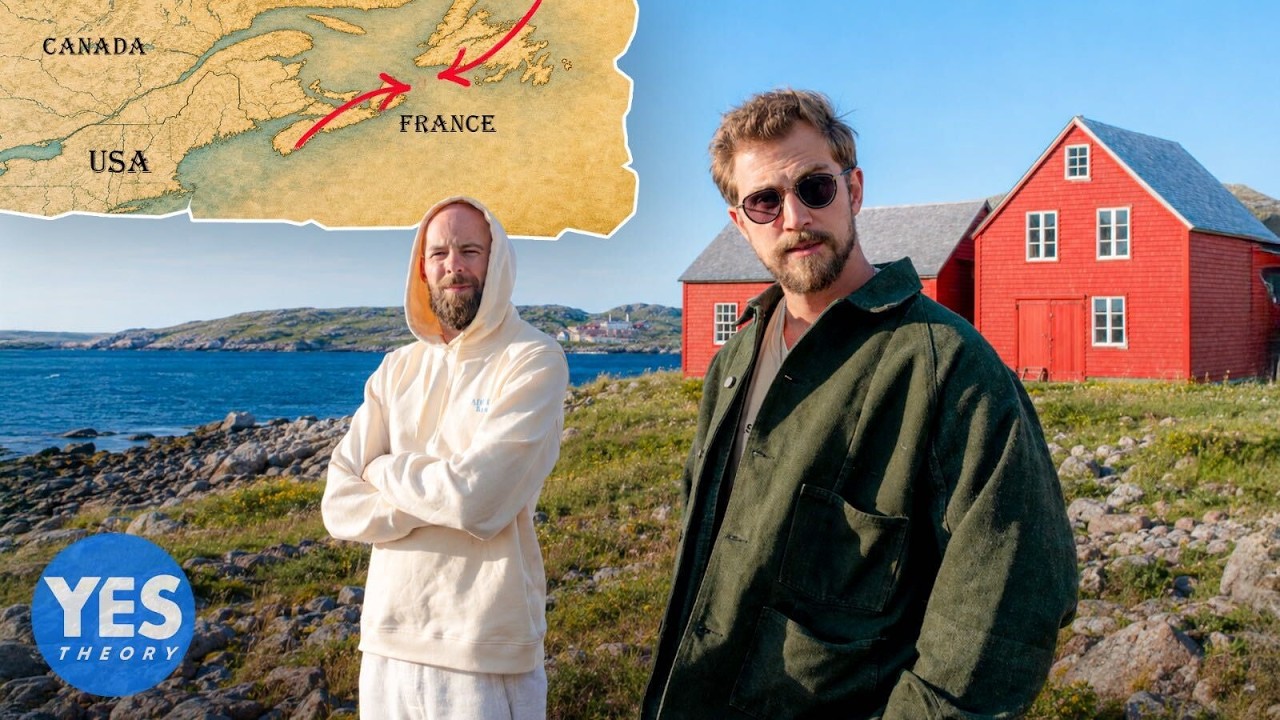
The customs officer at the Saint Pierre and Miquelon border already knew the Airbnb address. When the Yes Theory crew showed him where they were staying, he told them the door was unlocked and the key was inside. That is the kind of place this is: a few small, colorful islands perched just off the coast of Newfoundland, technically French territory, where everybody knows everybody and nobody seems to be in a hurry about anything. Most people have never heard of Saint Pierre and Miquelon. That is precisely what makes them worth understanding. Because beneath the serenity of this quiet fishing community is a chapter of history that helped supply alcohol to an entire criminal empire during the American Prohibition era, and there are unopened whiskey cases in people’s homes to prove it.
How a French fishing outpost survived two centuries of empire collapse
The story of how a cluster of North Atlantic islands ended up flying the French flag while surrounded entirely by Canadian and American geography goes back to 1763. At the end of the Seven Years’ War, France faced a hard choice during the treaty negotiations: keep its small Caribbean island territories or hold onto its vast North American landmass. The sugar trade made the Caribbean far more profitable at the time, so France surrendered its continental ambitions with a single exception. Britain allowed France to retain Saint Pierre and Miquelon as a fishing station, on the condition that no military fortifications would be built there. The arrangement held. Centuries later, the islands remain a French collectivity, with French license plates on the cars, French flags on the buildings, and French citizens who have sometimes never set foot on the European mainland.
The buildings are bright and compact, more reminiscent of a Greenlandic village than a Parisian arrondissement. A grocery store on the main island has been run by the same family since 1912. When a flight arrived directly from France during the crew’s visit, locals poured into the street to greet relatives they had not seen in years, turning an ordinary afternoon into an impromptu family reunion outside the oldest shop in town.
The quiet winter the mafia came to call
In 1920, Prohibition transformed the islands overnight. Because Saint Pierre and Miquelon were French territory, alcohol could be legally imported from Europe by the shipload. Warehouses filled quickly with whiskey, rum, and champagne, then smaller boats ran the goods quietly toward the American mainland. The money that flowed in dwarfed anything the fishing industry had ever produced. Businesses appeared, jobs multiplied, and the islands briefly became one of the Atlantic’s busiest alcohol transshipment hubs.
Whether Al Capone personally visited is still debated locally. ‘It’s a legend, I think,’ one resident said. But the mafia’s money passing through is not disputed. Inside the island’s small museum, real prohibition-era alcohol cases recovered from local homes sat on display, sealed and unopened. The man stationed at the museum entrance, it turned out, was a direct descendant of the island’s main smuggling operator, the man who ran coordination with the criminal syndicates. He had been describing his own ancestor as a historical figure before letting that connection slip.
A Yes Theory subscriber the crew encountered by chance at the ferry terminal put it more bluntly: ‘It’s 100% true Al Capone did come here.’
The bench that might be the world’s best
A short ferry ride from the main island sits Ile aux Marins, a smaller neighboring island where a retired couple has converted an old house into a self-sufficient summer home, running on solar panels, with a vegetable garden they built themselves. They invited the crew inside within minutes of meeting them. Across the island, locals parked their wheelbarrows in a designated communal spot with a sign inviting anyone who needed one to borrow it and bring it back. An older woman who had grown up there remembered six or seven nightclubs from her younger years, back when the prohibition money was still shaping the culture. She identified, without hesitation, as French.
The crew’s bag, left unattended on a path while they stopped to talk, was exactly where they had left it when they returned.
The wheelbarrow parking sign on Ile aux Marins
A small wooden sign beside a row of communal wheelbarrows, the kind of community infrastructure that requires no explanation to the people who live here, sitting in the open on a path where nobody locks anything.
Saint Pierre and Miquelon is not a dramatic discovery. It is a quiet, specific place that somehow never made it onto most people’s maps, even though it has been there, French and uninterrupted, since before Canada or the United States existed. The customs officer who already knew the Airbnb address would probably tell you that is just how things work here.