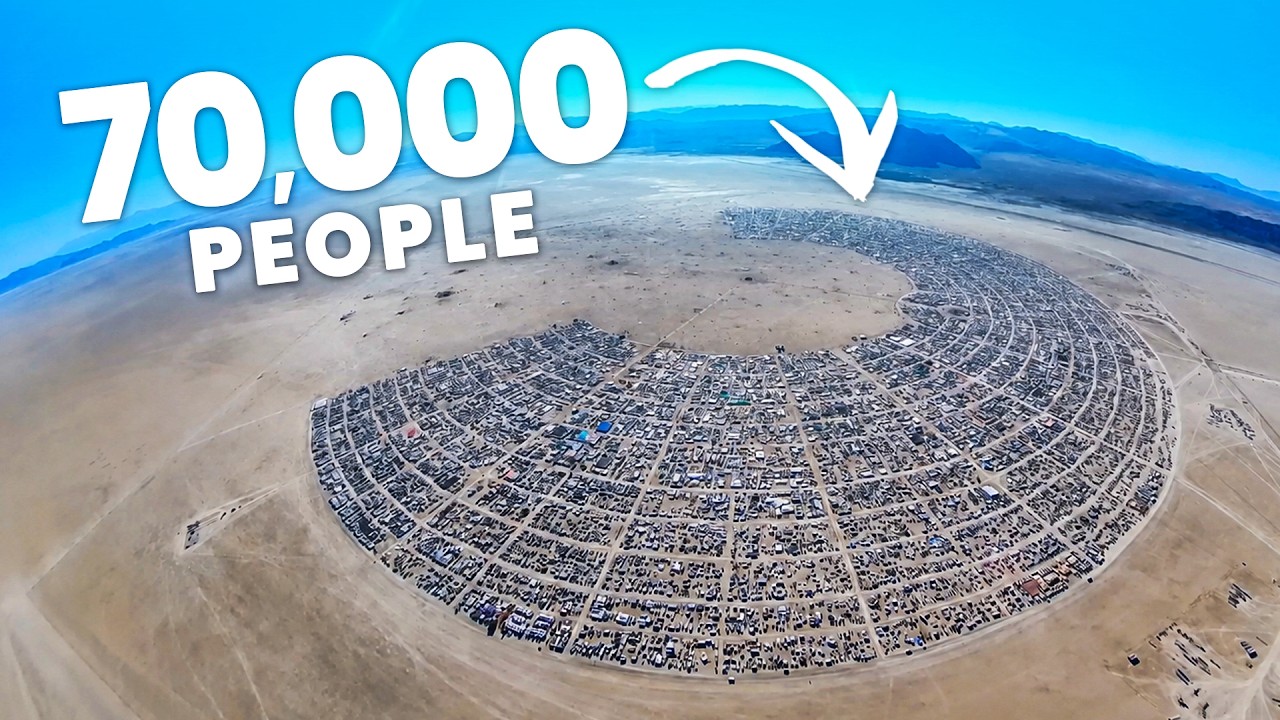
Burning Man 2026 – On August 1st, a group of people gathered at a GPS coordinate in the middle of an empty Nevada desert, passed a 12-pound sledgehammer between them one by one, and drove a 3-foot steel stake painted gold into the cracked earth. That stake, called the golden spike, is the only fixed point in what will become a functioning city for 70,000 people in less than a month. How a temporary metropolis rises from dust, runs for eight days, and then disappears without a trace is one of the more quietly extraordinary feats of modern civic engineering.
Twenty-nine days to lay nine and a half miles of city limits
Before a single camp goes up, a survey crew of 21 people takes on the entire 5.62-mile city plan. They start before sunrise, because once the playa heats up, the shimmer off the ground makes precise measurements unreliable. Using GPS equipment, lasers, measuring lines, and thousands of colored flags, they transfer a digital blueprint onto miles of prehistoric dried lake bed. In 2018, that crew finished the layout in seven days.
Then comes fence day. Before sunrise, teams spread across the planned perimeter dropping steel posts beside survey flags, hammering them in by hand with heavy post pounders, and running orange plastic mesh between them. In 2023, crews installed approximately 2,175 stakes and finished nine and a half miles of fence in nine hours. The mesh is not just a boundary marker. Once the wind arrives and a paper cup becomes a projectile crossing miles of open desert, that fence is the first line of defense against the spread of what Burning Man calls MOOP: matter out of place.
More than 750 people join the Department of Public Works each year, some living in the desert for weeks before the event and staying weeks after. They install the medical site, fuel depot, communications network, power grids, and a shade canopy covering roughly an acre over the central meeting space, built with shade cloth and tension cables so wind passes through rather than lifting it airborne. They also prepare the Black Rock City Municipal Airport, a temporary runway on the lake bed that handled 2,953 takeoffs and landings in 2024 alone.
Where 1,188 theme camps and 75 funded art installations find their place
Placement is decided before anyone arrives. Each of the 1,188 theme camps that attended in 2024 submitted dimensions and plans in advance, and a team fit them into the curved grid without blocking roads or placing enormous sound systems beside quieter camps. The city’s layout, unchanged since 1999, reads like a clock face wrapped around the man at the center: streets radiate outward by clock position, curved cross-streets run alphabetically, so a location like ‘6:30 and C’ is enough to find someone in a city that did not exist thirty days earlier.
For 2026, Burning Man awarded $1.3 million across 75 funded art installations. The man pavilion features a staircase climbing nearly 60 feet through a structure shaped like the roots of a giant tree. The temple of moon is organized around the lunar cycle. Every funded artist first reports to the Art Army headquarters, where plans and paperwork are verified, and is then escorted to an exact desert coordinate. Heavy equipment can assist, but the artists are responsible for construction, safety, and full removal. The survival guide is specific about what cannot come at all: loose feathers, glitter, and sequins, because thousands of tiny pieces would be almost impossible to retrieve.
Hurricane Hillary tested that timeline in August 2023, shutting the entrance for nearly two days during the busiest part of build week. Eight of the largest artworks paused mid-construction. More than 350 artists waited outside watching their remaining build time disappear. When the gate reopened at 1:00 p.m. on Wednesday, crews had only days left. They installed nearly 400 artworks before opening.
Everything the creator’s team confirmed lands in the post-event numbers. In 2024, restoration crews recorded 1,508 lag bolts and pieces of rebar still buried across the site after everyone had gone. Each one is a small failure against Burning Man‘s agreement with federal land managers: government inspectors return to the desert weeks after the event, and if too much remains, the permit to return is at risk. So around 150 people walk in slow lines across the empty playa, heads down, searching.
As Everything Explained put it: ‘Four weeks before the gates opened, one gold-painted stake marked the center of a city that did not exist.’
The last team to leave
After the residents have cleared their camps and the infrastructure crews have pulled out the signs, generators, and fencing, the playa restoration team turns to the ruts. Tires cut into the surface after rain, and those ruts harden like concrete when the sun returns. Other crews break down dunes built up by weeks of vehicle and foot traffic, working to return the surface to the same flat condition it held before the golden spike went in.
Burning Man has passed every single post-event inspection. The desert gives no credit for it. Once the last crew drives out, the lake bed looks the way it always has: hard, flat, and stretching in every direction without a seam.
On August 1st, a gold-painted stake went into the ground at a GPS coordinate in the Black Rock Desert. Everything that followed, the fence, the airport, the arc of 1,188 camps, the 60-foot tree-root staircase, and 70,000 people for eight days, had to be traceable back to that single point. The harder task was making sure none of it stayed.