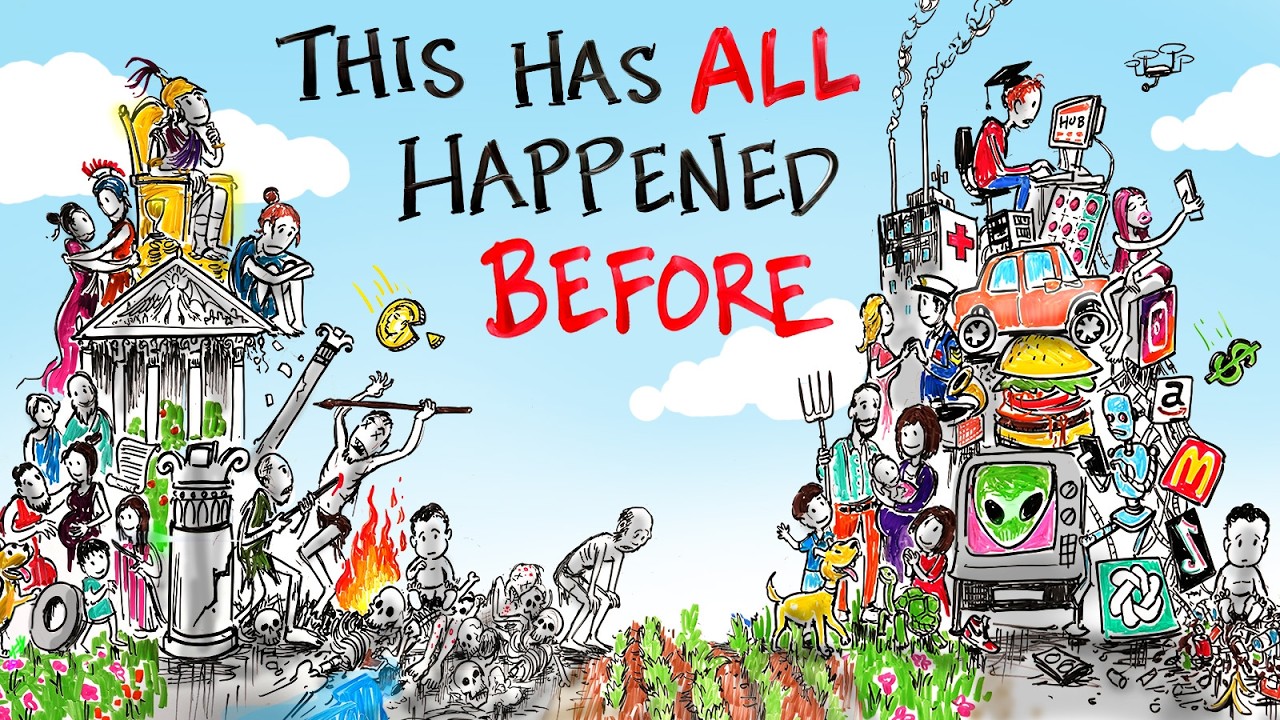
John from Medieval Mindset opens with a pointed observation: the phrase ‘unprecedented times,’ which echoed through every corporate commercial during 2020, turns out to be historically illiterate. Once you start studying what actually happened to civilizations across the last several thousand years, these times look considerably less unprecedented and considerably more like a rerun. That realization, he argues, is genuinely therapeutic, and the evidence for it stretches back to before Sparta existed.
When entire empires disappeared overnight and nobody called it the end
To frame the argument, John offers a governing metaphor: history is not a straight line heading toward a cliff but a massive, ever-turning wheel. When a spoke hurtles downward, the people riding it feel with absolute certainty that the apocalypse has arrived. The late Bronze Age collapse, roughly 3,200 years ago, is his first exhibit. Think earlier than ancient Rome, earlier than classical Greece, closer to the world of VeggieTales or The Prince of Egypt. A perfect storm of drought, famine, economic failure, and violent raids by a mysterious group known only as the Sea Peoples wiped out wealthy, deeply established civilizations that their inhabitants believed would last forever. And yet the wheel kept turning. Out of that apparent total darkness came the Iron Age, classical Greece, and the structural foundations of the modern world.
The fall of Rome gets a similar treatment. Pop culture imagines it as a light switch: glorious on Monday, barbarians at the gate on Tuesday, centuries of pitch-black misery by Wednesday. The reality was a slow, centuries-long dissolution of an over-centralized empire into localized, self-sustaining communities that quietly mixed Roman civic ideals with Christian humanism and eventually produced the European nations that exist today. The label ‘Dark Ages,’ John points out, comes from a shortage of surviving paperwork, not from any shortage of human ingenuity, love, or life.
While Western Europe was reorganizing itself, Baghdad was operating as the intellectual powerhouse of the planet. Scholars at the House of Wisdom were compiling the world’s collective knowledge, pioneering algebra, revolutionizing medicine, and preserving the classical Greek philosophy that would later travel back west and ignite the Italian Renaissance. And in the middle of the supposedly bleakest stretch of the Dark Ages, the Carolingian Renaissance under Charlemagne produced a sweeping revival of literature, art, and architecture roughly 600 years before Leonardo or Michelangelo picked up a brush. The monks widely dismissed as backwards figures also invented lowercase letters, spaces between words, and a legible writing style that anyone typing an email today is still using.
The birth rate panic that Polybius already wrote in the 2nd century BC
The most striking historical parallel John surfaces involves the current global anxiety about declining birth rates. The Greek historian Polybius described the identical phenomenon in the 2nd century BC, in language that reads almost indistinguishably from a modern demographic crisis op-ed. His diagnosis was that ‘men have fallen into such a state of pretentiousness, avarice, and indolence that they did not wish to marry.’ The underlying mechanism then was the same as now: in highly developed, expensive urban environments, people calculate that children cost a fortune and that fewer of them preserves a higher standard of living.
History also offers a counterintuitive footnote. After the Black Death thinned Europe‘s population dramatically, the surviving peasants suddenly held enormous leverage. The nobility desperately needed workers, which forced a renegotiation of rights and broke the structural back of feudalism. John puts it plainly: ‘labor getting expensive and scarce forces society to innovate,’ and what that innovation looks like depends on the value placed on human dignity.
The apocalyptic instinct itself gets its own explanation. Every 52 years, the Aztec calendar completed a full cycle, and the entire empire would extinguish every fire, smash all household pottery, destroy personal belongings, and wait in silence for the dawn. Then the sun rose, and everyone had to clean up their smashed kitchens and go back to work. In the year 1000 AD, a loud minority in Western Europe abandoned farms, gave away savings, and fled to the mountains convinced Jesus was returning on January 1st. On January 1st, 1001, the sun rose, and everyone awkwardly hiked back down and returned to their jobs. ‘The world has survived 100 percent of its predicted apocalypses so far,’ John notes, ‘and chances are catastrophically high that you are still going to have to awkwardly go to work tomorrow.’
The Polybius quote sitting in a 2nd-century scroll
Somewhere in the surviving record, a Greek historian looked at his own civilization’s declining birth rates and reached for a moral explanation, writing words that now land on modern readers as eerily familiar. The scroll did not resolve the problem. Neither did the problem end the civilization.
The wheel, John from Medieval Mindset argues, never stopped. It absorbed every crash people were certain was the final one, and on the other side of each crash came something new: a different kind of order, a burst of creativity, an era that future generations would label a golden age. The world is not heading toward a cliff. It is following a curve that has bent this way before, and the people riding it, every single time, were completely convinced theirs was the spoke that would not come back up.