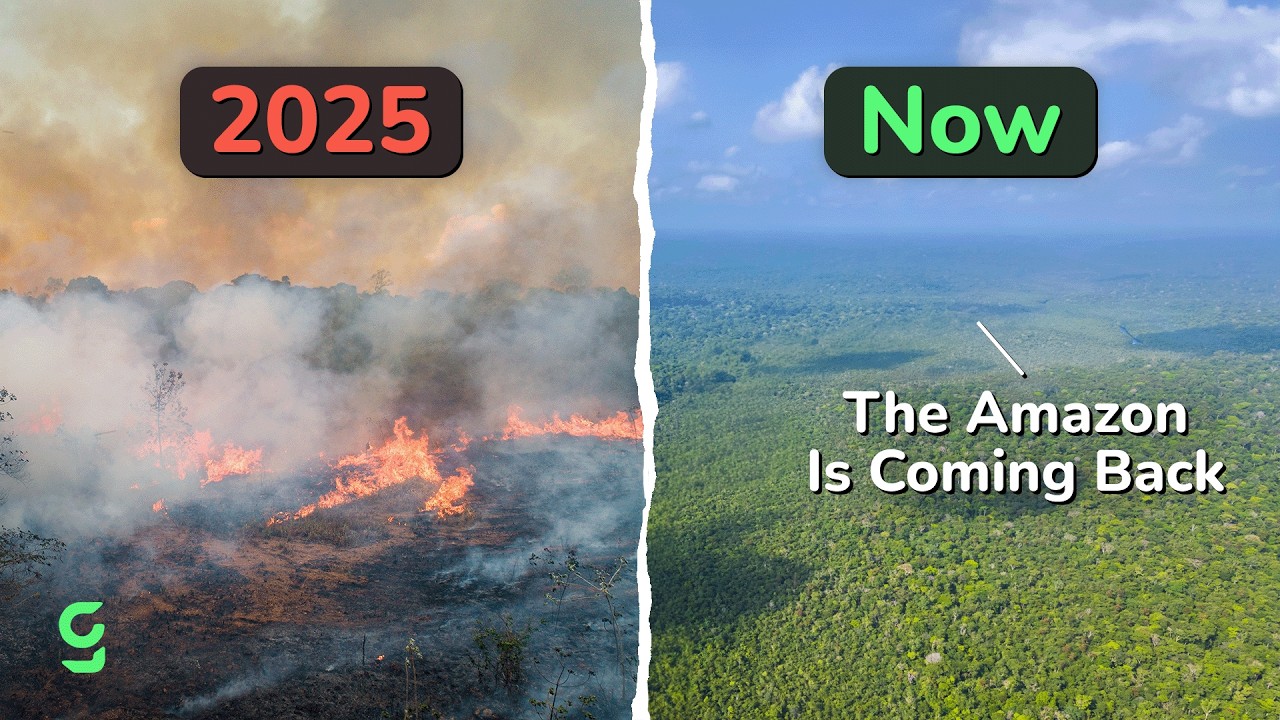
In the Brazilian Amazon, the land that holds roughly one in ten of all known species on Earth, something went quietly right. In the first half of this year, deforestation dropped by nearly 40% compared to the same period in 2025, and forest fires burned the smallest area recorded since measurements began in 1985. These are not small numbers in a familiar story of loss. They are a reversal, arriving at a moment when the world badly needed one, and they are only the start of what October brought.
Why the Amazon stopped burning
The connection between clearing and fire is more direct than it looks. Amazon trees hold enormous moisture, and their shade keeps the ground underneath wet. A healthy, intact forest barely burns. But when land is stripped for agriculture, the ground dries out and open earth catches fire easily. Fewer chainsaws meant fewer flames. A late rainy season this year also pushed back the window when farmers typically burn cleared land, and tighter enforcement cut illegal clearing before it could start. El Nino could bring hot, dry conditions back in the coming months, but for now the forest is wetter, greener, and more intact than it has been in four decades.
In Kazakhstan, a different kind of restoration was underway. The Caspian tiger, hunted to extinction by 1948, left behind one scientific surprise: its DNA was nearly identical to the Amur tiger of Siberia, differing by just a single letter in the genetic code. That near-match opened a door. At the end of July, a wild female Amur tiger was flown in from Russia and released into a reserve in southern Kazakhstan, joining a male and two cubs that had arrived weeks earlier. The goal is a self-sustaining wild population of around 50 animals within ten years.
Vision, vaccines, and the ocean
For the roughly 8 million people worldwide living with advanced age-related macular degeneration, a condition that destroys central vision needed for reading faces and driving, doctors could until now only slow the damage. A new retinal implant, about the size of a pinhead, placed just beneath the retina and paired with camera-fitted glasses, has now been approved for real-world use in Europe. In a small trial, over 80% of patients saw their vision improve. Some who had been considered blind could read letters and words again. Vision is currently restored in black and white, but the team is already developing software that could eventually allow patients to recognise faces. The first surgeries are expected in Germany and the UK this year.
On the Pacific coast of British Columbia, six Indigenous nations spent two decades pushing for a say in managing the waters their communities depend on. That push produced a protected ocean reserve covering around 6,700 square kilometres, one of the richest marine ecosystems on the planet, co-managed by the nations and the Canadian government. The salmon and crab fisheries that had grown harder to find now have a formal shield.
For children too young and too frightened for a dental drill, a liquid called SDF offers a different path. Painted directly onto a cavity in around ten seconds, it kills the decay-causing bacteria and stops the damage from spreading. A large trial treating more than 800 children under six found decay had stopped in over half of treated teeth after six months. It does leave a dark stain, but it holds the damage until a child is old enough for conventional treatment, or until the tooth falls out on its own. A regular doctor can apply it during a standard visit, no dental clinic required.
New HIV infections and AIDS-related deaths have fallen to their lowest levels in more than 30 years, with a recent UN report showing that deaths have been cut by nearly 60% in the last 15 years. An mRNA flu vaccine, using the same platform as COVID shots, cleared trials showing it cut cases by more than a quarter compared to the standard egg-grown vaccine, and can be produced in one to two months rather than six to eight. In Nigeria, GPS tracking of vaccination teams helped identify more than 200,000 children who had never received a single vaccine in just a year and a half. And globally, almost 30% of new cars sold this year are forecast to be electric, a record that arrived while the overall car market shrank by around 5%.
As the channel’s presenter put it when describing the electric vehicle surge: ‘It happened while the car market as a whole was shrinking.’ Fifty countries hit electric vehicle sales records in the same quarter, with the fastest growth coming not from China or the United States but from Brazil, India, and Vietnam, where sales roughly doubled.
A pinhead-sized implant and what it restored
The retinal implant approved in Europe this month is the detail worth sitting with. Smaller than a pinhead. Placed under the retina. Paired with a pair of glasses. And for someone who had been classified as blind, enough to read a word again.
The Amazon’s 40-year low in fire damage did not arrive as a single dramatic intervention. It came from a wetter season, stronger enforcement, and communities working harder after the record-breaking fires of 2024, each factor quietly stacking on the others until the numbers told a story nobody had expected to read.