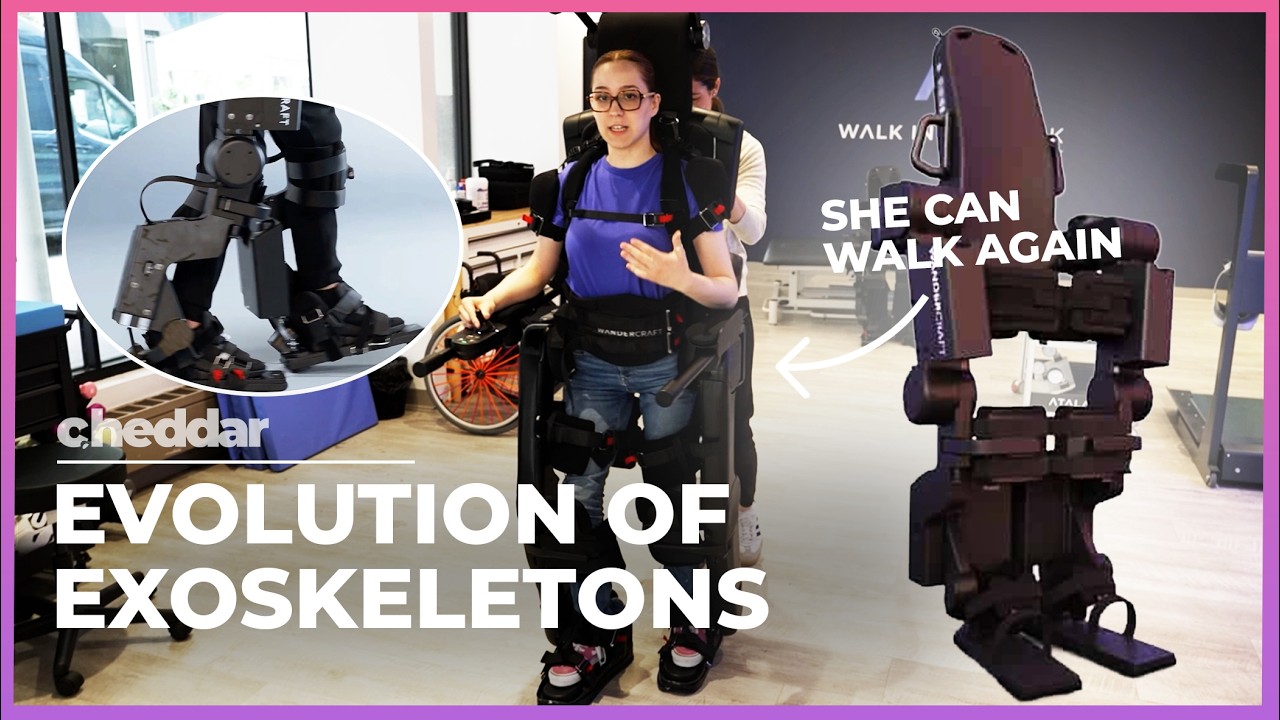
The first time Caroline stood up inside the exoskeleton, she said she immediately felt something she hadn’t expected: a reconnection with her surroundings and her environment. For millions of people living with spinal cord injuries, stroke, or multiple sclerosis, that kind of moment has long been considered out of reach. But inside a Manhattan clinic run by French robotics company Wandercraft, engineers and clinicians are systematically dismantling that assumption, one step at a time.
The ten seconds that changed everything
Wandercraft’s origin story traces back to a group of engineers watching Boston Dynamics robots navigate the world and seeing something the rest of the crowd missed. Not a spectacle, but a solution. Several of them had family members who had lost the ability to walk, and that personal weight shaped every line of code that followed.
The first real test came four years into the company, with 16 employees and a prototype barely off the whiteboard. A woman with a spinal cord injury was placed inside the device. The team wrote code on the fly for about an hour, pressed a button, and she stood for roughly ten seconds. As the company’s co-founder recalled: ‘There was absolute silence in the room. Like everyone was just like… and it was a very emotional moment.’ She managed one step that day. The entire team understood it was the first step toward getting the technology out of the lab entirely.
Ten years later, Wandercraft has deployed clinical devices into over 100 hospitals worldwide, maintains a Paris research and development headquarters, and opened its first American clinic in Manhattan this year.
From hospital to living room to factory floor
The company’s clinical device, Adelant X, is already inside rehabilitation hospitals helping therapists implement physical therapy goals for patients recovering from spinal cord injury and stroke. It handles early mobilization: getting people upright and walking under supervised conditions.
The newer device, Eve, goes further. Just cleared by the FDA following a clinical trial with 24 patients in the Bronx and New Jersey, Eve is described as the first hands-free personal exoskeleton built for home use. It carries 12 motors, three at each hip, one at the knee, and two at the ankle, enabling forward walking, backwards movement, side stepping, and 360-degree turning. A sit-to-stand feature, a balancing mode for reaching into lower cabinets, and even in-session games for neurological rehabilitation are all built in. A companion trained alongside the user guides both of them through every walking mode they will encounter at home. The unit generates a session report with step counts, average speed broken down by left and right leg, and total standing and walking time.
Screening takes 10 to 15 minutes. Sizing the device takes five. Within a first session, users are typically standing for about 20 minutes, with subsequent sessions reaching over 45 minutes.
Caroline put the emotional weight of it plainly: ‘It’s given me a lot more confidence to be open about my disability and about my hopes for the future for people with disabilities.’
The same AI-assisted balance technology powering Eve has now migrated to the factory floor. Wandercraft’s humanoid robot, Calvin, carries a payload of close to 90 pounds and is already being deployed at Renault, which announced 350 units over the next 18 months. The company still builds everything in France near its global headquarters, and a new facility four times the size of the current one is opening soon, designed to ship 2,000 units a year.
Medicare coverage assistance is available for eligible patients at the Manhattan location. A second US hub in Miami is opening in the coming months.
A joystick sitting on the clinic table
On the demonstration floor of the Manhattan clinic, a standard joystick controller rests near the device, one of three joystick options available to users. Three user-facing buttons determine every movement and mechanism the exoskeleton can perform.
Wandercraft’s bet is that the distance between rehabilitation technology, home technology, and industrial robotics is already smaller than it looks, and shrinking faster than most people expect.
 Wake up to Only Happy News!