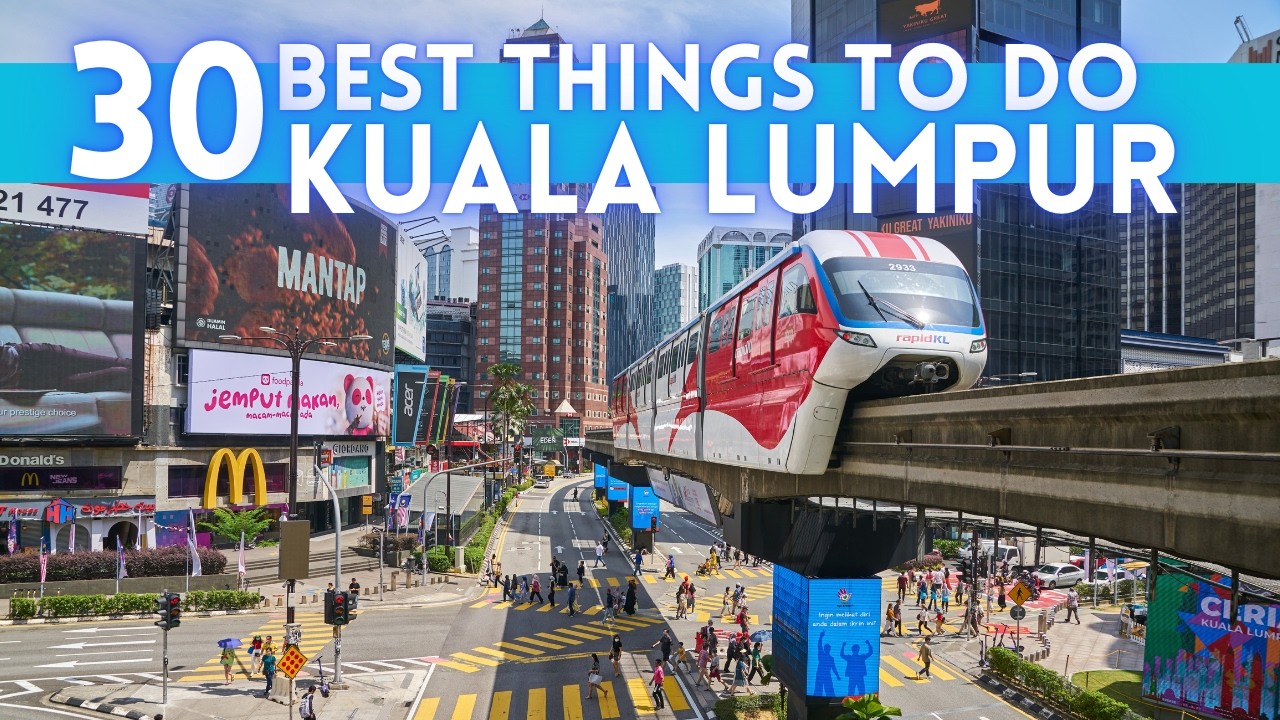
Jalan Alor on a weekend night is not a street so much as a slow-moving current of people, smoke from barbecue grills, and the smell of durian drifting in from fruit stalls at the edge of the crowd. That sensory collision is the reason Kuala Lumpur keeps pulling travelers back: a city of three major religions, three dominant ethnicities, and what feels like three dozen legitimate things worth your time. Island Hopper TV spent enough time on the ground here to put together 26 of them, and the list moves from street-level chaos all the way up to a highland resort sitting at 5,600 feet.
Start in Bukit Bintang and build your days outward
First-time visitors are pointed squarely at Bukit Bintang or KLCC as a base, and the logic is practical: both neighborhoods put the city’s density of food, nightlife, transit, and landmarks within walking distance. Jalan Alor, the food street running through Bukit Bintang, is described without hesitation as probably the most happening place in all of KL. The stalls run from Chinese barbecue to shawarma to fresh jackfruit for anyone eating plant-based, and the crowd on weekend evenings is thick enough that grabbing a Grab from directly inside the strip can add 40 to 45 minutes of gridlock. The smarter move is walking a few blocks out before hailing one.
The Pavilion mall anchors the shopping side of the neighborhood, its outdoor fountain and oversized screen giving it a Times Square quality that locals and tourists both use as a meeting point. For nightlife, Changkat is the call: bars, pubs, clubs, and live music running through the same block structure, picking up meaningfully on weekends.
The Petronas Towers remain the skyline’s most recognizable landmark even though they have since dropped to third tallest in the city. An observation deck and skybridge visit runs around 98 Malaysian Ringgit, roughly 20 US dollars, and the surrounding KLCC park is best timed for sunset. Across town, the older Menara Tower offers 360-degree views with less crowd pressure.
The temples, the highlands, and the quieter half of the city
Kuala Lumpur’s religious geography is one of its most striking qualities. Thean Hou Temple is a large, photogenic Buddhist site worth a morning. Batu Caves is the Hindu answer: rainbow-painted stairs climbing to rock caverns open to the sky at the top, with a towering golden deity at the base and a koi pond in the caves below. In Brickfields, known as Little India, the Sri Mahamariamman temple was recently renovated and sits close enough to Chinatown that both neighborhoods can be covered in a single afternoon. Merdeka Square, the independence park, has a mosque nearby and is an easy walk to Chinatown and the Central Market, where the second level in particular carries the rugs, silks, and quality souvenirs that modern malls rarely stock.
The Perdana Botanical Garden is free year-round and sits near the KL Bird Park, which runs about 85 Ringgit (around 18 US dollars) for adults. The butterfly garden is close enough that all three can be done in a single morning. The TRX Exchange, a rooftop park attached to a mall that opened about eight months before the trip, gives a newer option for an evening stroll near Bukit Bintang.
Genting Highlands is the city’s most ambitious day trip: a two-hour climb to a mile-high resort area where the temperature drops enough that a jacket is genuinely necessary by evening. Resorts World operates gambling and amusement parks up here, and a cable car runs through the clouds.
A moment at the Batu Caves stairs
The rainbow-painted staircase at Batu Caves holds more visitors than it looks like it should, particularly in the midday heat. The stairs are steep, the paint is vivid, and at the top the cave ceiling opens to an actual patch of open sky.
July is rainy season in KL, and some of the city’s sweat and shimmer is best understood through that lens. As Island Hopper TV noted after getting caught in one of the afternoon downpours: ‘Because KL is so hot I actually don’t mind a little bit of rain occasionally.’ That trade-off follows you through most of the list, heat offset by water, chaos offset by shade, and a city big enough to fill 26 days if you let it.
 Wake up to Only Happy News!