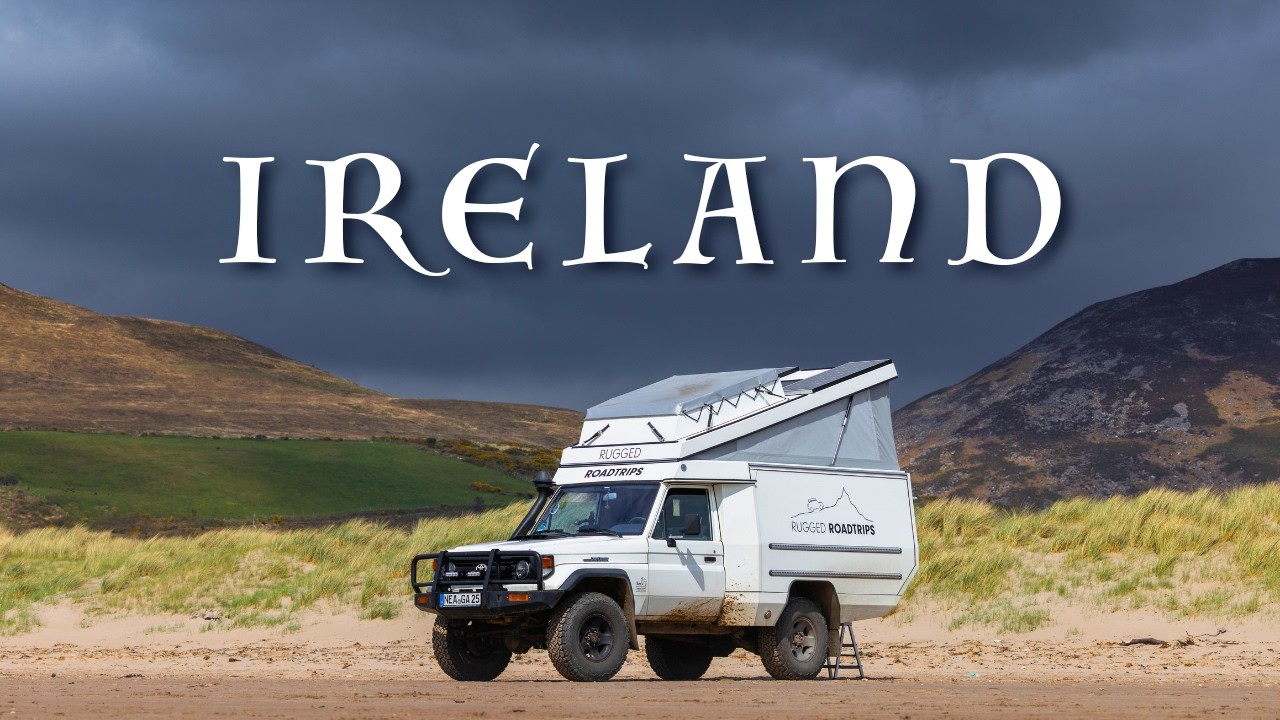
Four weeks, 4,000 km, and a conservative count of four million sheep. That is the raw arithmetic of Lucas T. Jahn’s grand Irish road trip, a full circuit of the island from the mountains south of Dublin to the basalt columns of Northern Ireland’s most famous coastline. For anyone who has ever wondered whether Ireland delivers on its postcard promise, the answer arrives somewhere around the third consecutive soaking on a windswept ridge: yes, but not in the way you expect. The beauty here is rarely polite, and the weather makes no apologies.
The journey opened not in Dublin itself but 45 minutes south of it, where the Wicklow Mountains form a broad upland of heath, moorland, and quiet lakes. April rain arrived early and stayed late, cloaking the valleys in a mood that felt less like bad luck and more like atmosphere. In Glendalough, that atmosphere had a 1,400-year precedent. St. Kevin chose this valley in the sixth century for its profound quiet, and the remains of his medieval monastic settlement still stand, anchored by a 30-metre round tower whose entrance sits 3.5 metres above the ground. The only way in was by ladder, a useful arrangement during raids, though its primary function was simply to call the monks to prayer.
Where the Atlantic Has Been Winning for Millions of Years
The southwest rewarded patience. The Mizen Peninsula, the island’s southernmost point, carries a weight the scenery alone cannot explain. Between 1845 and 1855, around one million Irish emigrants sailed past Mizen Head on their way to the United States, watching the cliffs until they disappeared. Dunloe Castle, founded in 1207 and wedged between precipitous cliffs and a lake, offered its own kind of melancholy. The wind there has a cold bite that makes medieval life feel less romantic in the retelling.
The cable car crossing to Dursey Island felt improbable for a country without truly high mountains, but that is Ireland’s habit of undercutting expectations pleasantly. Six permanent residents share the island with several hundred sheep. The walk stretches 6.5 km, easy to follow, and the island’s highest point holds a Napoleonic-era signal tower, one of 81 built around the Irish coastline as an early warning system against a French invasion that never came.
In Kerry, the mountains demanded a different kind of respect. From the summit of Carrauntoohil, Ireland’s highest point at 1,039 metres, Jahn offered a clear-eyed assessment: ‘Never ever underestimate the Irish mountains. They may not be the most impressive when it comes to altitude, but they definitely make up for that in ferociousness.’ He reached the top breathing hard after a steep ascent, stayed long enough to absorb the lakes below and the peaks around him, then moved on.
Islands, Seals, and a Six-Summit Loop Nobody Else Was Walking
Great Blasket Island, reached by a 45-minute boat crossing and a final transfer by dinghy, delivered the trip’s most quietly astonishing scene. The last 22 inhabitants left in 1954, defeated by isolation, population decline, and falling fishing quotas. Gray seals have reclaimed the beach since then. Around 200 were counted hauled out on the sand during the visit, a number that climbs toward a thousand during breeding season. In the water they dive to 70 metres. On land they hover at the water’s edge, seemingly reluctant to get wet.
The six-summit horseshoe loop in the Burren, which Irish climbers regard as the most arduous day hike in the country, consumed nearly six hours and zero trail markings. Jahn completed all six peaks on his own, with a wildfire visible roughly 15 km away and the sun still holding. The Cliffs of Moher, drawing more than 1.5 million visitors each year to a drop of 214 metres at its highest point, offered spectacle at the other end of the solitude spectrum.
Further north, Tory Island, the most isolated inhabited island in Ireland, delivered puffins at its eastern cliffs and a crossing bumpy enough that several passengers, as Jahn put it, had ‘guttural conversations with plastic bags.’ The Giant’s Causeway closed out the journey in Northern Ireland: 40,000 basalt columns, the product of volcanic activity roughly 50 to 60 million years ago, when cooling lava contracted and fractured into the distinctive pillars that still line the shore.
The Signal Tower at the Edge of Everything
On Dursey Island’s highest point, one of those 81 Napoleonic-era signal towers stands in the open Atlantic wind, built to watch for an invasion that never materialized, still watching.
By the final day, in the Mourne area of outstanding natural beauty, the weather cycled through blue skies, dark clouds, sunshine, and rain within the same hour. Ireland held its character to the end: landscapes that rarely announce themselves and then refuse to leave you alone, a wind that functions less as weather than as a permanent resident, and a quiet that, once found in a valley or on an empty ridge, is very hard to argue with.