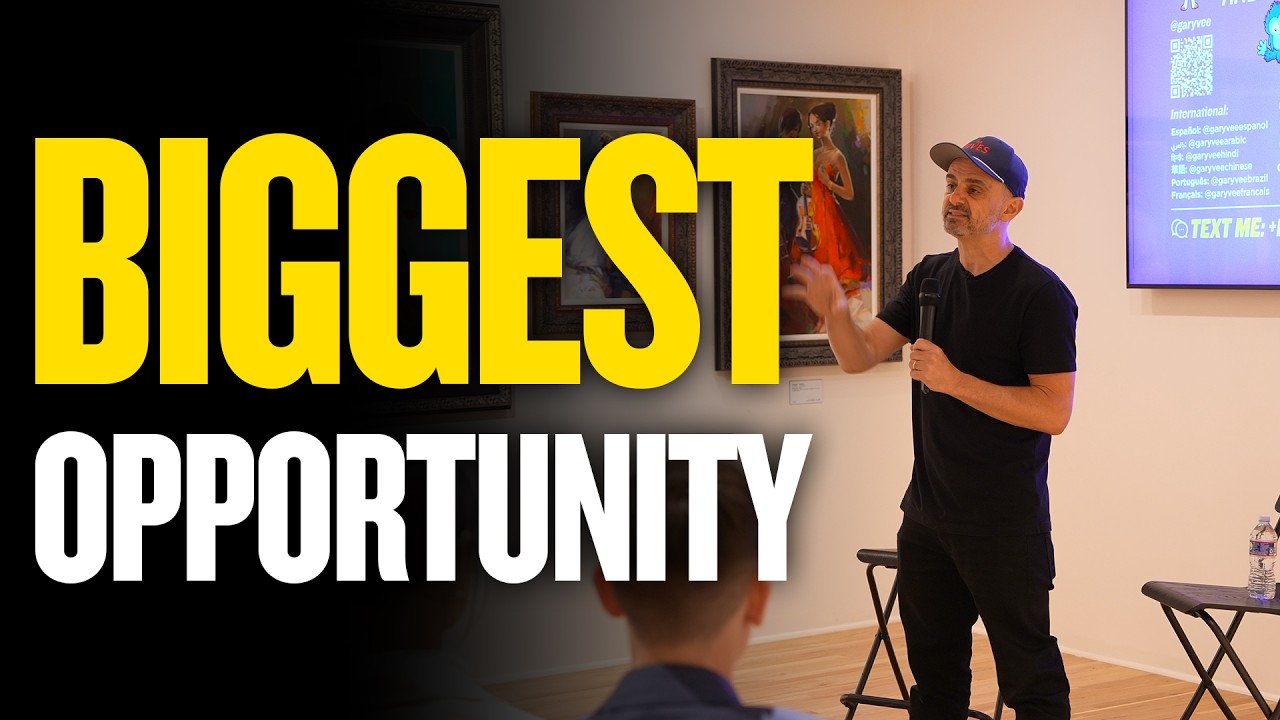
Gary Vaynerchuk stood in front of a room of the highest performers in the building and told them, plainly, that being good at their jobs was their biggest problem. The audience, an elite group of auction-based art sales professionals who sell to first-time buyers on cruise ships, had earned their spots in that room. That, he argued, was exactly the trap. When the most driven people in any organization stop feeling the pressure of starting from zero, they quietly start capping themselves without realizing it.
The silence most successful people never question
Vaynerchuk opened on a point he returned to three times across the talk: being silent on the internet is a bad strategic move. Not a missed opportunity. A bad move. He started making videos about wine within three months of YouTube launching, shifted to business and leadership content six months after that, and credits that decision with changing the trajectory of everything that followed. His push to the room was direct. Whether the topic is salesmanship, how to manage people, how to build lifetime value with a customer rather than chase a one-off transaction, or something else entirely, he could not push the group harder to start putting their expertise on record somewhere, in video, in audio, or in the written word. He paused on the Substack question, asking the room how many consumed newsletters on the platform. Almost no hands went up, and that reaction visibly energized him. ‘Substack is growing so quickly as a newsletter written platform that is building enormous levels of fame similar to what I saw on YouTube in ’06 or Instagram in 11 or TikTok in 16,’ he told the group.
The case he made was not purely about career upside. He described receiving five to ten messages a day from people telling him something he put into the world changed their life, and suggested that kind of return might be what some people in the room were actually missing. He also raised the scenario of someone with 50,000 followers being able to raise money for a nonprofit around a disease that hit their family because they had built a platform, versus not being able to because they had not.
Where emotional intelligence beats the algorithm
The second half of the talk moved into territory that surprised parts of the room. Vaynerchuk argued that AI will commoditize most transactional skills inside of five years, including auction performance, and that the two things no technology can fully replicate are deep emotional intelligence and a personal reputation built over time. He was specific about the emotional intelligence piece, naming empathy, kindness, and compassion as the core of it, and candor as the piece most leaders quietly avoid because they mistake silence for kindness.
He used himself as the example. For roughly 25 years, he said, he delivered no real feedback to employees, walking past problems with encouragement and then letting people go with no prior warning because he had confused his own empathy with good management. When he finally named the blind spot and rewired his approach, calling it ‘kind candor,’ his agency moved from 100 million dollars in annual revenue to 400 million dollars over six years.
On the question of how to build drive in people who do not already have it, he reached for a story about his father and landed on a line that drew a visible reaction from the room. His father had spent years complaining about employees who lacked ambition, and Vaynerchuk’s response, delivered bluntly to his face one day in the car: ‘Dad, if these people were as good as you, they wouldn’t work for you.’
The framework he left the room with was not about fixing that gap. It was about accepting it, reading each person’s actual ceiling, and then building toward the best version of that person rather than a replica of yourself.
The $46,000 bet and one lesson about not knowing what you don’t know
Vaynerchuk shared that at 32, after spending most of his twenties earning between 50,000 and 60,000 dollars a year while living on roughly 11,000 dollars annually, he had accumulated 213,000 dollars in savings. He wrote two checks that emptied his account into two startups he believed in. His 46,000 dollar investment in Twitter returned significantly when Elon Musk acquired the company. His roughly 167,000 dollar position in Facebook remains untouched. His point was not to celebrate the outcome. It was that he had believed so completely in Facebook at the time that, had he known what a special purpose vehicle was, he would have raised money from his wine collector clients and taken a percentage of the upside. Not knowing a single financial instrument, he said, may have cost him a trillion-dollar outcome.
The comic book collection nobody in the room was building yet
Near the close of the Q&A, Vaynerchuk threw out a specific unsolicited call for the group: buy comic books. He said coins are positioned similarly to where trading cards were in 2017, that younger buyers are entering the collectibles market in numbers that will move prices, and that anyone with a working knowledge of that category should be paying close attention.
Somewhere in that same room, a first-time art buyer on a cruise ship is probably still hanging the piece they bought during a 30-minute conversation they thought was just a conversation.