Will buckled his ski boots in 90-degree August heat, looked down a steep grass hill with a cat track gap at the bottom, and said out loud what everyone around him was already thinking: ‘I was talking a big ass game. Now I’m pretty scared.’ That specific mix of commitment and dread is exactly what grass skiing is, a sport that looks impossible on paper and turns out to work disturbingly well in practice. When the crew at Sickos spotted a grass ski reel on Instagram, they ordered a pair of the tank-tracked, ball-bearing sleds within a week. A month later they were hitting backflips.
Tank tracks on a park hill
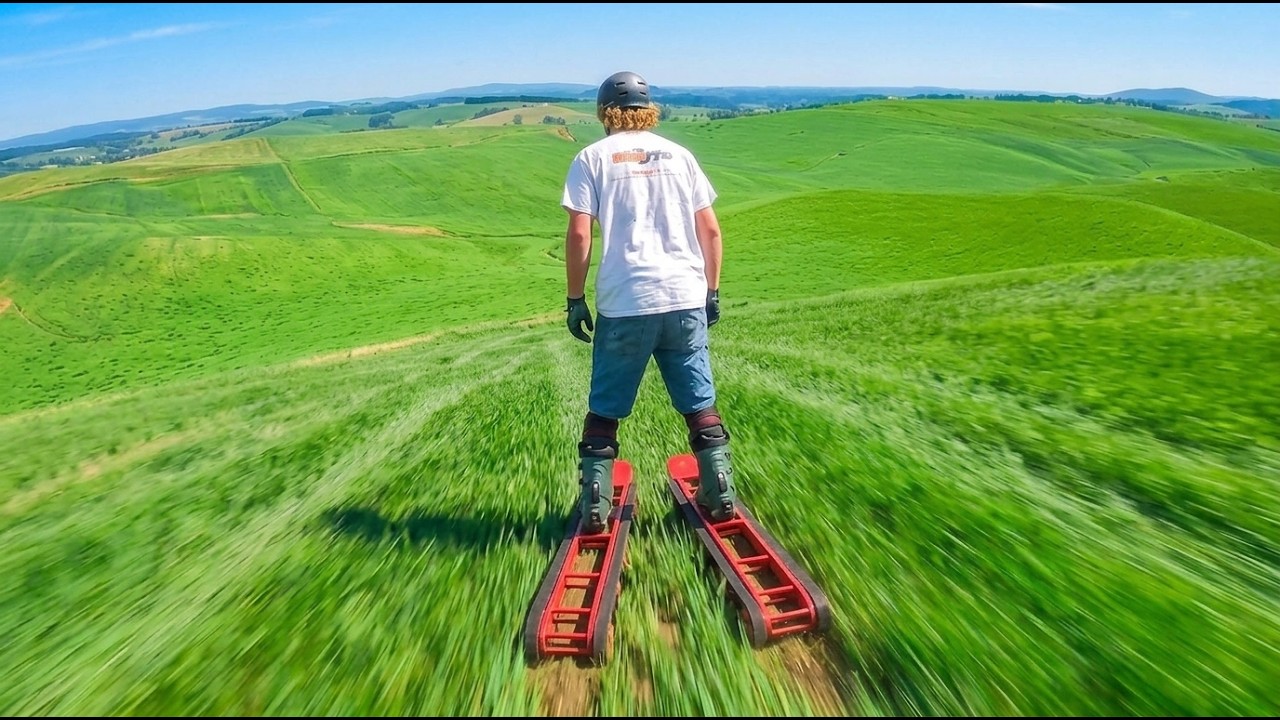
The skis themselves took everyone a beat to understand. Instead of a flat blade, each one is a continuous loop of small balls wrapped in plastic sheeting, essentially a miniature tank tread that mounts directly to a standard ski boot binding. There is no release mechanism. As one of the crew noted early on: ‘If you eat it, you’re just locked in with this thing.’ The first tentative side-steps on a mellow park hill produced immediate chaos and immediate delight. Within minutes, someone was skating across flat grass and yelling that it looked like ice. A makeshift chairlift followed, then a full park setup with a winch, and then the group dragged everything to a rocky backcountry field because the park had, in their words, been maxed out.
The progression from there was genuinely escalating. A rocky hillside at around 90 degrees added grip complications that one rider compared to skiing with debris stuck to the base, sticky and unpredictable. Then came a massive open grass hill where the plan was to build speed from progressively higher start points until things got properly fast. Charlie and Will went from the very top together and came out the bottom yelling. The jump section followed: a winch-assisted kicker that started small and grew until Caden was clearing the table and landing a 360 on the third attempt. Will put it plainly after his own first hit: ‘This gives me big confidence in how the backflip is going to go later.’
The backflip that took three tries and 25 dollars and a nickel
The slip-and-slide jump was massive, the landing zone was described as ‘so skinny there is not a lot of margin for error,’ and safety pads were added after the crew established that without them a bad landing meant ten feet of air into hard ground. Will went first, stuck the backflip clean, and rode away on the grass. Caden went next, disclosed that his only previous ski backflip attempt had broken his collarbone in high school, and proceeded to attempt the trick anyway. His first try landed him on his feet but not riding out. His second produced what the group charitably called a belly flop. A $20 bet from one person and a $5 chip-in from another and a nickel from a third sent him back up for a third attempt. He landed it clean and rode away. Twenty-five dollars and a nickel changed hands.
Also present: Joaquin, an editor from Argentina who had met the crew in person for the first time two days earlier after a year of working together remotely. He was handed grass skis almost immediately. He survived.
The helmet that became a projectile
Somewhere between the park and the big hill, someone bombed a slope too early and launched a helmet down the run. It somehow landed next to a bystander named Collab, who grabbed it. The crew spent a full minute reconstructing the chain of events that had to occur for that to be fine.
The grass skis are available for two people to win through the crew’s secondary platform, Seekers TV, details in the description of the original post. As one of the group observed before the backflip session: ‘Everyone can use these, because I don’t know anywhere in the world where you don’t have grass or some type of hill.’ Someone immediately replied: ‘The Sahara Desert.’ The skis remained on the hill.