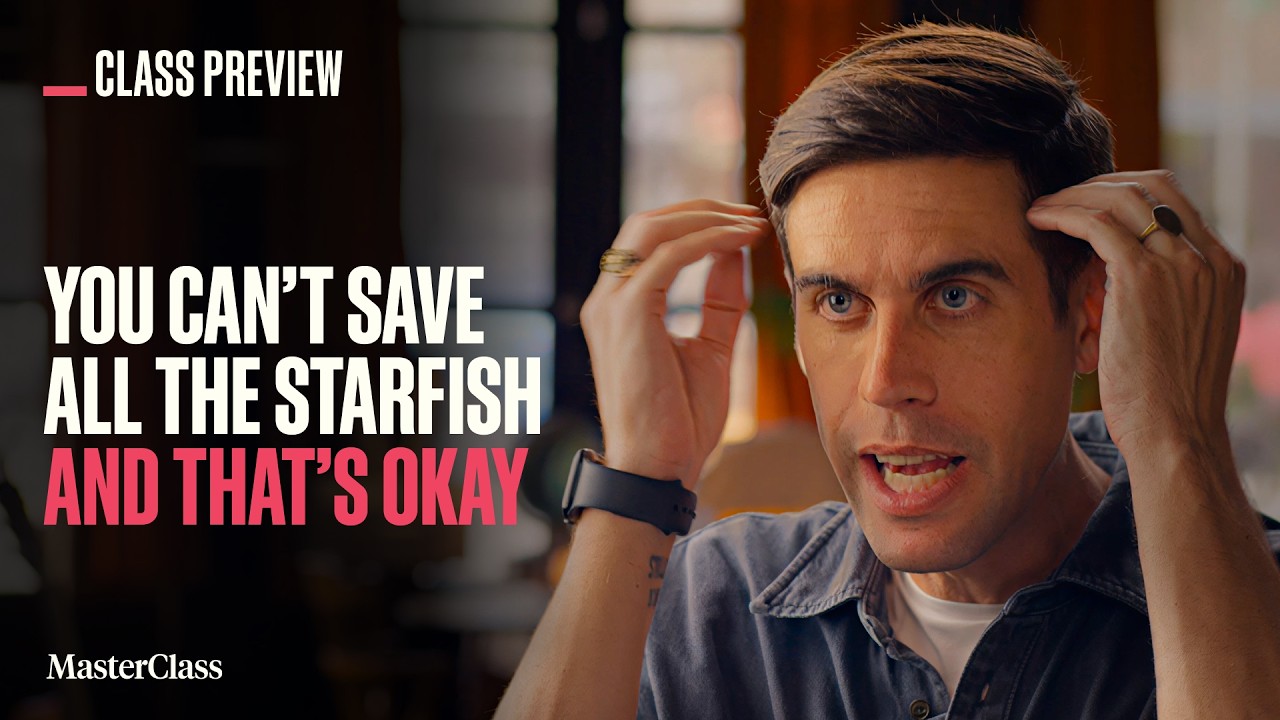
Ryan Holiday opens with a boy on a beach, kneeling in the sand, throwing starfish back into the ocean one at a time. A cynical adult tells him it’s pointless, that he will never save them all. The boy picks up another one, tosses it into the surf, and says: ‘It matters to this starfish.’ That image, simple and stubborn, is the axis around which Holiday’s teaching turns: the question of how to live well when the scale of what needs doing feels impossible.
The Stoic case for thinking about death today
Holiday spends real time on what Stoic philosophers called the active meditation on mortality, and he is careful to strip the morbidity out of it. Marcus Aurelius, he explains, kept a private instruction to himself on the subject: ‘You could leave life right now. Let that determine what you do and say and think.’ The point is not to dwell on an ending. The point is to use the ending as a sorting mechanism for everything else.
The sharper formulation comes from Seneca. Most people, Holiday notes, treat death as a distant single event, something that happens once, far in the future, leaving plenty of time to get around to the important things. Seneca’s correction is harder to shake off. ‘The time that passes belongs to death,’ he wrote. Every minute and every day is already part of that process. Holiday frames this not as a reason for anxiety but as a practical tool: if your time is the one resource nobody is making more of, and the one resource you cannot recover once it is gone, then the Stoic meditation is actually clarifying rather than grim.
What Marcus Aurelius did when he was already the wisest man in Rome
The second current running through Holiday’s teaching is the idea that learning is not a phase of life but a practice that has to be chosen daily. He tells the story of Marcus Aurelius being spotted leaving the imperial palace as an old man. A friend asks where he is going. The emperor answers that he is heading to see a philosopher named Sextus, to learn that which he does not yet know. The friend is stunned, because by any measure Marcus Aurelius already held the reputation as one of the greatest leaders who ever lived.
Holiday’s response to that story is direct: ‘If Marcus Aurelius at this point in his life is still a student, what excuse do we have?’
He draws an equally sharp contrast with people who describe philosophy as something they ‘studied in college,’ using the past tense as though the subject is now complete. To the Stoics, he says, that framing would have been almost unrecognizable. Socrates, widely considered the wisest man of his age, was bewildered when the Oracle named him so. What he eventually concluded was that his wisdom consisted precisely of knowing his own ignorance and refusing to stop asking questions.
Holiday brings this directly to the people in the room. Nobody forced them to show up. No teacher is grading the work, no principal is deciding whether they advance. The propulsive force behind a lifelong education, he says, has to come from inside the person doing it.
The tablets on the table
The detail that lingers is the image of Marcus Aurelius picking up his writing tablets before walking out of the palace to attend a philosophy lesson. An emperor, carrying his notebooks to school.
The boy is still at the water’s edge, throwing starfish back one at a time, not because he can save all of them, but because the one in his hand is reason enough.