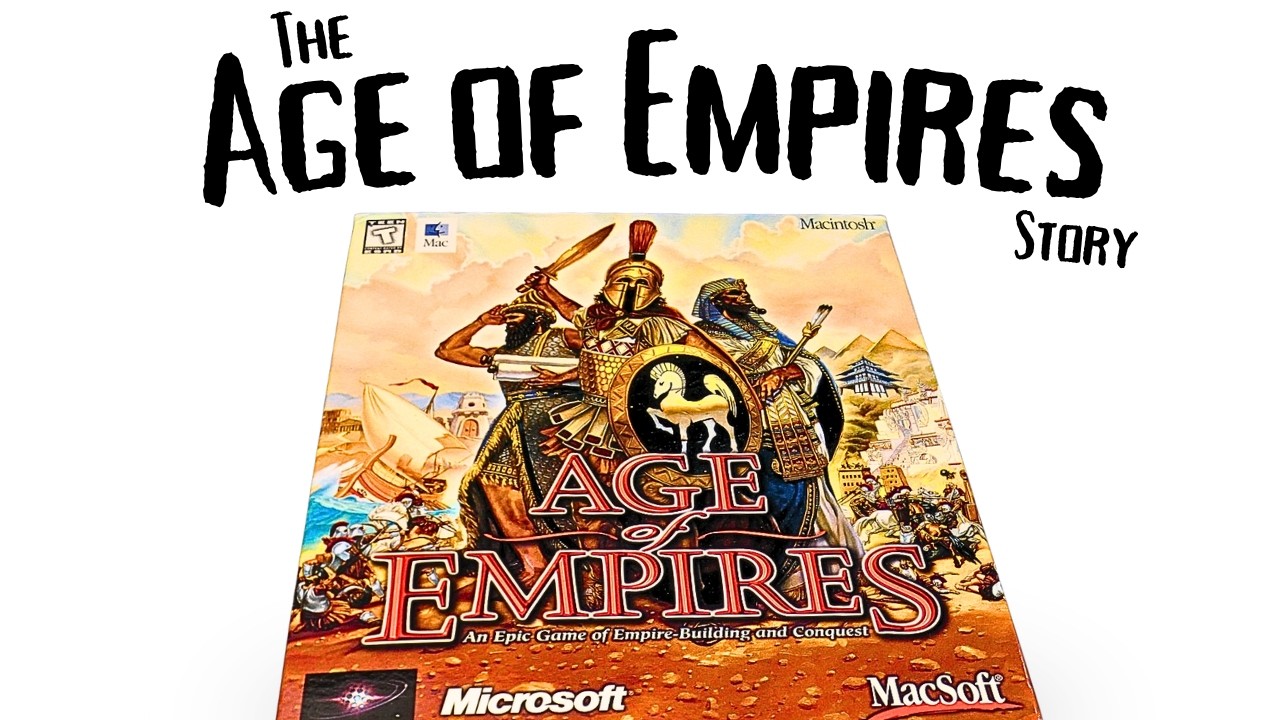
Tony Goodman ran an IT consulting firm in Dallas called Ensemble Corporation when he stumbled across a Microsoft graphics library in 1994 and thought, essentially, why not try making a game? He had no game development experience. His brother Rick had none. Their programmers built databases for a living. Their first demo was a piece of land and some troops. That was it. And yet the story that started in that Dallas office eventually helped convince Microsoft to build the Xbox, introduced millions of people to Joan of Arc and Genghis Khan, and turned one of the most beloved strategy franchises in PC history into something historians still credit for sparking their careers.
The least worst idea they had
The early brainstorming sessions at Ensemble were, by Rick Goodman’s own account, not exactly visionary. Tony suggested a desert island survival game. Someone wanted to make a train game. But Rick kept returning to Civilization, admiring its scale while resenting its turns. Then a programmer brought in Warcraft, and the concept clicked: build an economy, advance through history, grow an empire, but make it happen in real time. Rick later described the moment with perfect honesty. Out of everything they considered, this was simply, in his words, ‘the least worst idea we had.’
They called it Dawn of Man, pulled in Bruce Shelley, a designer who had worked alongside Sid Meier on Railroad Tycoon and Civilization, and started building. Shelley brought with him a philosophy from Meier that would quietly shape everything: a good game is, at its core, ‘a series of interesting decisions.’ The team spent roughly nine more months producing a working prototype, an isometric world with primitive units, rough buildings, trees, and scattered resources. Rick looked at it and thought it would never sell. They shipped it anyway, on October 13, 1997, and within months it had moved hundreds of thousands of copies worldwide. By 2000, that number had climbed to around 3 million.
A Microsoft product planner had first seen the prototype during a routine Texas visit. What was supposed to be a quick meeting apparently stretched to four hours. And when the money talks came, Tony pushed Rick to ask Microsoft for an extra $600,000 on top of the deal. Rick, the cautious accountant, thought the request was insane. Microsoft said yes.
The sequel that became a cultural artifact
Age of Empires 2: The Age of Kings arrived in 1999 after a turbulent development that saw Rick Goodman leave the company to chase his original dream of simulating all of human history. The sequel team, two relative newcomers, initially crammed in every idea they had, found the result was chaos, stripped it back to the first game’s solid bones, then added features one at a time, cutting anything that failed playtesting with no mercy.
What emerged had unit formations, civilization-specific unique units, castles, market trading, and campaigns written with genuine flair: an Attila story narrated by a traumatized Frankish monk, a Genghis Khan campaign opening with a haunting line about a blue wolf. Steven Rippy’s soundtrack, with tracks carrying names like Shamburger, made the act of building a medieval town feel quietly epic. The game sold 2 million copies in its first few months. Six years later, in 2005, it was still selling 675,000 copies annually, outselling most new releases on the shelf.
Historian Holly Nielsen has noted that when she speaks about games and history, fellow historians regularly admit afterward that Age of Empires 2 was part of what made them interested in the past in the first place. Public historian Greg Jenner had a similar experience, the name Genghis Khan entering his vocabulary while he was still in school, arriving not from a classroom but from a campaign menu.
A game that outlived its makers
Ensemble Studios was shut down by Microsoft in 2009, shortly after finishing Halo Wars for the Xbox 360. Tony Goodman founded Robot Entertainment. Many former Ensemble staff quietly started new studios. A group of Age of Empires 2 modders called Forgotten Empires had spent years building unofficial expansions. Microsoft eventually noticed them, and the fans became the developers, helping bring the series back through a run of definitive editions before Age of Empires 4 arrived in 2021, more than 15 years after the last numbered entry.
According to Microsoft executive Stuart Moulder, Age of Empires had helped prove something important inside the company: that Microsoft could actually make and sell games to dedicated players. That credibility mattered when the company began seriously considering whether to enter the console market at all.
The Damascus moment for one game designer
Somewhere in the Ensemble offices, Rick Goodman stared at an isometric prototype on a monitor: rough terrain, primitive units, no real purpose yet. He redrew the game’s technological structure somewhere around 78 times before the architecture clicked into place. Even then it was too ambitious. Bruce Shelley pointed out that a single match running four or five hours would kill online play before it had a chance. Seven ages of human history became four: Stone, Tool, Bronze, and Iron.
The little settlement with a few villagers chopping wood still had a long way to go before it became a medieval city. But it was already becoming something.
The tank that the Ensemble team used to test their very first graphics demo, the one firing at palm trees in an empty field, is not on display anywhere. There is no plaque. It was just a test object, a placeholder, a thing to shoot while the real idea took shape around it.
 Wake up to Only Happy News!