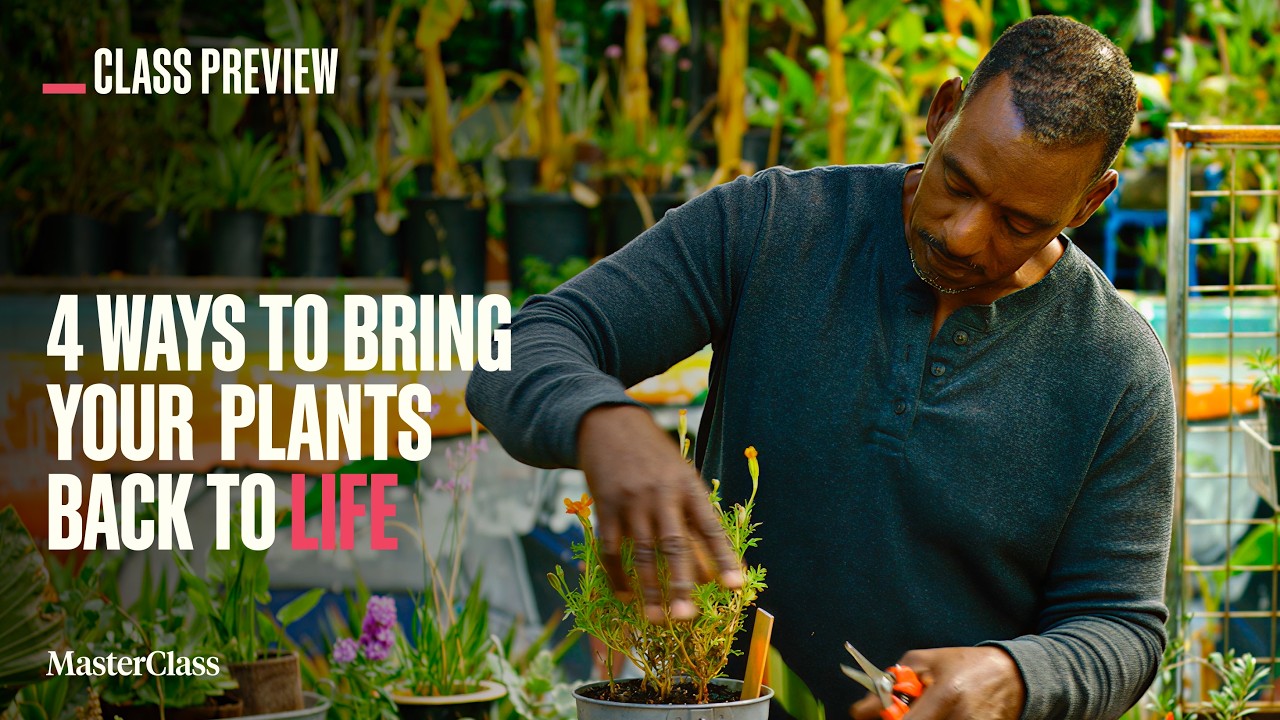
Ron Finley crouches over a pot of basil that has gone fully to flower, and the plant looks like it has given up. It has not. Most gardeners at this point would let it run its course, not realizing that one cut changes everything. The gap between a thriving herb garden and a dead one often comes down to a handful of techniques that nobody ever teaches, and Finley has spent years correcting that. He works through the session with the directness of someone who has watched too many good plants die from bad information, moving from a flowering basil stem to a root-cracked pot to two side-by-side broccoli plants in completely opposite states of distress.
Why cutting the flowers actually saves the plant
The first revelation Finley walks through is deadheading, and the logic is counterintuitive enough to stick. Basil is an annual, meaning its entire biological mission is to flower, set seed, and finish. Once it flowers, it decides the job is done and stops producing leaves. That is when the flavor disappears and the bitterness sets in. ‘If you want more leaves, you cut the flowers off,’ Finley says flatly. ‘That’s what you do with basil.’ By removing the flower heads just below the last bloom, the plant is tricked into continuing its growth cycle, pushing out new leaves in another attempt to reach its reproductive goal. The same principle applies to marigolds, except in reverse: cut the dry, spent flowers off a marigold and it redirects energy into producing new blooms rather than holding onto the old ones.
Deadheading is not the only technique Finley demonstrates with this kind of biological clarity. He also walks through pruning, explaining that a broken or damaged branch draws the plant’s energy toward repair, just as a wound on a person generates heat at the site of injury while the body works to fix it. Removing those dead and struggling branches frees that energy for healthy growth. The dry material pulled off is not waste, he points out. It goes into the compost pile, unless it is diseased or carrying bugs.
Root-bound and underwater are not death sentences
The session’s most vivid moment comes when Finley pulls a plant from under the table to show what root-bound actually looks like. The roots have cracked the ceramic pot from the inside. They have looped around the top of the rim, run through the drainage holes, and shaped themselves to the floor of the container like a basket. ‘Stop being so cheap,’ he says, and means it. His prescription is a pot double the size of the last one, giving the roots room to spread and pull in nutrients again.
For watering, Finley lines up two broccoli plants side by side. One is underwater, its stalk gone soft, leaves curling inward and drooping. The other is flat-leafed and stiff. He notes that the underwater plant, if watered immediately, would show visible leaf recovery within 30 minutes. The overwatered plant carries a different risk: the root ball begins to rot from excess moisture, and the stem browns right at the soil line. His test is simple, push a finger two inches into the soil. Dry means water it; wet means leave it. He also mentions that water departments in some areas offer soil moisture meters at no cost, or they can be bought online and inserted directly into the pot.
The parsley that grew through the bottom of its pot
A parsley plant sitting on the table has roots emerging from the drainage holes, dense and circular, holding the exact shape of the container’s base.
Finley sets both the over-watered broccoli and the wilting one side by side before wrapping up, and his point is the same for both: neither plant is gone. The basil with its flowers still holds so much flavor in the blooms that he drops them into water and makes watermelon juice with them. The plant that looks finished is still full of possibility. All it needs is the right cut at the right moment.