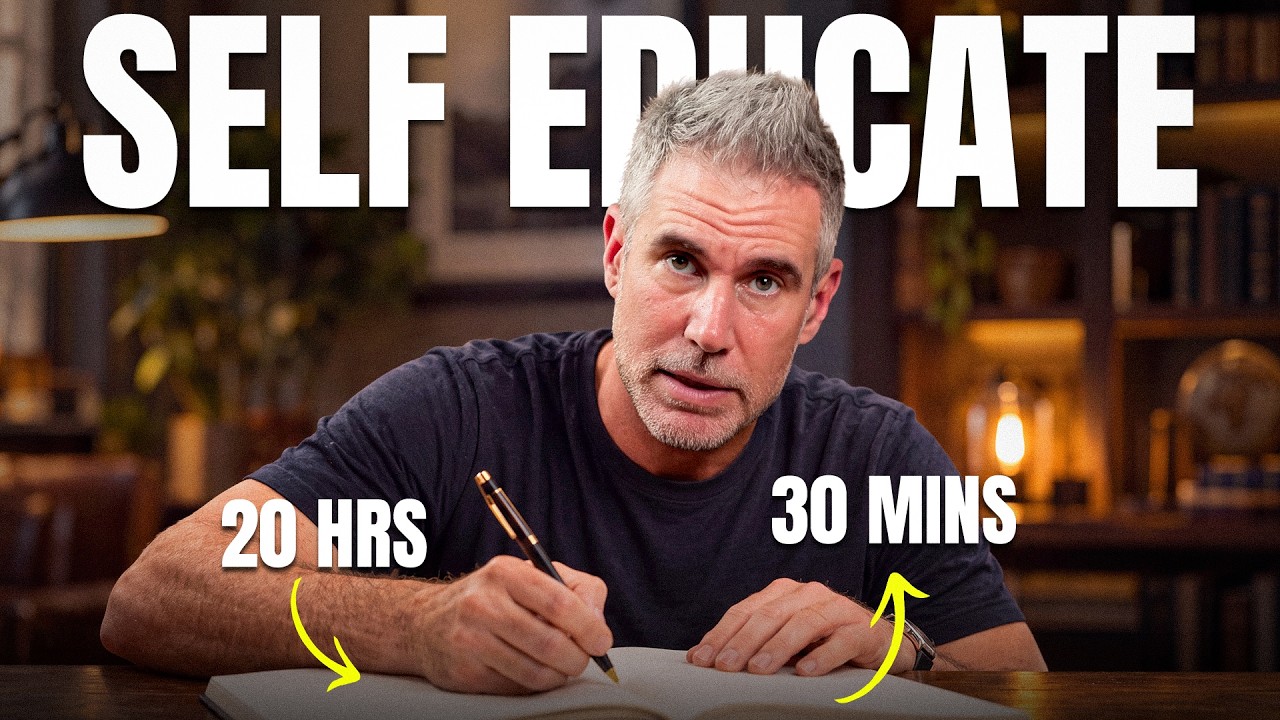
Somewhere around 35 or 45 or 55, a quiet crisis arrives. The degree is framed on the wall, the career is built, the house is bought, and yet the question surfaces anyway: is this it? David Bayer, a personal growth educator, opens with that exact moment because he lived it, and he argues it is not a sign of ingratitude or failure. It is the natural consequence of receiving one kind of education your entire life while being denied another kind entirely.
The education nobody actually gave you
Traditional schooling, Bayer points out, is extraordinarily good at teaching a person how to function in the world. Mathematics, writing, professional skills, credentials, all useful, all genuinely necessary. What it never covered, and what no institution formally assigned, were the questions that arguably determine the quality of an entire life: who am I, how does my mind work, where do my beliefs come from, and what role do I play in creating the reality I experience?
The ancient Greek inscription at the Temple of Apollo at Delphi distilled it to two words: ‘Know thyself.’ Bayer’s argument is that modern civilization has built an educational system capable of explaining almost everything except the person sitting inside it.
The gap matters because beliefs are not passive thoughts. Neuroscience, he notes, tells us that out of a hundred things a person could focus on at any moment, only twelve register, and that twelve percent tracks almost exactly with what a person already believes. Beliefs organize perception, shape emotional states, drive decisions, and therefore produce results. Two people walk through the same experience and emerge with completely different conclusions, because they were running on different operating systems the whole time.
The real problem, then, is not that people receive beliefs from parents, schools, media, and algorithms. That is simply how human beings learn, and no one has time to independently verify everything. The problem is that borrowed information quietly becomes borrowed belief, and at some point a person stops recognizing that an idea was handed to them and starts experiencing it as reality itself.
Why fiction keeps winning and what to do about it
Bayer cites a keynote by author Yuval Noah Harari to explain why correcting borrowed belief is genuinely hard. Truth, Harari argued, has structural disadvantages. It is complicated, it is expensive in effort, and it is finite. Fiction is simple, cheap to consume, and can be manufactured infinitely. You can generate a thousand false stories in the time it takes one person to verify whether a single one is accurate. Technology, Bayer adds, is amplifying that gap exponentially.
But he identifies a second, less comfortable obstacle. The truth outside us is hard to find. The truth inside us is hard to face. Sometimes a belief persists not because a person lacks information but because the belief is protecting them from something they do not want to see: that they are contributing to the problems in a relationship, that they do not actually want the career they spent twenty years building, that an obsession with achievement is covering a deeper conviction that they are not enough.
Bayer connects this to his own recovery from a period of blackouts, a failed business, and broken relationships in his early thirties. He wanted to create fiction about it. ‘What’s the big deal,’ he remembers thinking, framing the chaos as ordinary weekends. Real self-education, he says flatly, required a rigorous honesty he was not ready for until he was.
In practice, he offers a starting point: pick one area, money, relationships, health, success, and ask what you actually believe about it. Then ask where you learned that. Then ask what evidence contradicts it, not supports it, because finding support is easy. Ask what reality that belief is currently producing. Your bank account, your health, your relationships right now, he argues, are the balance of what you believed up until this point.
The goal is not to distrust everyone. It is to stop confusing authority with truth. A person can sit with a doctor, listen carefully, and still not blindly accept everything. They can read the news without assuming the story shown represents all of reality. ‘Don’t believe something because David Bayer told you so,’ he says directly. ‘Take what I’m teaching you, examine it, question it, test it against your own experience, and then decide what you believe.’
The moment the question arrived
A person sits somewhere in their mid-thirties or fifties, credentials intact, bank account present, and something still does not feel right.
Bayer calls that discomfort the beginning of the second education, not the education of a profession, but the education of a self. Whether anyone sits still long enough to start it is the only open question.