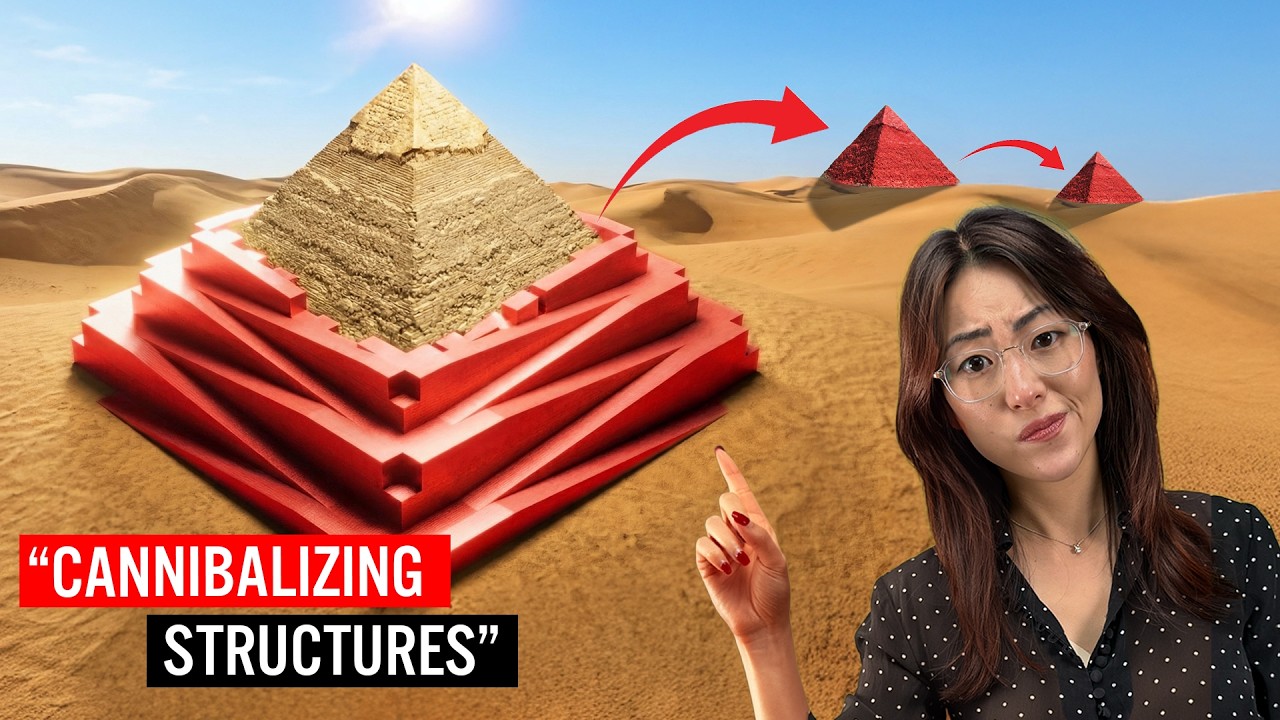
Huni Choi is not an architect. He is not an Egyptologist. He is the kind of person who spends a decade placing thousands of individual stone blocks inside a 3D model, one by one, until the math either holds or falls apart. Two years ago, he sent those ten years of work in an email to architecture creator DamiLee, who almost deleted it. When she finally read it, the theory flipped her understanding of the most studied structures on Earth. The central claim: the Great Pyramid was not built up from the ground. It was carved down from a much larger mass.
Why every existing ramp theory keeps breaking at the top
Before getting to Choi’s model, it helps to understand why the problem is so stubborn. The Great Pyramid stands 146 meters tall, contains roughly 2.3 million stone blocks, has a base that is almost a perfect square off by mere centimeters, and is aligned to true north by just one-fifteenth of a degree. That razor precision is not a finishing detail. It is load-bearing from the very first course, because even a tiny angular error at the base compounds into a catastrophic deviation by the apex.
The classic external ramp theory requires a ramp stretching roughly two kilometers to keep the slope gentle enough for human workers. The problem is there is zero archeological evidence of a structure that size ever existing or being torn down. The spiral-ramp variant is tidier in theory, but the faces of the pyramid had to remain perfectly straight and visible as construction progressed, and a fat ramp wrapped around the outside blocks every corner the builders needed to check. Architect Jean Pierre Houdini proposed a hybrid with a short external ramp for the lower third and a hidden internal spiral for the rest. In 2015, muon tomography gave the pyramid a deep scan using high-energy particles from space that slow down in dense rock, allowing a 3D density map without touching a single stone. The scan revealed a massive unexplained void above the Grand Gallery, but found no clean spiral trace running just under the surface, which strongly weakened Houdini’s internal ramp argument.
Every major theory, DamiLee notes, tends to work on paper until the final meters. ‘The apex actually is the rarest and hardest part to explain,’ she says, citing an Egyptologist in her research, ‘and the key to the pyramid’s construction.’
The trapezoid that ate itself into a pyramid
Choi’s model starts from a different premise entirely. Before construction began, the Giza plateau already had a natural limestone outcrop with elevated terrain. His theory proposes that builders first shaved and terraced these high points into a working platform, then overbuilt: instead of starting with a pyramid shape, they constructed a gigantic trapezoidal mass with an integrated ramp system baked into its geometry. A trapezoid spreads outward toward the top, which keeps the working ramp at a manageable seven-degree grade all the way up and leaves a flat, stable deck around the apex with clear sightlines to all four edges.
Once that mass reached full height, crews began carving it downward into the final pyramid shape. Working from a wide, stable platform toward a point is dramatically more forgiving than building toward a point from below. Choi’s model estimates the initial trapezoidal mass at roughly 8 million tons. Carving it down to the Great Pyramid’s approximately 6 million tons yields around 2 million tons of reusable stone, which his calculations suggest was distributed to the satellite pyramids and ancillary structures at Giza. Add up all the stone cycling through that loop and the total comes to roughly 14 million tons, with about 1 million tons left over. That remainder lines up with mainstream volume estimates for the entire Giza complex.
This also reframes the famous ‘missing evidence’ problem. The ramps were not lost to time. They were the pyramid’s own body, cannibalized back into the system. The Egyptians recycled broken boats into furniture, furniture into smaller objects, and later dynasties literally mined old pyramids for new buildings. A closed-loop construction engine is, as DamiLee puts it, ‘a very Egyptian thing to do.’
Supporting detail arrives from a separate researcher who catalogued roughly 6,000 surviving casing stones across three sides of a neighboring pyramid and found a repeating pattern: small tapered stones forming vertical streams on each facade, which function as king stones, stitching simultaneously laid masonry sections together. All three accessible faces show the identical pattern, with no clustering at corners or centers, which suggests crews worked from multiple directions at once across a wide, stable, unobstructed deck rather than from a single ramp edge.
The researcher who spent ten years placing virtual stones
Choi’s work does not claim to be proof. As DamiLee frames it honestly: with the pyramids, the standard of evidence is not ‘this is absolutely true’ but ‘this is the least wrong answer.’ Archeology cannot run a live construction experiment, and multiple methods could produce the same final shape. What a strong theory can do is predict what traces should exist, and then find that real-world evidence matches those predictions from multiple independent directions.
What Choi’s model adds to the conversation is a way to stop treating missing evidence as a dead end. If the builders deliberately cannibalized every construction trace back into the structure itself, and if they restored the site to something close to purity once each phase was done, then the absence of a two-kilometer ramp is not an unsolved mystery. It is the system working exactly as designed.
On the Giza plateau, the natural limestone outcrop that Choi’s model identifies as the starting material is still visible, unchanged and unexcavated, holding whatever the next ten years of scanning technology might eventually find inside it.