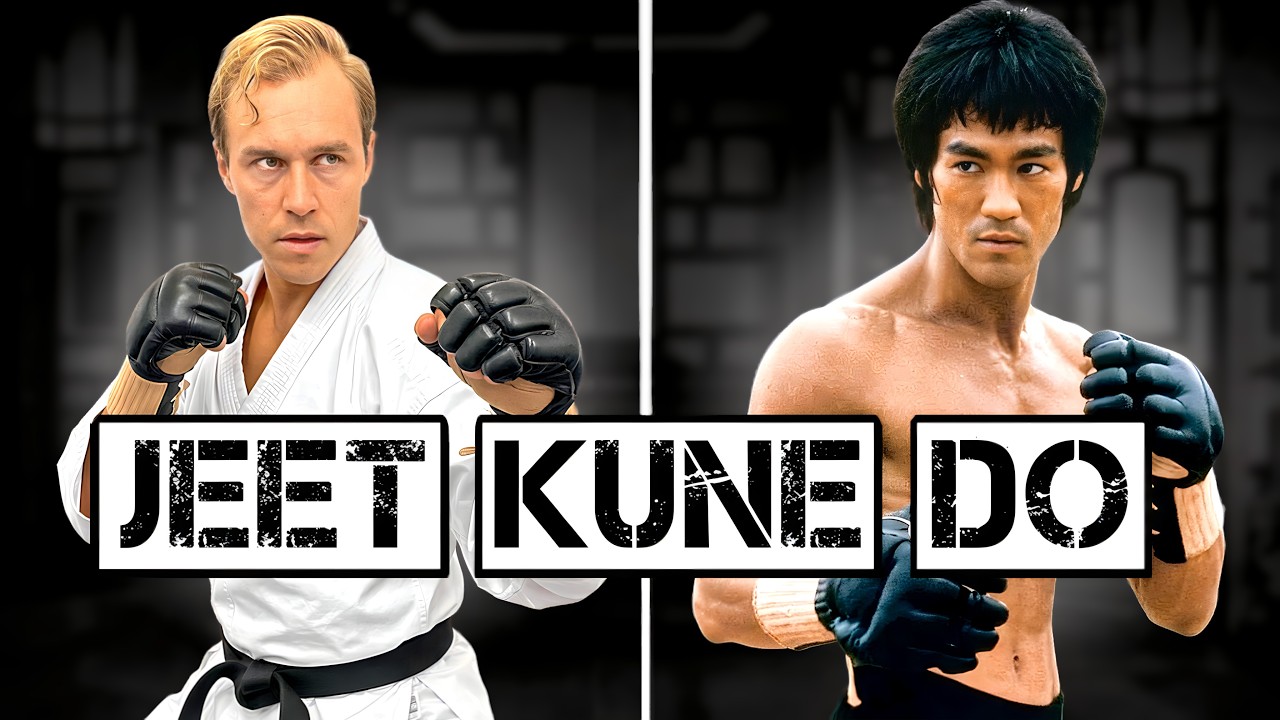
Sifu Singh holds up one open hand and tells Jesse Enkamp to just touch it. What follows is not a demonstration but a lesson in invisibility: the hand vanishes, reappears at a different angle, and Jesse’s reaction arm chases air. That gap between where the threat appeared to be and where it actually landed is the entire argument for Jeet Kune Do, the fighting system Bruce Lee built, and the reason Sifu Singh, one of its most recognized living practitioners, spent a long afternoon unpacking every piece of it.
The stakes are straightforward. Most people who study martial arts train for a version of conflict that never quite arrives. Jeet Kune Do was designed for the one that does.
The four ranges and why range decides everything
Sifu Singh opens the technical conversation by drawing an invisible map in the air. Every fight, he explains, moves through four ranges: long range, mid-range, close range, and ground. At the longest distance, the available tools are the eye jab and the kick. In the middle band, boxing and what he calls trapping hands operate. Closer still, a headbutt becomes not just legal but logical. Then comes grappling, then the floor. The question Jeet Kune Do asks is not which range belongs to which style, it asks how fluidly a person can transition between all of them without stopping to think about it.
The eye jab gets the most time. Sifu Singh demonstrates why range and joint extension matter more than raw reach: rather than leaning the body forward and closing distance dangerously, he rotates and opens his joints, gaining several extra inches while keeping his base stable. The result is a strike that lands without committing. ‘I don’t have to hit you and penetrate through you to create pain,’ he says. ‘I can stay far away and just flick.’ Even UFC bouts get stopped by an accidental eye contact, he notes, which tells you something about how much damage the threshold actually requires.
The sidekick gets a similar deconstruction. The cinematic version, the explosive launch Bruce Lee made famous on screen, is real but incomplete. The practical version targets the knee and exploits the opponent’s own step. Once a fighter understands that any offensive movement requires a weight shift, the kick no longer needs power behind it. The opponent’s own momentum does the work. ‘So you’re using my step against me,’ Jesse says. Sifu Singh nods. ‘You don’t even need all of that power then.’
Breathing, the 45-75 rule, and the cobra principle
Halfway through the session Jesse is tense and slow, consistently a beat behind. Sifu Singh stops the drill and addresses the gas tank. He asks Jesse to inhale all the way to 100 percent capacity. Tension locks the shoulders immediately. Then exhale completely to zero. Same result. The target zone for a working fighter, he explains, is 45 to 75 percent, never the extremes. ‘In a fight, people go peaks and troughs,’ he says. ‘The extremes is where you make mistakes.’ The sharp nasal inhale followed by a voiced exhale is not performance; it creates what he calls a biofeedback loop, an audible confirmation that the body is still breathing when adrenaline would otherwise cause it to hold.
Relative speed, not absolute speed, explains the eye jab’s effectiveness and the cobra comparison that Sifu Singh keeps returning to. A cobra does not simply move fast. It changes speed. Muhammad Ali’s jab started low, not from a guard position, which meant opponents were tracking the wrong visual cue. Jeet Kune Do uses the same principle deliberately: present one mechanical picture, deliver a different one.
The moment Jesse did not see coming
Late in the session, after the philosophy has settled and the drills have loosened things up, Sifu Singh catches an arm and drops into a bar submission before Jesse has processed that the exchange had started. Jesse’s reaction is immediate and honest: ‘I did not expect that arm bar. This is not a karate fight. This is real stuff.’
That phrase is probably the cleanest description of what Jeet Kune Do actually promises. Not spectacle. Not tradition for its own sake. Contact with the moment, exactly as it arrives.
The Kendo-derived open-finger training gloves Sifu Singh brought sit on the mat between them afterward, their split design allowing both striking and grappling in the same session without the padding sacrifices of either a boxing glove or a standard MMA glove, a small engineering detail that reflects the system’s larger premise: no single tool, no fixed range, no settled answer.