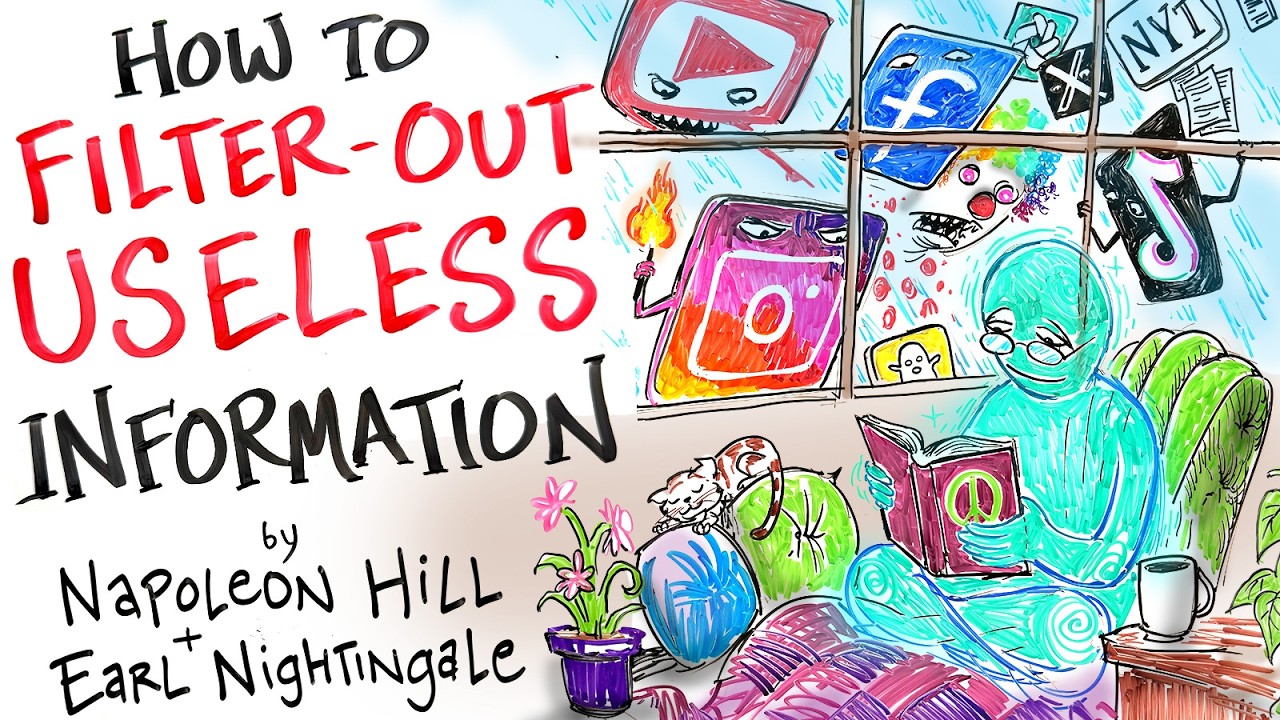
Somewhere on a pinhead, according to researchers cited in this audio, it will soon be possible to store one thousand books of five hundred pages each. The technology has been building toward that point for decades, compressing entire libraries onto surfaces no larger than a comma’s dot. And yet Earl Nightingale’s conclusion, delivered in the measured cadence of a man who has thought this through carefully, is that none of it solves the actual problem.
The problem is not storage. The problem is time, and the choices made within it.
When Thomas Jefferson’s era had a simpler version of this challenge
Back when Thomas Jefferson was alive, a person who had read fifty well-chosen books could reasonably call himself educated. That benchmark held for generations. Then the presses accelerated. According to Nightingale’s narration, more than one thousand books on business alone were published within a two-year window. Harvard’s library, which held 212,000 volumes a century ago, now contains eight million. Yale’s grew from 95,000 to more than five million. Somewhere in that expansion, the idea of ‘keeping up’ shifted from a reasonable ambition to an impossible one.
Nightingale puts a number on the impossibility. Even a disciplined reader who works through three books a week across a fifty-year reading life will finish no more than one twenty-fifth of one percent of the world’s books. The avalanche, as he calls it, keeps growing regardless of how fast anyone reads.
His answer is a single word: selectivity. Not speed-reading courses or better filing systems, though he acknowledges those help at the margins. The core skill, he argues, is judgment: the ability to look at a mountain of available material and decide, without guilt, that most of it does not belong in your life. That takes a kind of ruthlessness, he admits, that most people find genuinely difficult to muster.
Napoleon Hill’s seven habits for thinking without getting fooled
Napoleon Hill enters the conversation with a companion framework. Where Nightingale addresses what to read, Hill addresses how to evaluate what lands in front of you. His seven rules for accurate thinking are delivered as a kind of personal contract, one the listener is invited to memorize and practice daily.
The rules have a consistent spine. Rule one asks that no opinion be accepted as fact until its source has been checked and its accuracy confirmed. Rule two warns that free advice carries exactly the weight of its price. Rule three flags a specific signal to watch for: when someone speaks about others in a slanderous way, Hill says, that is evidence of bias before a single fact has been examined. Rule four covers the trap of leading questions: if you tell someone what answer you are hoping for, most people will try to give it to you, whether or not it is true.
Rules five and six move into territory Hill considers nearly philosophical. If something exists, he argues, it can be proved. Where no proof is available, the safer assumption is that nothing exists. And then, more surprisingly, he describes what he calls a silent, invisible quality that both truth and falsehood carry with them, one that an honest, practiced mind can learn to detect. The final rule is the most portable: simply ask ‘how do you know?’ Hill notes that this question, asked consistently and directly, produces visible discomfort in people who have been speaking with more confidence than evidence.
Hill points to scientists as the model. They investigate with open minds and do not allow what they wish to be true to shape what they report as true. He reserves his sharpest warning for the end: a person’s own emotions are likely to be a bigger obstacle to accurate thinking than any outside source of misinformation. Believing what you wish to believe is easy, he says, and it is also the mechanism by which most people lock themselves into repeated failure.
The person who keeps asking one simple question
Somewhere in a conversation that has already moved on to other things, someone pauses after a confident claim and asks, quietly, ‘how do you know?’ The person across from them stops. The room shifts slightly. No resolution follows.
Back at the pinhead and the micro-library in the living room den, Nightingale’s original point holds: even if every book ever written fit inside a single cabinet by the front door, reading them would still be impossible. The only workable response is to decide what actually matters and read that, carefully, while letting the rest go.
Source: Watch original
This article was reported in November 2026.
OHN Editorial Note: This article is based on publicly available sources. If you spot an error or have updated information, contact us at editorial@onlyhappynews.com. We correct mistakes promptly.
 Wake up to Only Happy News!