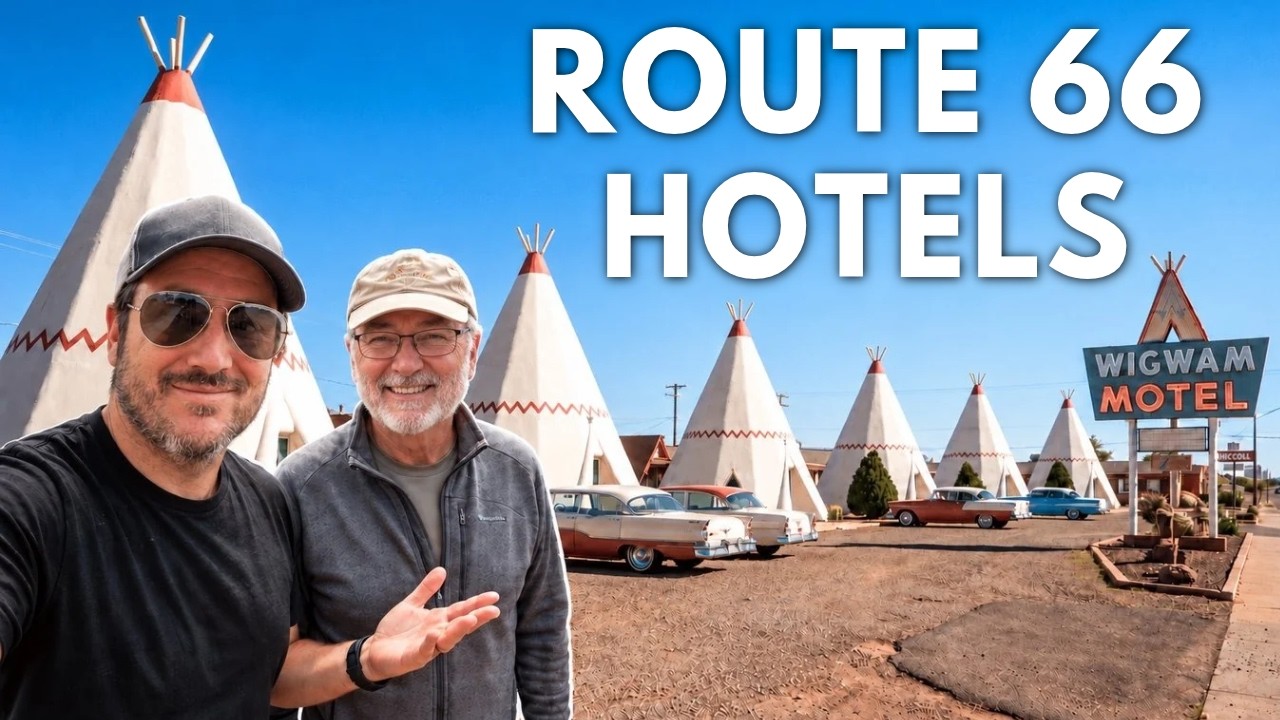
The elevator inside the Drake Hotel in Chicago has a seat in it. Not a bench in the lobby, not a chair near the front desk, but a seat inside the elevator car itself. That small detail set the tone for a road trip that would cover more than 2,000 miles and 13 historic properties, from a New Year’s Eve 1920 grand opening gala to a cluster of concrete teepees in San Bernardino.
The question driving the whole exercise was straightforward: which of these famous Route 66 stays are actually worth booking, and which are trading entirely on nostalgia? The answer turns out to depend heavily on what you value, how many people are traveling with you, and whether you can win at bingo.
Where the road starts and what it costs to begin in style
The Drake, sitting about a mile and a half from the official start of Route 66, opened on New Year’s Eve 1920 with a dinner for over 2,000 guests. Walt Disney and Princess Diana are both on the guest list. The rooms are smaller than the grand lobby suggests, and the pricing reflects downtown Chicago luxury, but for a first night before heading south and west, the architecture and lake views make it a defensible splurge.
The Wagon Wheel in Cuba, Missouri came next and offered something the Drake cannot: the title of oldest continuously operated motel on Route 66. It opened in the mid-1930s as the Wagon Wheel Cabins, built from Ozark fieldstone in a two-door cottage style that looks nearly identical to what Depression-era travelers would have seen. Cuba is a small town with limited dining options, and that matters when planning overnight stops, but the stone cottages and the vintage neon sign at night make it one of the most visually striking stops on the entire route.
In Springfield, Missouri, the Rockwood Motor Court dates to 1929, making it one of the oldest structures on the route that guests can still sleep in. Its 10 stone cottages were rehabbed and reopened in late 2019, each with its own theme. Springfield calls itself the birthplace of Route 66, and that context makes staying here feel like more than just finding a bed. The tradeoff is that only 10 rooms exist, which means it sells out fast around Route 66 events, and the cottages themselves run small.
Boots Court in Carthage, Missouri was built in 1939 at the crossroads of Route 66 and US Route 71. Its original selling point was a radio in every room. Those radios are still there. Televisions are not. Clark Gable stayed in the room that Through My Lens booked, and the carports that gave old Hollywood stars somewhere to park out of sight are still part of the structure. After years of near-demolition, the property has been fully restored to its streamline design. The neon wraps around the building at night and the Hollywood connection is genuine. The absence of a TV is either charming or a dealbreaker depending on the traveler.
When Route 66 passes through cities that still have skylines
Tulsa’s Mayo Hotel opened in 1925 as an 18-story landmark at the peak of the city’s oil boom. Elvis Presley, John F. Kennedy, and Charlie Chaplin all passed through. The hotel closed in the 1980s and sat empty for decades before a major restoration brought it back in 2009 with the original grand lobby and marble staircase intact. A rooftop bar now gives guests a reason to linger past dinner. The cons are consistent with the category: big-city pricing and valet-only parking.
Oklahoma City’s Colcord Hotel spent most of its life as an office tower before converting to a luxury hotel in 2006. It sits close to walkable downtown blocks, has well-appointed rooms, and carries the kind of historic architecture that photographs well. Valet parking added to the cost during the visit, and the nightly rate runs higher than the roadside motor courts further west.
In Amarillo, Texas, the Big Texan Steak Ranch is better known for its 72-ounce steak challenge than its rooms, but it has been a Route 66 landmark since the 1960s. The original location opened on the route itself; the current property sits along Interstate 40 on a 1920s alignment of Route 66. The old west facade and surrounding store feel theatrical in a deliberate way. The assessment from this trip was that the property showed more wear than a previous visit had suggested.
The Blue Swallow Motel in Tucumcari, New Mexico stopped the entire ranking conversation. Its story began in 1939, its turquoise and red neon sign still advertises 100% refrigerated air, and every room has its own garage, a direct holdover from the early motor court era. The motel has 12 rooms. At dusk, when the neon comes on, people stop on the roadside and photograph it continuously until staff turns it off around 11 p.m. Booking two months in advance and landing the last available room is apparently a normal experience here. Tucumcari is a small town, and the motel has limited family room options, but for two travelers who can plan ahead, it landed as the top pick for the entire route.
Albuquerque’s El Vado Motel opened in 1937, the same year Route 66 was realigned along Central Avenue. The city of Albuquerque purchased it in 2005 after years of disrepair, and it reopened in 2018 as a boutique property with a pool, a tap room, and food vendors in the courtyard. The adobe shell is original; the rooms inside feel new. That gap produced a split verdict: one traveler found the lively courtyard with bingo nights appealing, while the other rated it toward the bottom of the list, a position that may or may not have been influenced by losing a bingo game to the only other group present.
El Rancho Hotel in Gallup, New Mexico opened in 1937 and immediately became a base camp for Hollywood studios filming Westerns in the surrounding landscape. John Wayne, Ronald Reagan, and Katharine Hepburn are among the names on the guest list, according to the hotel. Many rooms carry the names of stars who slept there, and the walls hold signed photographs. The lobby, with its wooden staircase, large fireplace, and Navajo rugs, reads like a film set that was never struck. A hidden room upstairs added a discovery moment to the visit. Room sizes here run larger than most other properties on the route, though the bathrooms did not keep pace with the square footage.
Hotel Monte Vista in Flagstaff, Arizona opened on New Year’s Day 1927, one year after Route 66 was designated. It sits a block off the route in downtown Flagstaff, within walking distance of restaurants and coffee shops. During Prohibition it reportedly operated a speakeasy. It also carries a reputation as a haunted hotel. The train runs close enough to the building to be audible at night, and the rooms were among the most dated on the entire trip.
El Trovatore in Kingman, Arizona started as a service station in 1937 before becoming a motor court in 1939. It was nearly demolished before a restoration effort saved it and returned the neon sign to working order. The rooms are basic and could use updates, but the owner’s willingness to share Kingman’s history and Route 66 history with passing guests added something the room rate alone would not have delivered.
The final stop was the Wigwam Motel in San Bernardino, California. It opened in 1949 as Wigwam Village number seven, the last of seven teepee-shaped motel villages built across the country. Nineteen concrete teepees arranged around a pool each function as a complete motel room. A restoration in the 2000s brought the property back after its reputation faded in the 1970s. The rooms are small by design, and the surrounding neighborhood in San Bernardino is not the most welcoming stretch of the route, but as a piece of roadside architecture that doubles as a place to sleep, it has no real competition.
The final tally from two people who actually stayed in all of them
When the rankings landed, Blue Swallow took the top spot from one traveler and second place from the other. Boots Court and the Wagon Wheel appeared on both top-three lists. El Rancho in Gallup claimed the number one position for Pops, the traveling companion on the trip, based primarily on the lobby and the Hollywood connection to the American West. El Vado appeared near the bottom of his list. He declined to confirm whether that was because of the bingo loss. His face, by his traveling companion’s account, suggested otherwise.
A neon sign turning off at 11 p.m. in Tucumcari
At the Blue Swallow Motel, the photographers on the roadside kept arriving in the hour before closing. Some drove past, turned around, and came back. The 12-room motel was full. The turquoise sign reflected off hoods and windshields in the parking lot. At 11 p.m. it went dark.
That elevator seat in the Drake Hotel lobby in Chicago was the first surprise of the trip, an odd, specific detail that did not appear in any brochure. By the time the Wigwam Motel’s concrete teepees appeared on the edge of San Bernardino nearly 2,000 miles later, the route had produced enough of those details to fill a much longer list than 13 entries. The useful conclusion is practical: the Blue Swallow books out fast, the Rockwood sells all 10 rooms before big events, and the Boots Court radio still works.
Source: Watch original
This article was reported in November 2026.
OHN Editorial Note: This article is based on publicly available sources. If you spot an error or have updated information, contact us at editorial@onlyhappynews.com. We correct mistakes promptly.
 Wake up to Only Happy News!