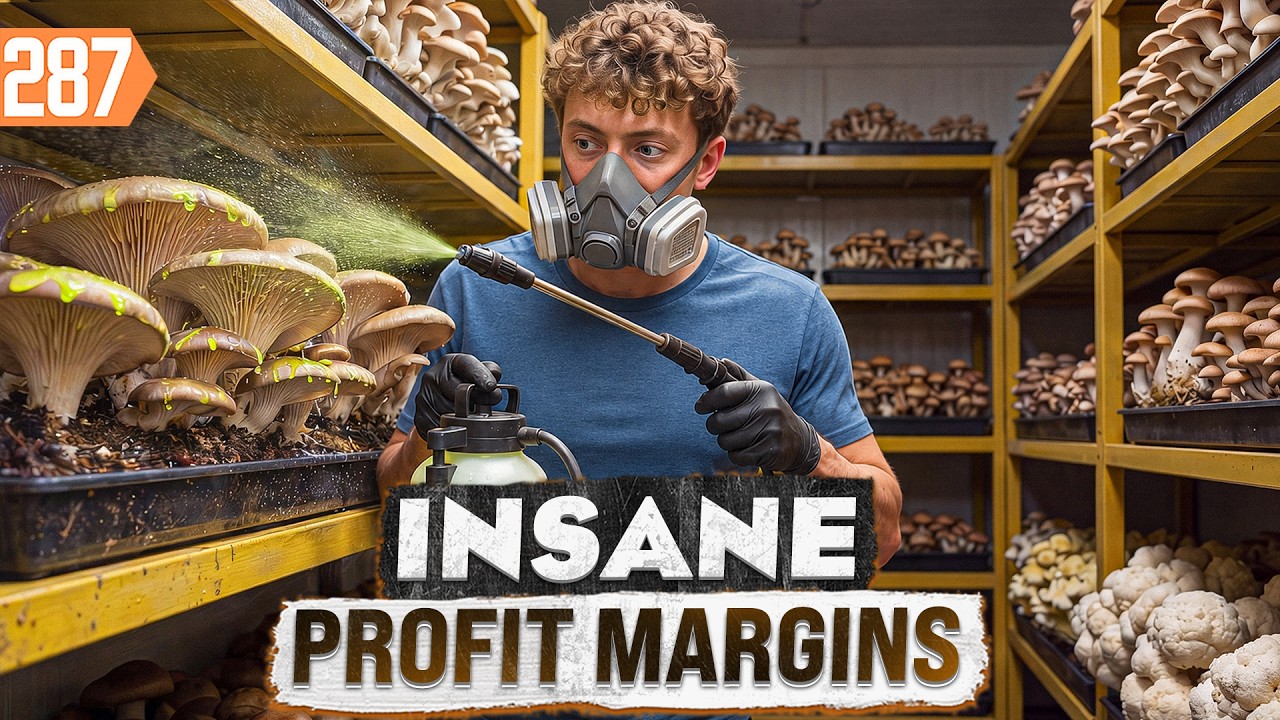
Hunter was 17 years old, still in high school in Northeast Pennsylvania, when his mom came home with a grow kit. He and his brothers watched blue oyster mushrooms push out of a block right there in the bedroom, and something clicked. He bought another kit, then another, and by the time he considered college, he had a different plan entirely. Six years later, Mount View Mushrooms supplies restaurants across the region, runs five farmers markets a week, and at peak season clears up to $10,000 in a single month. For anyone who has ever dismissed a hobbyist obsession as too small to be serious, Hunter’s numbers have a rebuttal ready.
Three items from a hardware store and a straw bale
The first stop on the day was a True Value store, not some specialty agricultural supplier. Hunter pulled three items: a pot priced at $37.99, a bucket for five dollars, and a bag of wood shavings for $6.99. Add a mushroom starter kit, available at most grocery stores for around $20, and a beginner has everything needed to run a first batch. The straw goes into boiling water for 20 to 30 minutes, then soaks for 10 hours to absorb moisture and continue killing off competing bacteria. The cooled straw gets layered into the bucket with crumbled mycelium spawn worked in between each tier, the lid goes on with a few small holes punched around the sides, and the waiting begins. Within four days, microscopic white webs thread through the substrate in every direction. By day ten, oyster mushrooms push out through every hole.
Hunter runs a custom-built pasteurizer at his parents’ place and a fog-filled grow room on a neighboring farm, where the owner trades space for help with the animals. That arrangement saves what Hunter estimates as ‘probably tens of thousands of dollars, maybe every year,’ since a properly insulated grow room with an AC unit could easily run over $1,000 to build from scratch. The grow room itself, which he built out himself with rigid board, racking, an AC unit, wheels, and lighting, cost $6,000 to $7,000 total. Beginners, he is quick to stress, need none of that infrastructure. A grow tent is the next meaningful step after the bucket stage, and a $1,000 budget gets there comfortably.
Oyster mushrooms at $40 a pound and a first check framed on the wall
The oyster mushroom is Hunter’s first recommendation for anyone entering the market: fast to fruit at seven to ten days from inoculation, resilient against beginner mistakes, and priced at $20 per half-pound at retail, which works out to $40 a pound. Lion’s mane, the other variety he harvests, matches that retail price. Wholesale to restaurants drops to $10 a pound, but Hunter notes that even wholesale margins sit around 95% once equipment costs are absorbed. A single grow block that costs roughly one dollar produces a first flush worth $60 at retail or $30 to $35 at wholesale, then fruits again for a second flush on the same block.
Hunter put it plainly when describing the economics: ‘You pretty much just take trash, turn it into treasure.’
His first sale was $33 for a small box of mushrooms dropped off at a brewery whose owner was the wife of one of his high school teachers. That check is now framed on the wall at the house. The 2025 season ran three peak months and generated $36,657 in total revenue, with $17,474 in expenses across supplies, fees, media, grow materials, gas, equipment, and a $46 food budget for Hunter himself. Net profit landed at 48%, and Hunter believes it could reach 50 to 60% after accounting for equipment purchases he made ahead of schedule for tax purposes. Seventy-five percent of that revenue came from farmers markets, with restaurants making up the remaining 25%. A single market in Scranton runs three days a week and costs $1,200 for the full year, a fee Hunter says he recovers in two days of sales. On the busiest days approaching Labor Day, he has done $1,500 in a single day at market.
Marketing spend: zero. Every client came through word of mouth, farmers market relationships, and showing up at restaurant kitchens more than once, at a time when the chef is not already deep in prep.
The $2,000 contamination wipeout that changed his process
About two years into running the business, Hunter walked into his grow room to find mold spreading across his blocks. A full crop wiped out, an estimated $2,000 in lost product, and a roster of chefs who had already put his mushrooms on their menus and needed a delivery. The reputation hit was as real as the financial one. His fix was to stop producing his own spawn in-house and outsource that single step to a professional lab, a decision that, as he noted, saved money and produced healthier mushrooms. The lab-made blocks are the one thing he does not make himself.
The framed first check
A small box of oyster mushrooms. A check for $33 from a brewery in Northeast Pennsylvania. Hunter still has it on the wall.
At the restaurant delivery that closed out the day, sous chef Kendrick received the freshly harvested lion’s mane and oyster mushrooms and braised them with white wine and soy sauce to accompany a steak. Hunter has been supplying that same restaurant for roughly five years, delivering ten to fifteen pounds per week at $150 to $250 per order depending on the species. Sitting at the table after the dish arrived, he said he still gets the same feeling he had growing that very first batch at 17: someone validating that a bedroom grow kit could actually become a business.