Mike had spent 20 years working in an office before he climbed onto his first roof in Pittsburgh last April. No construction background, no roofing credentials, just a trailer full of acrylic resin, asphalt shingle granules, and a custom-built pump that took a decade and more than $100,000 in destroyed equipment to perfect. Within a few months, he and his business partner Eddie had crossed $150,000 in gross revenue resurfacing roofs using a product called Liquid Roof, a franchise concept so new that most homeowners stop in their tracks when they see the trailer. The neighbor at one recent job site walked out to the curb that morning and told them flatly: ‘This is something new. I’ve never seen something like this before.’ She was right, and that novelty is both the business’s biggest obstacle and its most powerful sales tool.
Granules from the gutter, sprayed back onto the roof
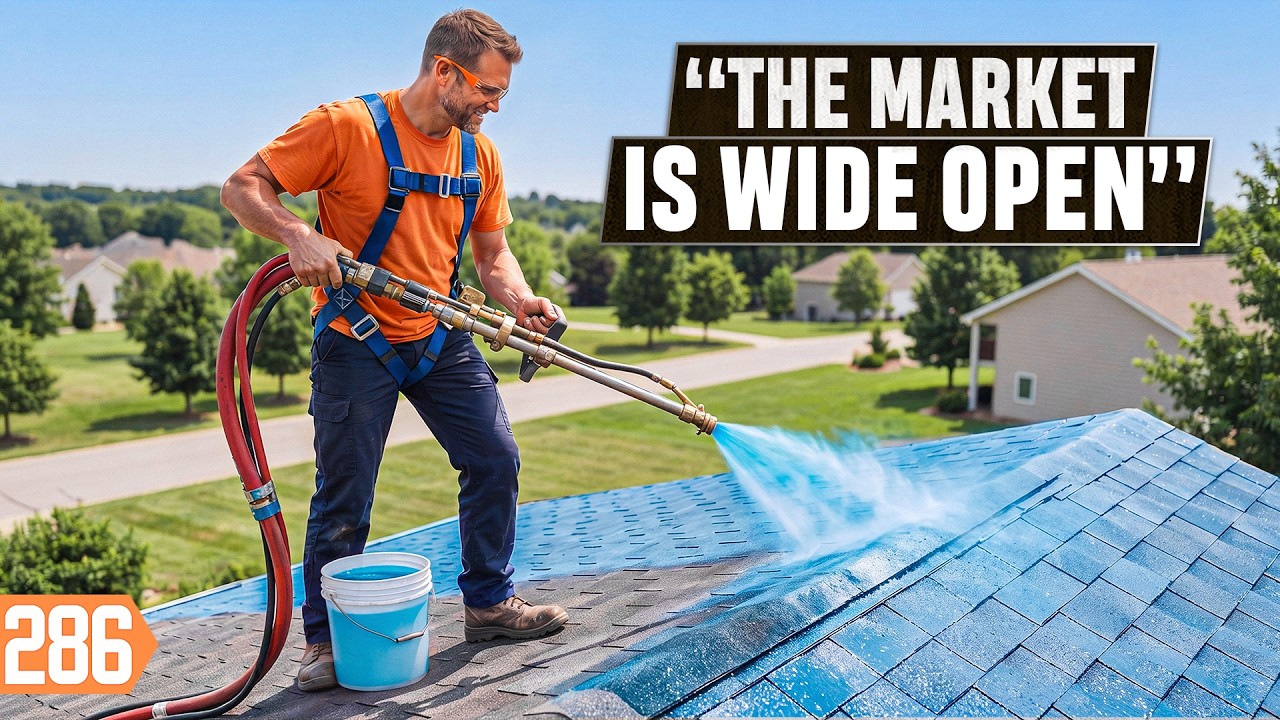
The core idea behind Liquid Roof is straightforward even if the execution took years to solve. Asphalt shingles lose their granules over time, the small aggregate particles that give a roof its color, its impact resistance, and its protection against UV degradation. Those granules are the ones that pile up in gutters. Liquid Roof mixes fresh asphalt shingle granules into a patented acrylic resin, then sprays the mixture back onto the existing roof surface using a custom-manufactured pump. At a shingle factory, granules are simply dropped onto tar and only the bottom layer bonds to the shingle. With this process, each granule is fully encapsulated in resin before application, meaning they lock in rather than gradually washing off. The result, according to third-party ASM, UL, and FM impact tests the company has commissioned, is a surface that exceeds the strength of the original shingle.
Carmelo, the founder who also launched a separate painting franchise with over 100 locations across North America, traced the origin of Liquid Roof to a lost sale. A customer wanted a full exterior renovation but balked because the roof would still look green and mismatched. Carmelo promised he could fix it, walked away with no idea how, and spent the next decade figuring it out. The pump problem alone consumed over $100,000 in prototypes before a custom solution emerged. The product was first commercially applied in 2017. A house treated on the east coast of Canada survived Hurricane Fiona intact, with 100 mph winds that damaged nearly every surrounding structure, a result that shifted the team’s thinking from color restoration toward something with much broader protective value.
A $6,000 job, five hours, 60% gross margins
The job Mike and Eddie tackled on the day of the visit was a 2,600-square-foot walkable residential roof outside Pittsburgh, an approximately one-hour drive from their storage space. The crew of four completed it in five hours. The sale price was around $6,000, which Mike described as a typical residential ticket. Their average across the season including one large commercial job ran about $8,500, and their average gross profit margin held at roughly 60%, with several jobs clearing 70%. A church they resurfaced came in at a price the client described as a fraction of the $100,000-plus quotes they had received for a full replacement. A high school roof they quoted recently ran around $250,000 against a competing replacement bid of $1.5 million.
Product cost runs about 30 to 33% of the job total. The franchise investment to get in is approximately $250,000 all in, covering equipment, initial marketing, and working capital. Because Pittsburgh winters prevent outdoor application, Mike and Eddie bought their franchise in August, completed training, and did not spray their first roof until April. Their revenue target for their first full 12 months is $500,000. Marketing spend runs about $4,000 a month, and between 80 and 90% of their residential customers have arrived through Facebook.
Mike put the education challenge plainly: ‘No one else in the entire country is putting granules back on a roof like we are.’
The yard sign left at the curb
Before leaving each job site, the crew places yard signs in the lawn with a QR code facing the street. The signs stay, with the homeowner’s permission, for neighbors to scan.
The finished roof on that Pittsburgh house held its tab lines clearly visible, each shingle edge distinct, the granule texture rough and solid underfoot. It did not look painted. It looked new.