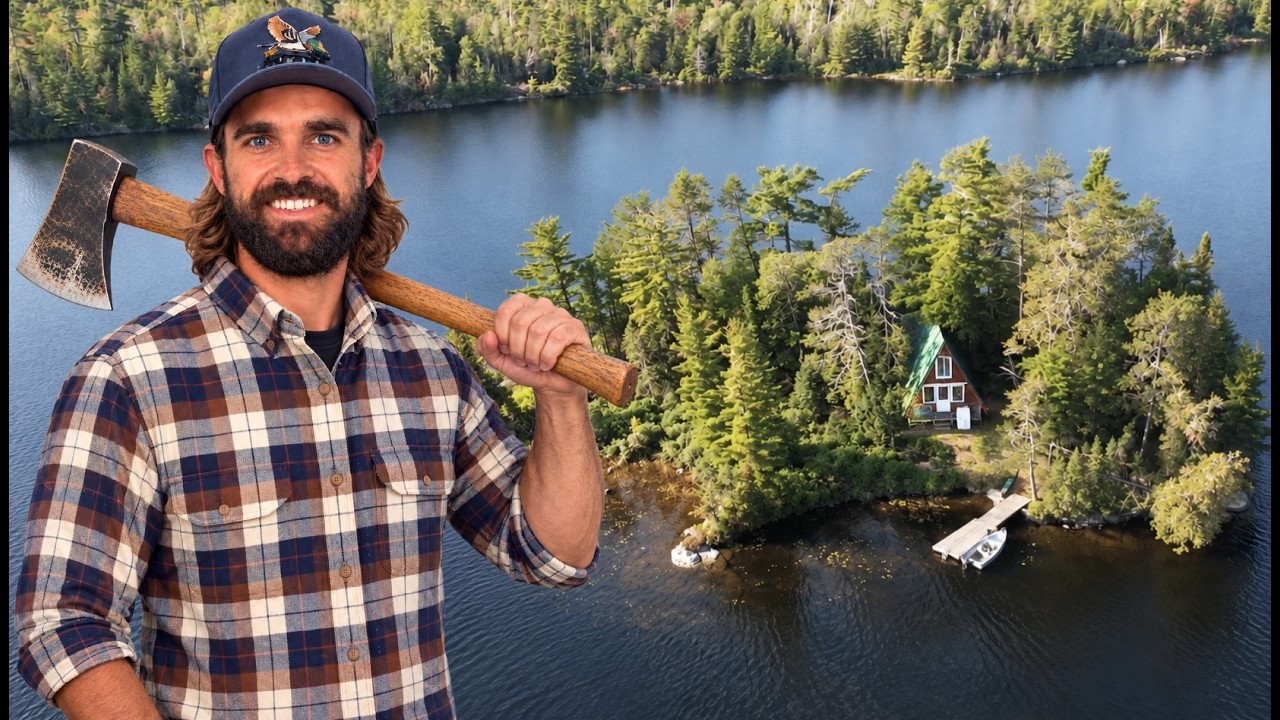
At 2 degrees Celsius, with frost on his face and a sleeping bag pulled tight around him, Adam Stew lay in his tiny island cabin watching the sunrise glow through the window and simply could not make himself get up. That moment of cozy paralysis is something almost anyone who has ever faced a cold morning understands, but on a remote island accessible only by boat, the consequences of dawdling are a little steeper. Winter was coming, the firewood pile was questionable, the Starlink sat loose on the ground, and the wood stove had not been installed yet. The weekend’s work had already been scheduled before the frost arrived.
Adam and his father made the crossing to the island using a strategy they had recently perfected: switching from the main motor to an electric trolling motor with plastic props to navigate a notoriously rocky bay. Chester, the dog, rode along as unofficial spotter. Standing at the bow, his father called down warnings about the boulders below. ‘That’s a prop masher,’ he said, eyeing one particular rock. ‘That’s a trip ender.’ The trolling motor approach, as Adam put it, ‘just takes all the risk out of the equation.’ A side bet ran alongside the crossing: whether the solar panels, left on the rocks from a previous trip, had blown into the lake. The loser had to empty the poo bucket. The panels were in the water. Adam’s father lost.
The wood stove decision nobody expected
The Yodel 602 CB, a compact cast iron unit built around secondary combustion that reburns gases typically lost up the chimney, arrived on the island looking smaller than expected. The plan had been to evaluate two possible installation spots, one in a back corner and one more central in the cabin, before committing to either. After careful measuring, clearance checks, and a frank conversation about heat distribution, the back corner option was ruled out almost immediately. Adam’s father was blunt: ‘I don’t even know why we measured this up. I just don’t see any value in it.’ The central spot, despite requiring a 16-foot ladder to clear the ceiling and a route through the metal roof, was the obvious choice. They noted the old stove patch on the wall where a previous owner had run the stack, almost certainly without the insulated pipe or proper clearances. No installation happened this trip. That decision gets made with the expert back in town.
Starlink in a barrel and walleye at sunset
The Starlink solution turned out to be satisfyingly low-tech. A barrel was cut, partially buried in a hole dug into the boggy ground near the shore, then packed with a recycled mix of sand, earth, and rocks salvaged from a previously dug fire pit. A 4×4 post was mounted inside and the Starlink fixed to the top. ‘I still don’t think it’s perfect,’ Adam admitted. ‘Every hour we lose service for 30 seconds.’ He paused. ‘I’m sure we can manage.’
By 5:30, walleye clock was on. Adam and Tessa drifted a drop shot rig with a live minnow through a channel between islands, keeping the bait six to eight inches off the bottom. A solid smallmouth bass came up first, estimated at three pounds, released immediately. Then a walleye hit at the edge of dark. Their lake carries a slot size rule: fish between 46 and 60 centimetres must go back. This one measured 39 and three-quarters centimetres. Keeper. Adam’s father netted the cheeks along with the fillets. After 20 minutes in the camp oven with no flipping required, the verdict was immediate. ‘These are like a nine out of ten, Dud,’ Adam said, and his father, fork already moving, did not argue.
The poo bucket, honoured in full
At the end of the trip, Adam’s father pulled on a pair of vinyl medical examination gloves and made good on the double-or-nothing bet. He suspected he had been hoodwinked somewhere in the wager. He had not. The bet stood, the gloves went on, and the bucket got emptied, right on schedule.
The trolling motor ride out of the bay was calmer than the ride in, no wind, no prop strikes, Chester presumably dry. The weekend closed at a self-assessed 10 out of 10, with a Starlink that holds signal for all but 30 seconds an hour, a firewood pile tarped and stacked, and a cast iron stove still waiting for its 16-foot ladder and the right expert to sign off on the pipe.