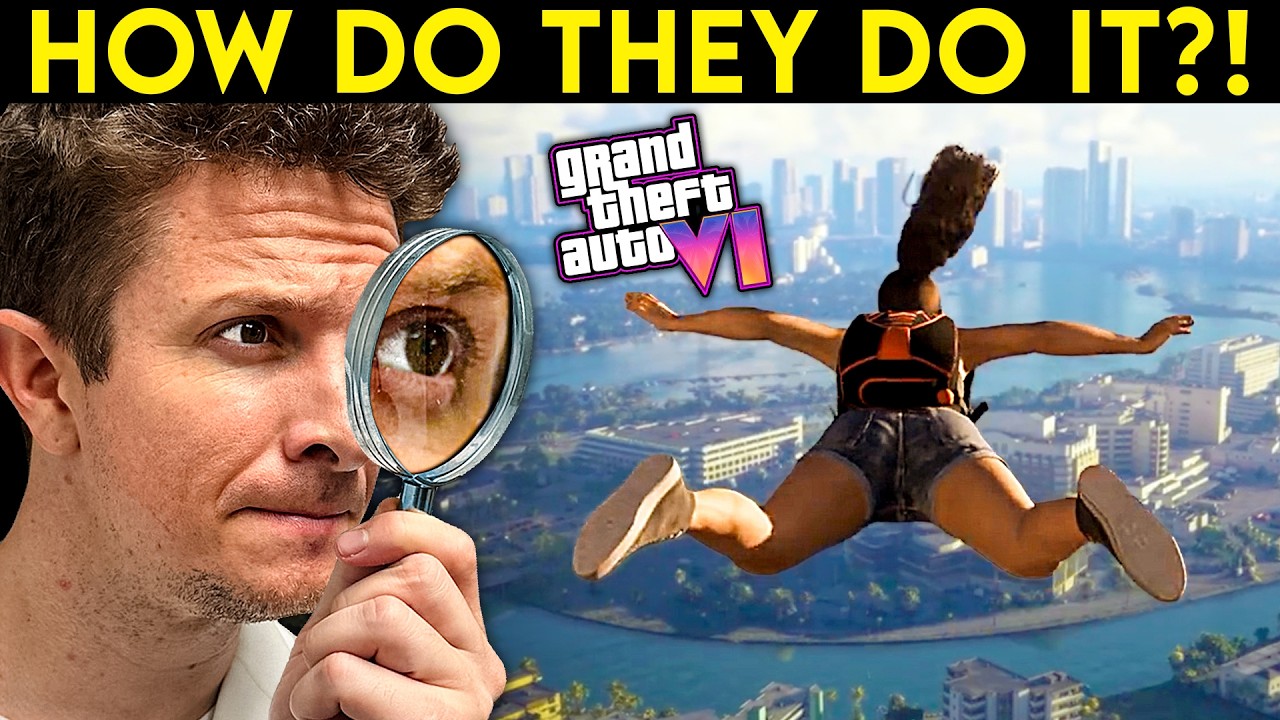
Coridor Crew’s panel of VFX professionals sat down to go through the GTA 6 extended trailer frame by frame, and within seconds one of them spotted something that should not exist on a PlayStation 5: arm hair on a walking character, catching light, moving with the body. That detail set the tone for an hour of professionals in a field that builds these things for a living being genuinely, audibly stunned. The question driving everything was not whether the graphics looked good. The question was how any of it is physically possible in real time.
The ragdoll system Rockstar is hoarding like treasure
Most video game characters collapse in one of two ways when they get hit. They play a canned motion-capture animation that cannot react to the actual ground beneath them, or they go fully limp in a physics simulation with no muscle memory at all. Rockstar’s approach, built on a proprietary system called Euphoria, does something closer to what a nervous system actually does.
When a character takes a shot to the leg in the trailer, the system does not simply trigger a fall animation. It reads the body’s center of mass, the velocity and direction of the impact, the position of every other limb, and then activates the muscles on the uninjured leg to attempt to compensate. If balance cannot be recovered, it enters what the panel described as a self-preservation mode, scanning for nearby objects and lifting arms to brace for impact, all while a physics solver is running simultaneously underneath it.
The panel pointed out that a version of this software, called Endorphin, was once available to film visual effects studios and was central to some of Corridor Crew’s own early work. Rockstar now holds the patent on the real-time version, and it is not available to anyone else. One panelist put it plainly: ‘Please, please give us Euphoria. Come on. What’s one more leak?’
Why a mojito glass is a bigger technical achievement than the explosions
A shot of a cocktail sitting on a bar table became one of the longer stops in the breakdown. The glass is refracting the scene behind it, bending the image through four distinct intersection points as light enters the cup, crosses the hollow center, exits the far wall, and bends again. That process requires the graphics processor to trace a separate ray for each path, and the panel noted it is the same fundamental technique used in film-quality computer graphics rendering, except here it is happening 30 times every second on consumer hardware.
The flower vase sitting nearby on the same table gets no such treatment. The panel flagged that immediately. The system is quietly making priority decisions in real time, allocating ray-tracing budget to whatever the eye is most likely to examine closely and quietly dialing back on everything else. That hidden optimization logic, the part the player never consciously sees, is where much of the engineering lives.
The hair on a background character who is simply standing near the edge of a club scene required its own extended discussion. Rockstar has not disclosed how they are rendering it, but analysis by others in the field suggests it is entirely strand-based hair across the whole game, with no fallback system for distant characters. A faint grain visible in the hair under close inspection suggests it is being rendered at a lower resolution and upsampled using temporal anti-aliasing, a noise-reduction technique that borrows information from the previous frame to build a cleaner predicted image rather than rendering everything fresh each time.
The global illumination driving the scene lighting works on a similar principle. The world is divided into a grid of what the panel called light probes, each one a tiny 360-degree scan of its immediate surroundings. As characters move through the environment, the lighting transitions between these scans rather than calculating true bounced light from scratch. Each probe updates every frame, stacking additional light bounces with each pass until the accumulated result approximates what a film renderer would produce over minutes of processing time.
The whole image being output is not actually 4K. The panel estimated it renders closer to 1,400 lines of resolution, then scales up to fill a 4K display, at 30 frames per second rather than 60. Every corner that could be cut has been cut. The result still looks like this.
The mojito that started it all
On the bar table in that club scene: a glass with mint leaves pressed against the inside, casting a shadow through translucent green, the scene behind it bent and stretched through four walls of refracting glass, sitting next to a plain cup that gets none of it.
Rockstar built a decade of proprietary systems into a game running on hardware that sits under a television, and somewhere in there someone made sure the cocktail refracts correctly. The cup next to it does not.