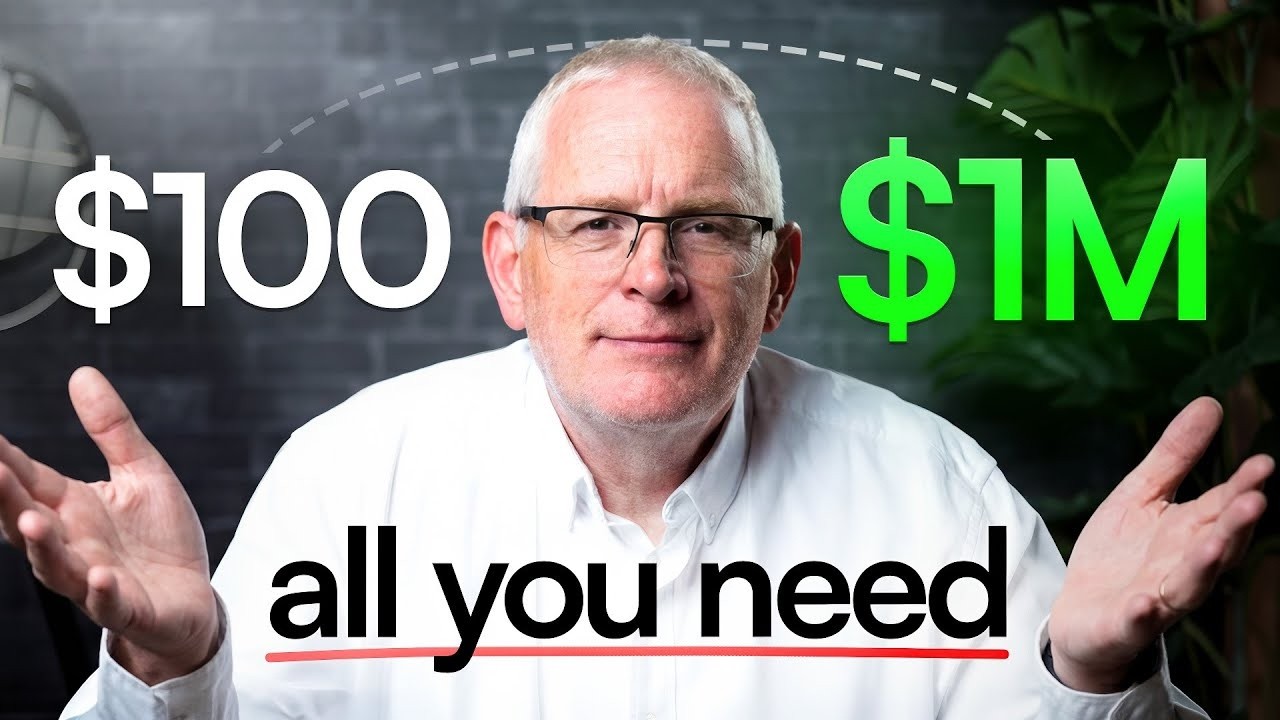
Billy started investing $200 a month at age 20, stopped completely at 30, and never added another cent. Jack started at 30, put in $300 a month, and kept going until 60. Jack invested $84,000 more in total and kept going for decades longer. Billy still won, finishing with around $813,000 against Jack’s roughly $678,000. That single comparison sits at the center of everything Mark Tilbury wants beginners to understand: in investing, time is the only resource that cannot be replaced. Tilbury has been at this for four decades, through the dot-com collapse, the 2008 crisis, and the pandemic, and what follows is the framework he wishes someone had handed him at the start.
Why leaving money in the bank is the quiet disaster nobody talks about
The argument for doing nothing feels airtight. The number on the screen never changes, so nothing bad is happening. But Tilbury is direct about the flaw in that logic: a single dollar from 1985 carries roughly the same purchasing power as $2.80 today. Stuff that used to be cheap just costs more now, not because the products got better, and he admits they probably got worse, but because the money got weaker. Inflation is, in his words, a silent thief that never takes a day off.
The practical math is just as stark. A million dollars in a standard bank account earns close to nothing in a year. Move it into a high-yield savings account at around three percent and it produces $30,000. Put it into the stock market at a historical average of around ten percent, and the same amount produces roughly $100,000, though Tilbury is careful to flag that no return is guaranteed.
For people who are not starting with a million dollars, the mechanism that matters most is compound interest. The Billy-and-Jack scenario above is not a trick. It is just what happens when money is given enough time to compound. Tilbury admits the early years feel like nothing is happening. He remembers checking his own account in the early days and thinking the same thing, and says that moment of doubt is precisely when most people cash out, right before the snowball tips over the ridge and starts rolling on its own.
Building the actual portfolio, step by step
Before any money goes into the market, Tilbury insists on a structural foundation he calls the 25-15-50-10 rule. Every paycheck gets split four ways: 25 percent to growth (investing), 15 percent to stability (an emergency fund sitting in a high-yield savings account, insured and out of the market entirely), 50 percent to genuine essentials, and 10 percent to spend completely guilt-free. He is frank that he learned the emergency-fund lesson the hard way, through a loan on a fancy VW Golf whose engine blew up, leaving him needing a second loan just to keep getting to work.
For the investing slice itself, his starting recommendation is index funds and ETFs, specifically the three-fund portfolio first popularized by the Bogleheads: a domestic fund to capture your home economy, an international fund for broader diversification, and a bond fund for stability. On the platform he walks through, the international options he points to include a fund with the ticker SWDA, covering over 1,500 stocks across 23 countries, and an emerging-markets fund with the ticker EIMI, giving exposure to companies from China, Taiwan, India, and South Korea, including names like Tencent, TSMC, and Samsung.
For individual stocks, Tilbury is honest about the stakes. A $1,000 investment in Nvidia a decade ago would now be worth roughly $140,000, a 14,000 percent return. That same $1,000 in Nike would now be worth around $700, a 30 percent loss. His rule is that individual stocks can be a small, optional, higher-risk portion of a portfolio, never the whole strategy.
He also walks through REITs (Real Estate Investment Trusts) as a way to own property exposure without a mortgage or a landlord’s headaches, bonds as the stabilizing layer that often moves opposite to stocks, dividends through companies like Coca-Cola which has raised its dividend for over 60 consecutive years and currently shows a 2.36 percent yield on its financials tab, and crypto, which he holds in a very small allocation while being blunt that an asset capable of rising 500 percent is equally capable of wiping out a position entirely.
On account type, he flags a detail most beginners overlook entirely. Two investors can hold identical positions and earn identical returns, yet end up with dramatically different after-tax results depending on the wrapper they used. His example: Peter Thiel used a Roth IRA to hold very early shares in companies including PayPal, Palantir, and Facebook, and those positions grew to around $5 billion, all shielded from tax inside that account. For 2026, the Roth IRA contribution limit sits at $7,500, or $8,600 for those over 50. UK investors can shelter up to £20,000 a year inside a stocks and shares ISA with no capital gains tax on growth and no penalty for withdrawing whenever they like.
The automation piece is where the strategy becomes self-sustaining. Setting up a recurring monthly investment through dollar-cost averaging means buying happens regardless of whether the price is high or low that particular month, which removes the pressure of trying to time a market that nobody on earth can reliably time anyway.
The five mistakes that turn slow wealth into no wealth
Tilbury ends with the errors he has watched beginners repeat across four decades. Panic-selling at the bottom locks in a loss that might have recovered in two days. FOMO-buying at the top means entering right before a crash. Holding a genuinely dying company out of stubbornness, what he calls ‘loyalty to an investment that fundamentally is broken,’ costs more than the pride it protects. Chasing the next Nvidia causes the mind to see patterns that are not there. And quietly accepting a one or two percent annual fee, which feels harmless, can swallow an enormous slice of long-term wealth across 30 or 40 years of compounding.
His 30-day challenge is deliberately simple: build the emergency fund, open the tax-advantaged account, set up the auto-invest on payday, and then, as he puts it, leave it alone and go live your life.
The number that keeps not feeling like enough
There is a moment Tilbury describes that most long-term investors recognize: glancing at the account in the early years and genuinely wondering whether any of it is working.
The snowball is sitting at the top of the hill. It just has not tipped yet.