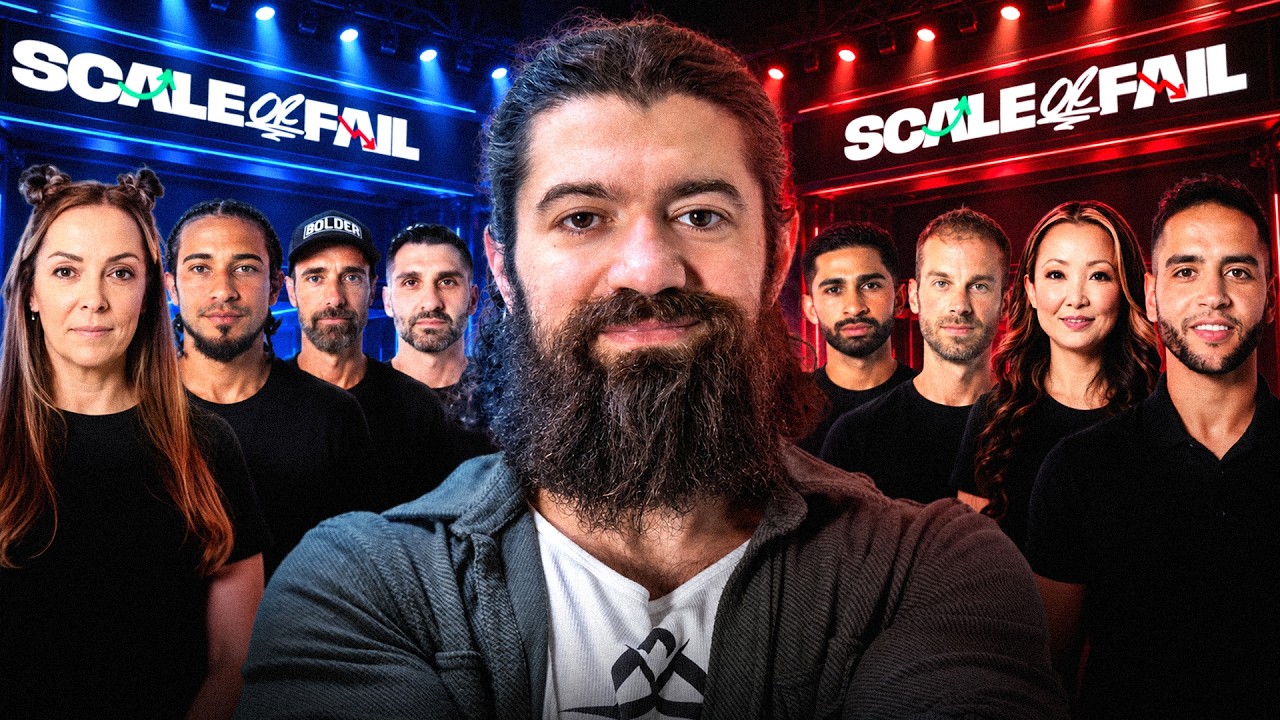
Joey Goon was standing in front of Alex Hormozi, Leila Hormozi, and Shanza, the CEO of their $250 million per year portfolio, making the case for his event planning company, Utopia Experience, when he dropped a number that stopped the room: a $15,000 sponsorship investment had returned $670,000 in closed business within weeks. What was at stake was $100,000 in cash and a golden ticket for a full year of hands-on guidance from Hormozi and his team, a prize the competitors repeatedly called priceless. Eight entrepreneurs had shown up 90 days earlier, each handed a customized growth road map. Only two made it to the final pitch round. Joey was one of them.
From 1.3 million to 4.1 million in 90 days
The competition opened with a qualification round built entirely on one metric: revenue growth. Each entrepreneur had 90 days to implement the specific levers Hormozi had identified for their business, and the four who grew the least were cut. The numbers that came back were striking across the board. Tina Sue, who coaches parents of children with autism and ADHD, took her 12-month run rate from $918,000 to $1.84 million after running 13 weekly webinars and selling 232 enrollment spots compared to 75 before. Caleb, who had launched his roofing company just six weeks before the original meeting, climbed from $370,000 to $2 million after deploying a menu-close sales script he described as hitting so hard it made customers ‘happy to give me their money.’ Hussi Nazir’s holistic dental practice jumped from $1.73 million to just over $4 million after hiring two specialist dental associates to take work off his father’s calendar and immediately raising prices, a move validated the next morning when a $70,000 case was paid in full at their Newport Beach location.
Joey’s path was the most aggressive. Hormozi had told him his pricing was made up on the spot, his margins were too thin, and his sales team was converting far worse than he was. The fix: build a real pricing formula, shift the sales team to appointment-setting while Joey handled closing, and go after B2B sponsored events instead of chasing individual accounts one at a time. Joey booked a sponsorship two weeks after leaving the first meeting. That single $15,000 investment produced $670,000 in closed business. By the final round, Utopia Experience was on track for $4.1 million in 2025, up from $1.3 million, with an additional $2 million still in the pipeline. His team closed $300,000 the morning of the finale, mid-competition, while Joey was in Las Vegas.
The pitch that decided it all
The final round was a head-to-head sales pitch. Tina went first, drawing on 16 years of entrepreneurship, a prior business that generated $20 million in affiliate commissions, and a genuine emotional case for the families she serves. Joey followed with four explicit buckets: quantitative proof, adherence to the road map, heart rooted in his late mother who originally built the company, and legacy he wants to pass to his daughter Sage. He left a six-figure career after his mother died, turned down an acquisition offer when the business was doing around $100,000 to $150,000 in revenue, and pivoted the entire company to a virtual production studio overnight when live events shut down. ‘If you stuck with the business when you weren’t legally allowed to do the business,’ Hormozi said during deliberations, ‘that’s a pretty good limit test of how committed you are.’
The vote split. Shanza backed Tina for the scalability of an online coaching model. Leila voted for Joey, citing his steady execution and the recurring nature of his contracts, noting that four million dollars was already booked for the following year. Hormozi cast the deciding vote for Joey, praising his LTV-to-CAC ratio as among the strongest in the room, though he noted that neither finalist had addressed what an investor actually wants in their pitch, calling it the biggest miss of the night.
The moment before the verdict
Joey Goon, standing on a competition stage in Las Vegas, mentioned almost in passing that he had nearly not applied.
Hormozi handed Joey the $100,000 and the golden ticket. The average revenue increase across all eight contestants was 2.4 times in 90 days, with the group collectively adding over one million dollars in revenue and more than $500,000 in profit in that window. Joey, who had almost not entered, walked out as the winner.