At 4:41 in the morning, pitch black and cold, a line of cars and vans stretched along the gate road outside Stonehenge. The air was crisp in the way that signals a season has genuinely turned, and a small crowd of people who had driven through the dark, or in one case simply walked down from a tent on the hill, pressed forward toward the stones for the autumn equinox gathering. What draws someone out of bed before dawn to stand in a field in Wiltshire and chant is not easy to explain in rational terms, but for the hundreds who gathered here, the reason was felt rather than argued. Some came as practicing druids. Some came as curious first-timers. One man came because he had sold his house, given away his car, and now lives in a tent a short walk away.
The man who gave everything away to live near the stones
His name is Stuart, and he will turn 50 next month. His son finished university last year, and somewhere in that transition, the rat race lost its hold. He tossed his phone out the window, gave away his car, gave away his possessions, and moved to Wiltshire with everything he now owns fitting inside a single tent. He walks barefoot most days, he said, to feel the energy in the ground. On this particular morning he had trainers on, but only just. ‘I’m the richest man in the world,’ he said, and he said it without irony, his eyes carrying the kind of brightness that makes a stranger want to believe him.
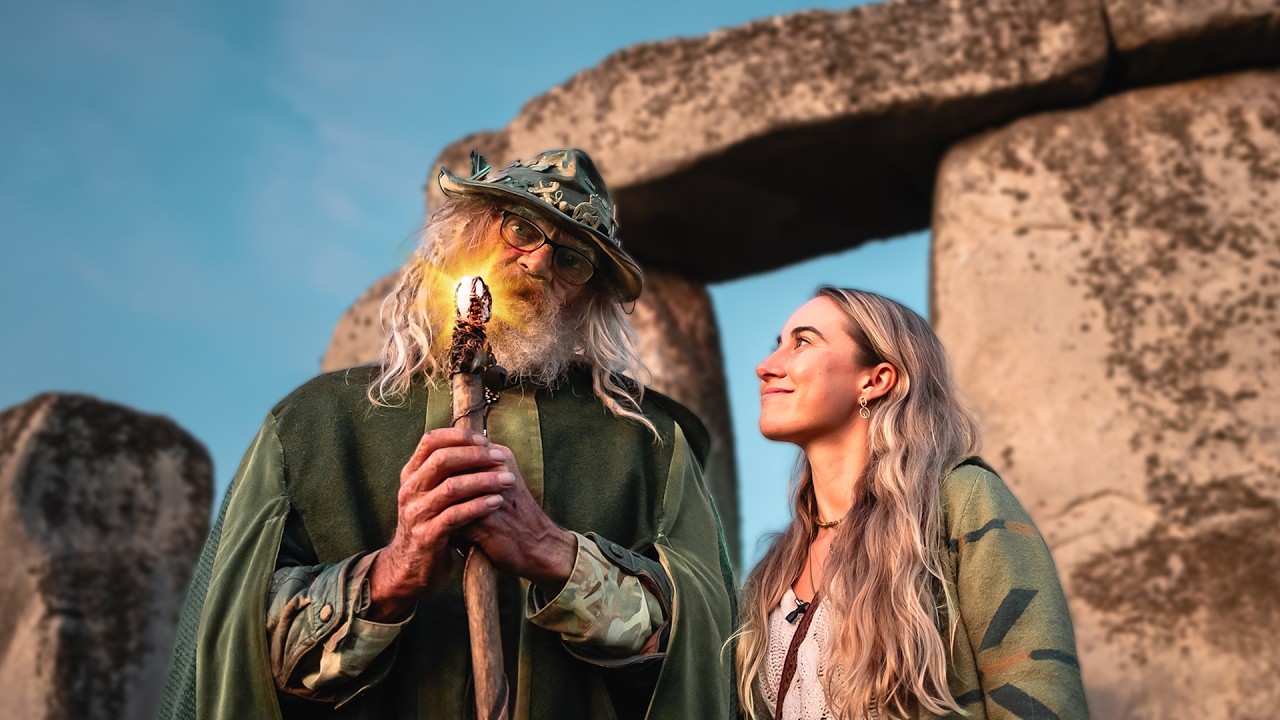
There is a second Stuart at this gathering, and he occupies a very different role. Stuart Hannington, known as the Wizard of Tottenham, is a druid at Stonehenge who took his oath to the earth inside the stone circle itself. He describes his function plainly: what a vicar or a priest does, he does, but for the earth rather than for any institution. He has no order, no hierarchy. ‘I serve the mother,’ he said. ‘I serve no people.’ He has been coming to Stonehenge since the early 1970s and began conducting ceremonies formally in 2006.
How the druids won the legal right to be here
The access the crowd enjoys this morning did not come easily. Hannington explained that druidry, which has been practiced for around 6,000 years, secured its right to hold ceremony at Stonehenge through the European Court of Human Rights. Because of that ruling, English Heritage, the organization that oversees the site, is obliged to open the stones for the equinoxes and solstices, and the druids in turn allow the public in as celebrants alongside them. Hannington described the sarsen stones themselves as ‘giant crystals, full of energy,’ and noted that the government attempted to shut down the Stonehenge Festival in 1986, specifically because a twelfth consecutive year would have granted the event protected status that could not later be revoked.
The ceremony itself opened with a call for peace throughout the whole world, repeated back in full voice by the crowd. The circle invoked the sun, the earth, ancient names, deep roots, tall stones. Songs moved through the gathering in waves. A druid who found her path around six years ago stood barefoot on the grass and explained that what she had been doing since childhood, making small potions, marking the seasons, giving thanks to nature, turned out to have a name. She brought her sister to her first equinox this morning.
A woman encouraged a first-timer to remove her shoes and try grounding against the earth. The instruction was precise and unhurried: face the sun, breathe in, draw from the ground, let go of what you do not need, then open your eyes slowly and look at a new day.
By the time English Heritage moved the crowd out at the end of the ceremony, the fog over the horizon was still holding, the sun not yet fully visible. The druids called it: see you at the winter solstice.
The wizard who stays until he is asked to leave
Stuart Hannington was still moving through the crowd as the site began to clear, stopping to speak with whoever stopped him, his robe carrying a Celtic knot pattern he described as a symbol of the circle of life continuing without end. He said this place pulls people in who are carrying problems, and someone has to be there to greet them.
Back at the gate road where the cars were parked in a long line in the dark, the air was still crisp and the season still arriving. The stones, built beginning around 3000 BCE and still standing without a complete explanation for why, had done what they apparently always do: pulled people out of their ordinary lives and into a circle together, just before sunrise, in a field in Wiltshire.