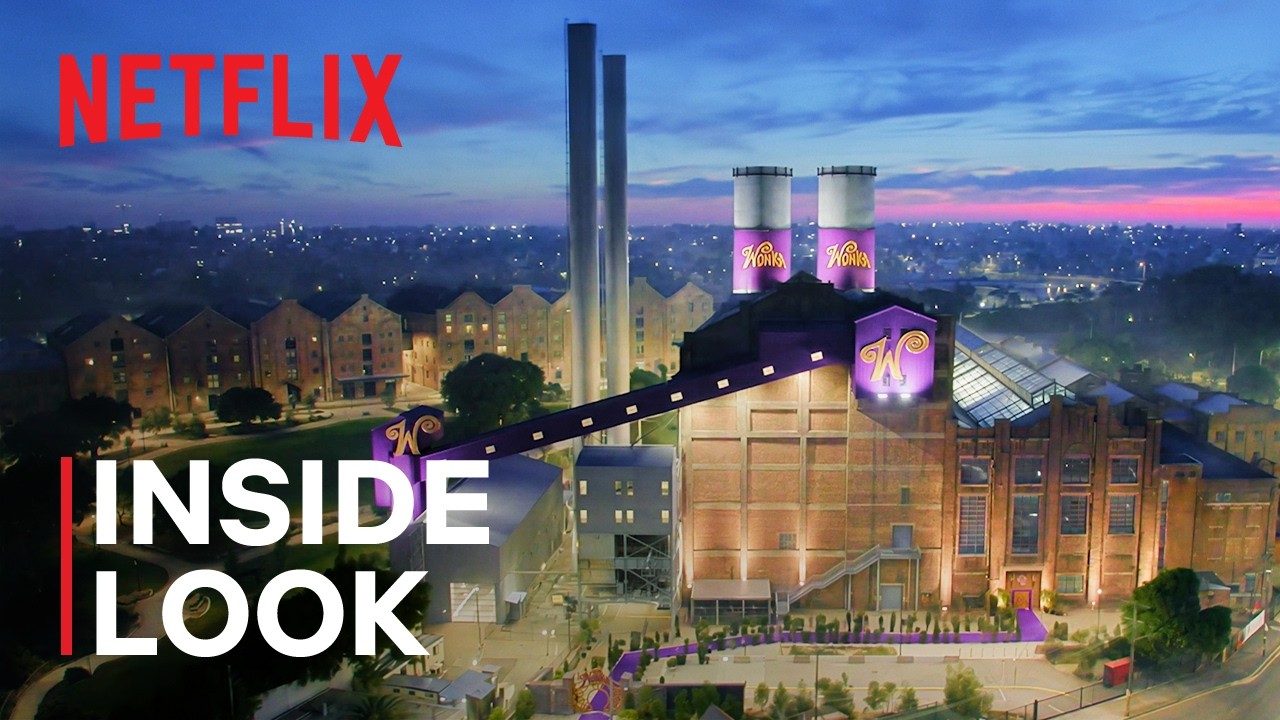
The chocolate river arrived from California. Shipped across the Pacific to Australia, it took considerable research and development to achieve the right viscosity and color, and the result is fully ingestible. That single detail captures everything about ‘Wonka: The Golden Ticket,’ a Netflix competition show built inside a 40,000-square-foot recreation of Willy Wonka’s factory, where the edible grass is real, the illusions work live with no green screen, and a cash prize of $100,000 per year for 30 years waits at the end. The team behind it had one guiding question from the start: what would Wonka do?
A factory you can almost taste
The set was designed with, as the production team put it, ‘the bones and the DNA of the 1970s factory that we all know and love.’ Walking in, returning audiences will recognize the mushrooms, the flowers, the plants, the moving cogs, and the machines that actually function. Pairs of contestants arrive, each bringing a family member or loved one, mirroring the structure of Roald Dahl’s original story. The stakes mirror it too: contestants can be mid-dream one moment and terminated from the competition the next. As one of the pairs said on seeing the elimination mechanic for the first time, ‘that’s super messed up.’
The Oompa-Loompas are part of the cast in a way the original never attempted. The production cast performers of varied sizes, genders, and backgrounds, with wardrobe and hair styled as a deliberate nod to the 1971 film. One performer has a direct line to that original: he was an Oompa-Loompa in the 1971 ‘Willy Wonka and the Chocolate Factory’ and has returned alongside his son, Ben, to work the factory floor again. He said he never believed he would be back in orange face and green hair: ‘Never in a million years.’ Their duties on set run the full circuit, delivering contestants into the chocolate room, piloting the Wonkatania boat, guiding players through tasks, and occasionally delivering the terminations.
Illusions built to fool people who never signed up to be fooled
The force perspective room was the production’s first major illusion and a new challenge for the team that designed it. A crew of five people each held a specific, timed job to make untrained members of the public vanish instantly from the space. The Wonkavision set presented a separate problem: the show beams contestants into a television set using what appears on set as something close to a laser screen that closes around a feed box, at which point the person inside disappears from view entirely. One contestant’s reaction: ‘Wait, what? Are we in the TV?’
For certain games, the production used a remote-presence technology that placed a host located thousands of miles away directly onto the set alongside contestants, making it possible to feature names who could not travel to Australia for the shoot.
All of it, every illusion and every special effect, had to work live. No green screen, no post-production fixes.
The still life of a chocolate river
A stretch of ingestible chocolate-colored liquid winds through the factory floor, its surface catching the light from rows of bulbs that the production describes, simply, as very expensive.
The show premiered with a prize that stopped at least one contestant cold. On hearing that $100,000 per year for 30 years was on offer, the reaction was immediate and unfiltered: ‘I can retire.’ The factory, it turns out, was built to produce exactly that kind of moment.