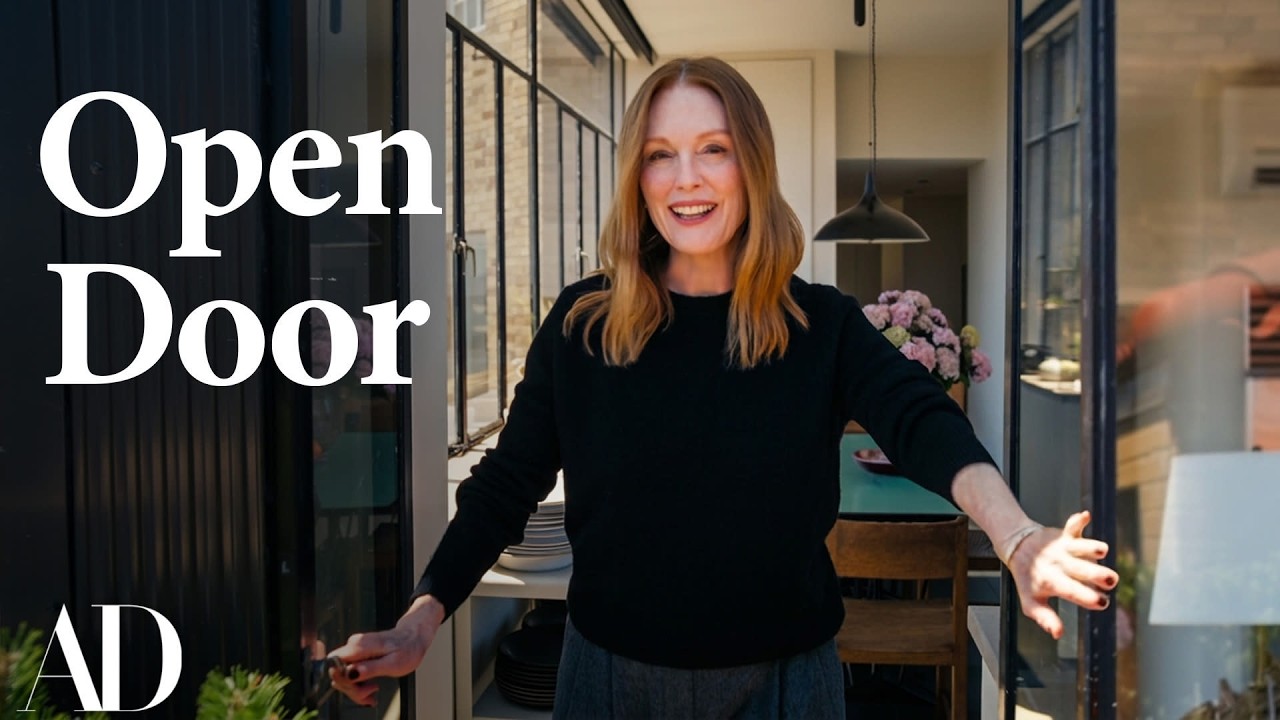
Julianne Moore paused at the edge of her rooftop terrace, gestured toward a guy on a balcony across the way, and said it plainly: this is how she experiences New York now. After nearly 25 years in a townhouse at street level, the actor moved high above the city into a compact, carefully considered apartment inside a building originally constructed as a hotel in the 1920s, and the shift changed something for her. Up here, the city is all around you, and the life of it arrives differently.
A small apartment where every detail was fought for
Moore worked with her architect, Oliver Freinlich, on an apartment she describes as compact enough that details become load-bearing decisions. The light switches are Forbes and Lomax polished nickel, chosen because they feel good in the hand. Cabinet handles, faucets, and fixtures were all held to the same quiet standard: a little bit of shine, everywhere, consistently. The wall color, Sea Pearl by Benjamin Moore, was arrived at by holding paint chips against three separate samples at once: concrete tiles from the kitchen, the stone of the mantelpiece, and the bookcases left behind by the previous owners, which she liked too much to replace.
The IKEA shelving unit in the kitchen was not a compromise. She needed a storage piece, considered having something built, found this one, assembled it herself, and immediately recognized that the color and the industrial quality suited everything around it. It stayed.
The living room runs on a projector rather than a wall-mounted television, because Moore refuses to sit at an angle to watch anything. There is also a working fireplace, which she notes is genuinely unusual for a New York apartment. A Nakashima piece sits nearby, which she describes as the first important furniture she ever bought. A Gaetano Pesce chair that must be kept away from direct sunlight because it can melt anchors another corner. A Louise Bourgeois piece shares a shelf with a wax baby sculpted by a woman named Elizabeth McCoy, whom Moore encountered on a photo shoot with Helena Christensen. The two objects, she said, are ‘both so feminine’ and feel like they are in conversation with each other.
Paris chairs, a Pierre Chapo table, and a picture of the moon
A pair of chairs Moore bought in Paris in 1995 have traveled with her through every home since. The person who sold them suggested they might be by Frank Lloyd Wright. Moore is skeptical: ‘I doubt it. If they were Frank, I don’t think I could have afforded them.’ A Pierre Chapo table she searched for over a long period serves as the entry table and her daytime workspace.
The bathroom kept its original bathtub from the previous owner, whose marble tiles were preserved and carefully matched by Freinlich. A marine lip runs the perimeter of the sink counter, designed so that a spilled glass of water rolls back rather than off the edge. Eileen Gray light fixtures complete the room, and Moore offered a deadpan observation about them: the lighting is so good in that bathroom that you sometimes look better in it than you do in real life.
A photograph on the bedroom wall was taken by her husband using a telescope and an iPhone. It is a picture of the moon.
The herb garden on the shared terrace
On the rooftop terrace, a small herb garden is planted and maintained jointly by Moore and the close friends with whom she and her husband share the outdoor space. The arrangement, she said, is ‘kind of amazing.’
Moore once accidentally locked her husband outside on that terrace. She had gone to work without realizing he was still out there. He had his phone, so she was able to come back upstairs and let him in. The door, she will tell anyone who uses it, has a handle only on the inside.
Back inside, standing near the Pierre Chapo table she spent years trying to find, the same table where she now works each morning with the terrace just beyond the glass, Moore said simply that being in that room makes her really happy. The guy across the way was probably still on his balcony.