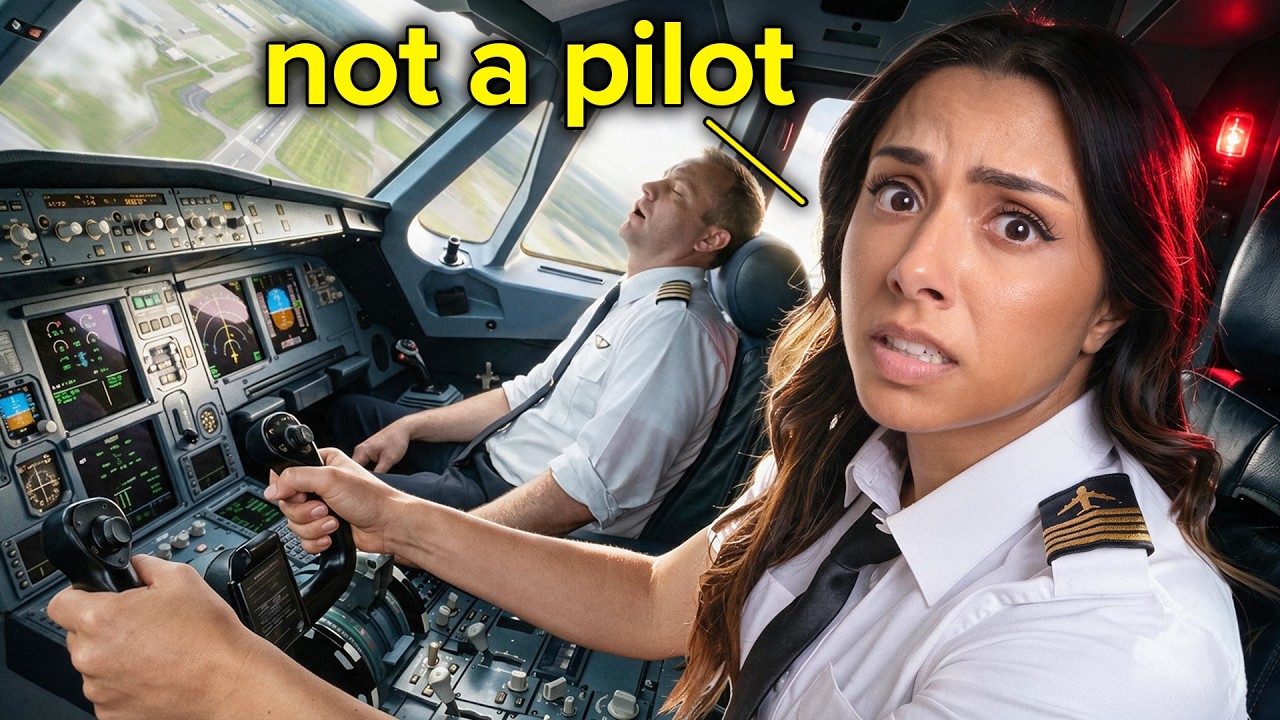
Michelle Khare dropped into the left seat of a high-fidelity Boeing 737 simulator, strapped herself in, and immediately could not find the button to talk to air traffic control. That small detail matters, because while she fumbled through roughly 3,000 buttons searching for the radio mic, the simulated plane was already burning fuel and overshooting the approach to Las Vegas. One-third of Americans believe they could land a commercial passenger aircraft with help from air traffic control. Khare decided to find out if any of that confidence was warranted, and the answer turned out to be far more complicated than a simple yes or no.
The scenario was designed to be brutal from the start. Jim, a veteran pilot playing the role of air traffic controller, laid out what was coming before Khare ever climbed into the cockpit: engine fires, engine failures, and conditions that seasoned airline pilots can recover from but that would expose every gap in an untrained person’s understanding. The simulator itself was full motion, meaning every micro-correction Khare made in the cockpit translated directly into physical movement for everyone strapped inside it.
Finding the runway while everything falls apart
Once Khare established radio contact, Jim walked her through the autopilot control panel one dial at a time. Airspeed at 310, heading at 268, altitude at 24,000 feet. The plane was stable, the autopilot was doing the heavy lifting, and for a stretch the whole thing almost felt manageable. Because she had taken so long to find the radio, though, the approach to Las Vegas was already compromised. Jim directed her through a full 360-degree loop to bleed off altitude at a safe rate, and Khare spent that time learning what a heading dial actually does and why rotating it clockwise tells the plane to turn right.
The relative calm ended the moment Jim told her to hand-fly the final approach. A bird strike lit up the fire warning for the right engine. Following Jim’s instructions, she pulled the fire handle and cut fuel to that engine, which extinguished the fire but left the 737 running on one engine and pulling hard to one side. Khare’s description of trying to keep the plane coordinated from that point was precise: ‘Trying to control the plane with one engine down is sort of like trying to control a car when it’s hydroplaning.’ When Jim asked her to pull the power back to slow the descent, she pushed the thrust levers forward instead, sending the nose up and adding speed. That translation error repeated itself across multiple attempts, each one ending in a crash.
What it actually took to get the wheels down
The correction that finally changed things was a trim knob in the center console. Jim pointed her to a large gray knob and told her to turn it left. The rudder response shifted, the plane stopped dragging to one side, and Khare found what Jim called the sweet spot: gear down, flaps at 15, auto-brake set to max, power pulled back to a controlled rate of descent. The touchdown was hard enough that the simulator needed what Jim diplomatically called ‘a maintenance check,’ but the plane was on the ground and everyone in the cabin was alive.
Jim put it simply after she cleared the runway: ‘We didn’t do it the way that normal airline pilots do it, but we got it on the ground.’
The moment she almost gave up on the yoke
During the worst of the single-engine chaos, with the plane shaking, the second fire warning active, and Jim calling corrections faster than she could process them, Khare said out loud that she had not been forced into the cockpit but had chosen it, and that she was going to follow through. She had no idea what a yoke was when Jim first mentioned it.
By the time the wheels touched down in Las Vegas, she did.