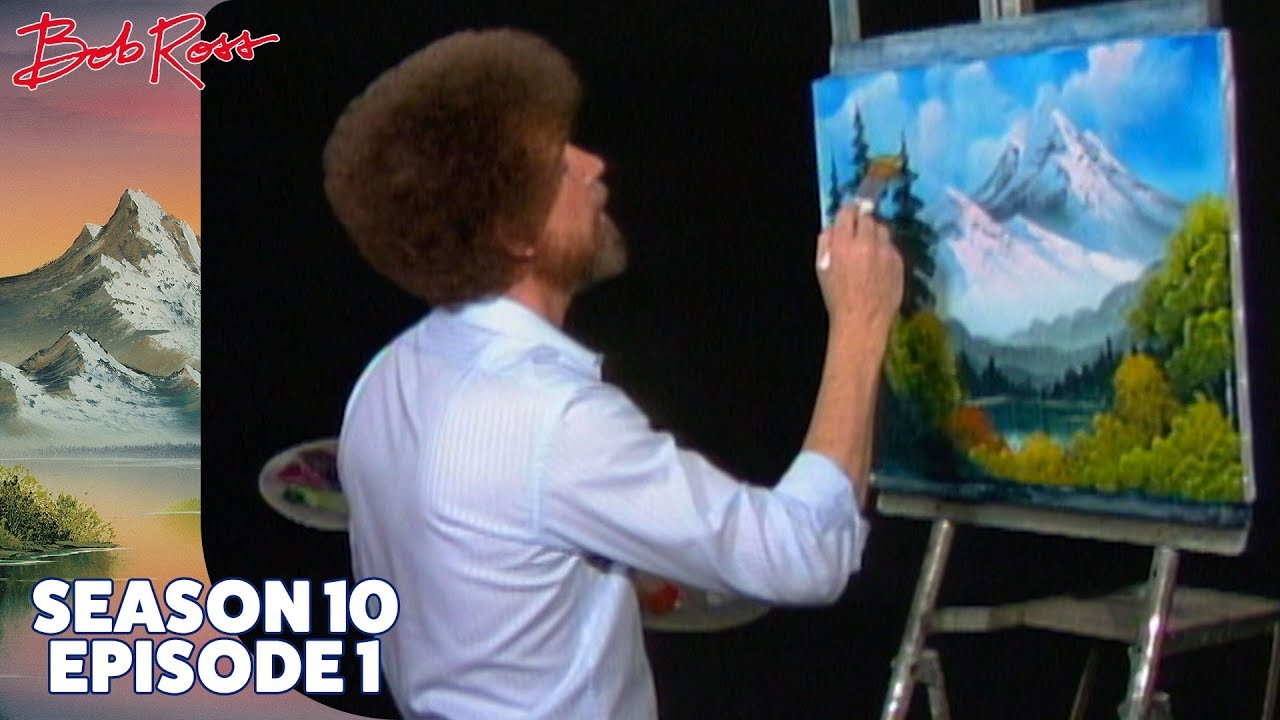
Bob Ross picks up a palette knife, presses titanium white flat against its blade, and cuts across once to load a small, precise roll of paint along the edge. That single gesture, unhurried and exact, is how a mountain gets its snow in his world. Season 10 of ‘The Joy of Painting’ opens with that same quality of attention that made millions of people reach for a brush in the first place, the sense that a spectacular landscape is not a feat reserved for the trained or the gifted but a sequence of logical, learnable moves available to anyone willing to slow down and follow along. The painting is called ‘Towering Peaks,’ and from the first stroke of phthalo blue across a liquid-white-primed 18-by-24 canvas, it earns the name.
Where the sky, the water, and the mountain come from
The session opens in the sky. Ross loads a small amount of phthalo blue onto a brush and works it across the upper canvas with criss-cross strokes, little x-shapes that blend into the wet liquid white beneath and produce soft gradations without effort. He notes that phthalo blue is ‘a happy color, bright and shiny,’ and he means it literally: the pigment is intense, and he uses just enough to tint rather than saturate. A touch of phthalo green goes in next, pulled horizontally from the outside inward to suggest a strip of distant water. Starting from the center and dragging outward, he explains, leaves a hard mark that is nearly impossible to soften on a wet surface, so direction matters from the first stroke.
The mountain arrives by palette knife. Ross blends a dark mixture of black, Prussian blue, van Dyke brown, and alizarin crimson, pulls it flat, cuts across the blade edge, and presses the loaded knife against the canvas with firm downward strokes. He spent nearly 14 years in Alaska, and that time shows in how fluently he reads a mountain’s geometry: ‘Mountains are just geometric shapes,’ he says, and the knife follows those angles without hesitation. Snow goes on with pure titanium white and no pressure at all. ‘Pretend that if you are not careful your hand will just literally float away,’ he tells the viewer, and the result is a highlight so light it seems deposited rather than applied. A Prussian blue and white shadow mixture, mixed to a cool mid-tone and loaded the same careful way, pushes secondary peaks back in space and creates the ridge-and-depth layering that makes the range feel three-dimensional.
Foothills, evergreens, and the lake that moved
Layers of foothills follow, each one slightly darker than the one behind it, tapped in with an oval brush loaded with a muted blue-green mixture. Ross keeps each successive layer darker in value as it advances toward the viewer, a principle he names directly: as things come closer in a landscape, they deepen in color. Fan-brush evergreens go in next, the bristles loaded to a chisel edge and tapped downward so the paint forms irregular, natural-looking tops. Then comes the moment that stops first-time viewers cold: he grabs the wet evergreen paint and simply pulls it straight down toward the bottom of the canvas. The reflection appears instantly. ‘On a wet canvas all you do is grab it and pull it down,’ he says, then drags a nearly dry brush horizontally across the pulled paint to create the shimmer of a still lake.
The foreground fills with a large brush worked to a chisel edge, dark mixtures blocked in quickly, then highlighted with cadmium yellow and sap green for leaf trees and bright accents for low bushes. A path in van Dyke brown curves behind a tree and disappears. Ross pushes a small bush right over it with a loaded brush, and the path vanishes into the undergrowth as if it was always meant to go somewhere private.
The liner brush near the end
Before Ross picks up the thin liner brush to sign ‘Towering Peaks,’ a palette knife is still in his hand, scraping fine sticks and twigs into the wet foreground paint. They are easy to miss in the finished painting, but they catch the light.
The sky that opened the session with criss-cross strokes of phthalo blue is still visible at the top of the canvas when he sets down the brush, the same happy color it was at the very first mark, now framed by everything that grew beneath it.