In 1887, a young physics teacher loaded an arrow tipped with a molten glass bead into a homemade crossbow and fired it across a room. The resulting fiber, at its thinnest less than a tenth the diameter of a human hair, was meant only to measure tiny forces. Nobody in that room imagined they had just demonstrated the physical principle that would one day carry the entire internet. But the path from that arrow to the fiber cables humming beneath every ocean required one stubborn electrical engineer willing to chase what his own boss called a wild goose chase.
When copper hit its ceiling
By the early 1960s, America’s phone network was buckling. Between 1960 and 1973, daily calls in the U.S. roughly doubled from 285 million to 576 million. In the same window, NASA sent people to the moon for $26 billion. AT&T spent nearly triple that amount just keeping its copper wires from falling apart. The problem was physics. Copper cables carry signals by shifting voice into stacked frequency bands, the way a radio separates stations, but at high frequencies something called the skin effect pushes the oscillating current to the wire’s outer surface only, shrinking the usable cross-section and bleeding signal energy as heat. Past 65 megahertz, signals died in under two kilometers. The Shannon-Hartley theorem, published in 1948, had already described the ceiling: to carry more information you need more bandwidth, and copper had run out of both. Researchers at Bell Labs noticed that visible light operates at frequencies in the hundreds of terahertz, offering bandwidth so vast one Bell Labs engineer described it as ‘a fabulous El Dorado, always beckoning us onward.’ The idea of sending calls down a glass fiber had been floating around since the 1960s, but when a Bell Labs scientist measured the loss of the best available glass fibers, he returned a figure of a thousand decibels per kilometer. Kao later illustrated the scale of that problem: it would be like starting with the mass of the observable universe and ending with less than the mass of a single atom.
The outsider who asked the obvious question
Charles Kao was not a material scientist. He was an electrical engineer, and it was precisely that outsider status that let him ask what everyone else had given up on asking: why was glass so lossy, and were those losses intrinsic to the material or just a manufacturing problem? Kao traced two culprits. The first was Rayleigh scattering, caused by the disordered, amorphous structure of glass locking in at uneven densities as it cools. Cool the glass slowly enough and the atoms pack more evenly, reducing scatter. Using calculations from a scattering paper by Corning researcher Robert Maurer, Kao estimated that scattering loss alone might reach as low as one decibel per kilometer if the glass solidified around a thousand degrees Celsius. The second culprit was absorption from metal impurities, particularly iron, which strongly absorbs violet, blue, and infrared wavelengths. The telltale green tint visible along the edge of any ordinary window pane comes from exactly this effect, iron filtering out every other color across just a few centimeters of glass. Experts told Kao that removing those metal ions could drop loss to around 20 decibels per kilometer, comparable to copper. In 1966, Kao’s team published their theoretical conclusions, ending with the careful observation that the material problem appeared ‘difficult but not impossible.’ Almost no one believed it.
Kao set out to prove it by measuring the purest glass ever made: fused silica, pure silicon dioxide requiring temperatures above 2,000 degrees Celsius. He only had pieces shorter than 30 centimeters, so he and his colleagues built an entirely new precision instrument to measure loss at that scale. When he finally got a reading, his equipment showed zero loss. He ran it again. The loss was so low it fell inside their margin of error of plus or minus four decibels per kilometer. After months of refinement, his 1969 result: fused silica had a loss of less than five decibels per kilometer. ‘Kao gave everyone a jolt,’ one Bell Labs scientist said. ‘That was the first practical measurement which said, Hey, you are not just whistling Dixie.’
The race then shifted to Corning, where Robert Maurer teamed with ceramics engineer Peter Schultz and physicist Donald Keck. Their counterintuitive move was to use fused silica for the cladding rather than the core, then raise the core’s refractive index by doping it with titanium. After a summer the team later described as burning ‘hotter than Hades,’ Keck tested a short, damaged preform on July 22, 1970. Light blazed back into his eye from the far end of the fiber. Loss: 17 decibels per kilometer. The single word he wrote in his lab notebook was ‘Whoopie.’ A refined measurement on August 21, 1970, confirmed 16.9 decibels per kilometer. They later switched from titanium to germanium doping, which survived the draw furnace without breaking down. When the first germanium fiber was drawn, the end lit up from the furnace light. ‘We kept winding and winding and thinking the light was going to go out,’ Keck recalled, ‘and it never went out.’ Loss: four decibels per kilometer.
By 1977, AT&T trialed a fiber system beneath Chicago. A Japanese team achieved 0.2 decibels per kilometer by 1979, still the standard today. The first transatlantic fiber optic cable went live in 1988, carrying 40,000 simultaneous calls, ten times the capacity of its copper predecessor. Digital signals meant those calls could zipper together bit by bit and later carry text, images, and video. The internet followed.
What a modern draw tower actually feels like
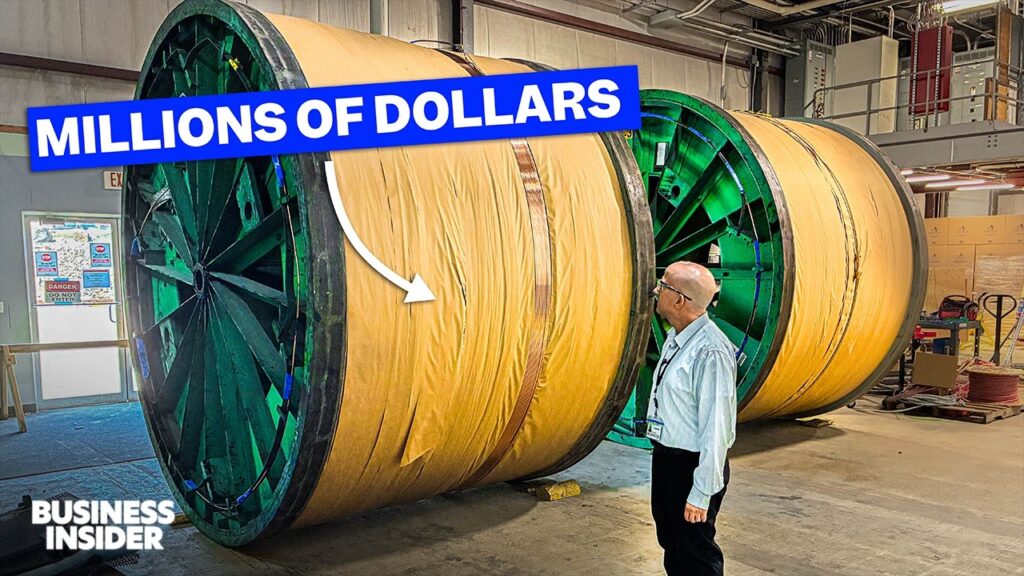
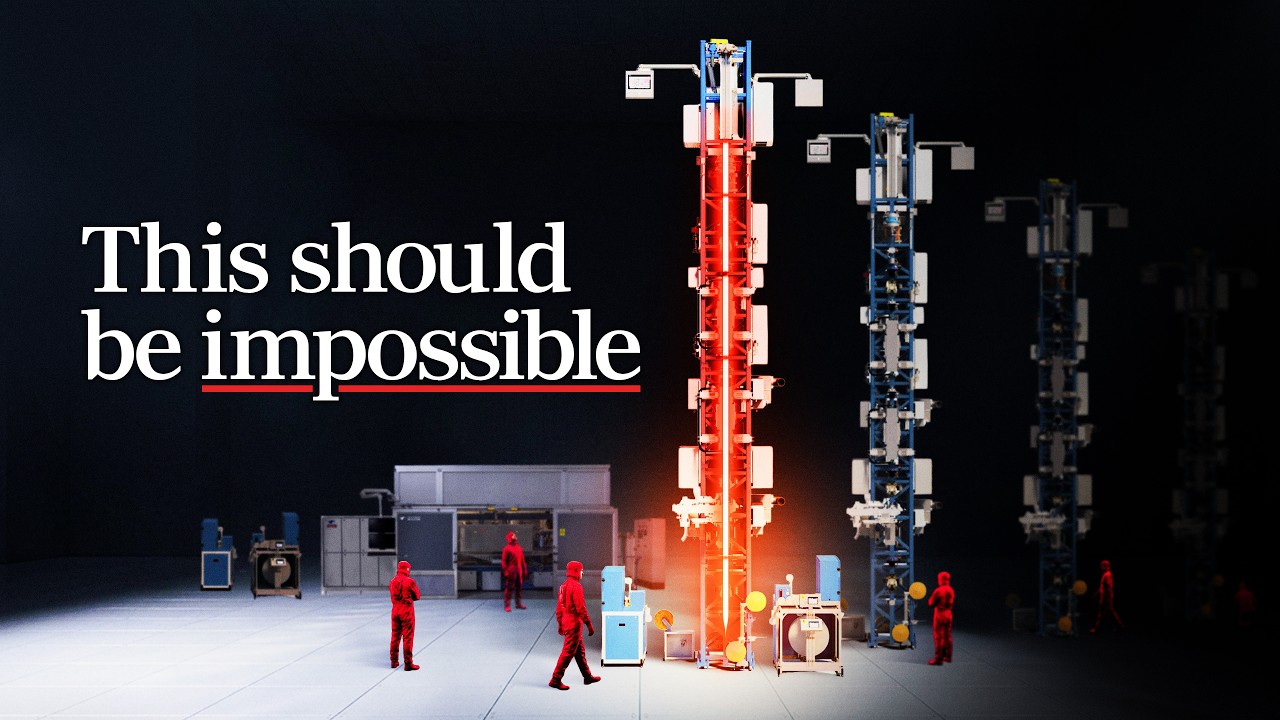
At Prysmian’s North Carolina factory, the process still begins with a preform built up from thousands of passes of plasma-deposited glass inside a rotating tube. A plasma torch running at approximately three times the temperature of the surface of the sun sprays silica onto the growing rod. Finished preforms ride seven stories up a draw tower, where the tapered end is heated to over 2,000 degrees Celsius, drops as what workers call a gob, and is pulled down to a final diameter of 125 microns over the space of a few meters. The remaining floors exist simply to cool the fiber slowly enough to avoid residual stress. Two plastic coatings follow. The result is a fiber stronger than a steel wire of the same thickness, though it snaps instantly if knotted. Each finished spool holds hundreds of kilometers of fiber, wound at over 50 meters per second. One reel in the warehouse measured 50.477 kilometers. ‘There are millions of kilometers here that we are pushing through every month,’ one engineer said.
The reel labeled 50.477 km
A single finished spool sits at the base of the draw tower, wound tight, its plastic outer coating still faintly warm.
Kao received the Nobel Prize in 2009. In his acceptance, he noted that the information revolution of the 1990s ‘could not have happened without optical fibers’ and that even one gigahertz had been ‘only a hope’ back in 1966. The thread connecting that moment to a crossbow fired in an 1887 classroom is a thin one, less than a tenth the width of a human hair, and it circles the globe eight billion kilometers over.