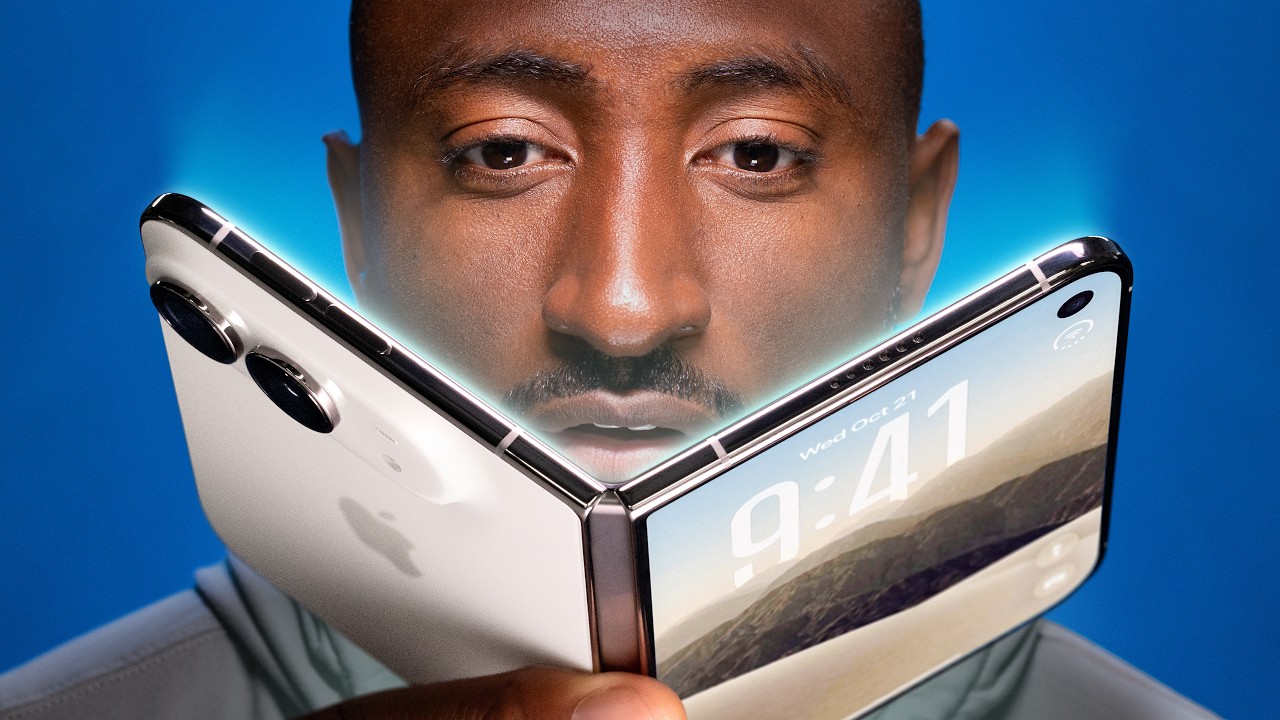
Marques Brownlee had been fielding the same question for a month straight before he sat down to deliver his verdict on the iPhone Duo. Should I get a foldable iPhone? Is it for me? Who is it even really for? Those questions matter, because the iPhone Duo costs $2,000, runs on hardware that is genuinely impressive in some places and genuinely first-generation in others, and arrives in a category that Samsung has been refining since 2019. The answer, it turns out, depends almost entirely on which part of the phone you spend most of your time with.
Where Apple got the iPhone Duo exactly right
The inner display is where Brownlee stops hedging. It is a 7.6-inch OLED panel running at 120Hz and hitting 3,000 nits, and it carries a nano-texture finish that does double duty: it diffuses the already mostly imperceptible crease and makes scrolling feel genuinely pleasant under a fingertip. He put it under a microscope trying to spot the micro-lenses that create the texture and found them too small to resolve. In daily use, there is a slight softness when reading text or watching video due to that diffusion layer, but he never found it distracting. The matte surface also blocks reflection well enough that he kept picking the phone up vertically, like an iPad mini, to read long-form content, something he said happened more naturally with the Duo than with any other foldable he has used.
The hinge deserves its own sentence. It uses variable resistance: stiff when prying the magnets apart at the start, smooth through the middle arc, then slow again near halfway so it can hold a range of partially-open positions, and finally a firm snap shut at close. That variable weight is the mechanical foundation for a half-open standby mode that activates even off power, showing a customizable clock or weather display when the phone is propped tent-style on a desk.
The opening animation has generated the most conversation since launch, and Brownlee has a theory about its origin. His read is that it was inspired by a lenticular sheet: lift the sheet and whatever is underneath slowly diffuses into view. ‘It was inspired by this lenticular sheet,’ he said, describing how the Duo’s transition mimics that exact visual effect, responding to hinge angle in real time so that new users intuitively grasp that they are revealing a second, larger display rather than triggering a glitch.
Continuity between the two states is exceptional. Mid-scroll on a webpage, mid-sentence in an email draft, mid-attachment: open the phone and it picks up exactly where it left off.
Where the iPhone Duo still shows its first-generation roots
The weight and thickness are the most immediate friction. A Samsung Galaxy Z Fold 8, now in its eighth hardware generation, is measurably thinner and roughly 20 percent lighter. Brownlee is direct about the consequence: after a week or two, that difference becomes something you notice every single day. He recalled a Time magazine quote in which Apple design chief John Turnis called competing foldables ‘cheap and crappy,’ and pushed back with a point worth sitting with. Metal and glass construction signals quality at a glance, he argued, but the same logic that makes AirPods Max feel premium also makes them heavier than most people would prefer after extended wear. The Duo is not worn on a face, but the principle holds.
The under-display selfie camera is, in his assessment, simply bad. Photo quality is poor. Video on FaceTime reads somewhat better. Apple clearly accepted that trade-off to keep the inner display uninterrupted, and Brownlee suspects a future generation will revisit the decision the way Samsung eventually did.
The app ecosystem is the biggest day-one limitation. At launch, Spotify, Google Maps, Discord, Google Calendar, and the majority of frequently-used third-party apps display as unoptimized iPhone layouts with a black bar occupying the right-side panel where controls should appear. On the inner display they remain small, centered islands in the middle of a large screen. Instagram shipped an optimized build the day he finished filming. His weather app of choice, Carrot Weather, also arrived. Most have not. He gives the ecosystem roughly six months before the gap closes meaningfully, citing Apple’s track record of pulling developers along through platform transitions.
The fingerprint reader on the power button is fast in hardware but artificially slowed in software. Apple programmed a deliberate pause after a registered finger touches the sensor so that users can glance at lock screen notifications before the phone opens. The intention is considerate. For anyone coming from Face ID, the pause reads as lag. Brownlee eventually found a workaround: wake the screen, swipe up, then touch the sensor for a near-instant unlock. He does not think most switchers will miss the zoom cameras or the thinner profile first. ‘I really think Face ID is going to be the number one thing people miss coming from other iPhones,’ he said flatly.
One configuration that went entirely unnoticed
Brownlee shot a full Tesla Roadster reaction piece on the iPhone Duo’s rear cameras without a single viewer comment about the footage quality. The Duo carries dual rear cameras: a 48-megapixel primary and an ultrawide, with the primary sensor appearing to match the one in the iPhone 17e rather than a thinner variant borrowed from the iPhone Air. In good light, results are solid. As light drops, the smaller sensor raises ISO earlier and introduces noise faster than the Pro lineup. There is no ProRes, no log recording, and no optical zoom beyond roughly 4x. For a $2,000 phone, the camera ceiling is deliberately set below the Pro tier.
The moment the Duo’s form factor actually clicks
Two apps pinned side by side, locked together as a pair by tapping the center divider, opening together every time either is launched. YouTube on one half and a notes app on the other. An email confirmation code on one side and a login portal on the other. That pairing gesture, and the continuity that carries it across open and closed states, is where the phone stops feeling like a novelty and starts feeling like a tool built around a real workflow.
The 4,900mAh combined battery, split between both halves, held up across a week and a half of mixed use, with Brownlee regularly finishing the day above 30 percent remaining. The A20 Pro chip drives that efficiency while handling multitasking without visible strain. IP68 dust and water resistance rounds out a hardware package that, weight aside, is genuinely competitive for the category.
The Duo is a 7.6-inch OLED iPad mini that fits in a pocket. Apple made it, finally, and it is fun. The animations and the hinge and the matte inner display carry the experience past a lot of the rough spots underneath. Whether those rough spots matter depends entirely on which apps you use, whether $2,000 feels like a reasonable entry fee, and how much the absence of Face ID will bother you on month three.
 Wake up to Only Happy News!