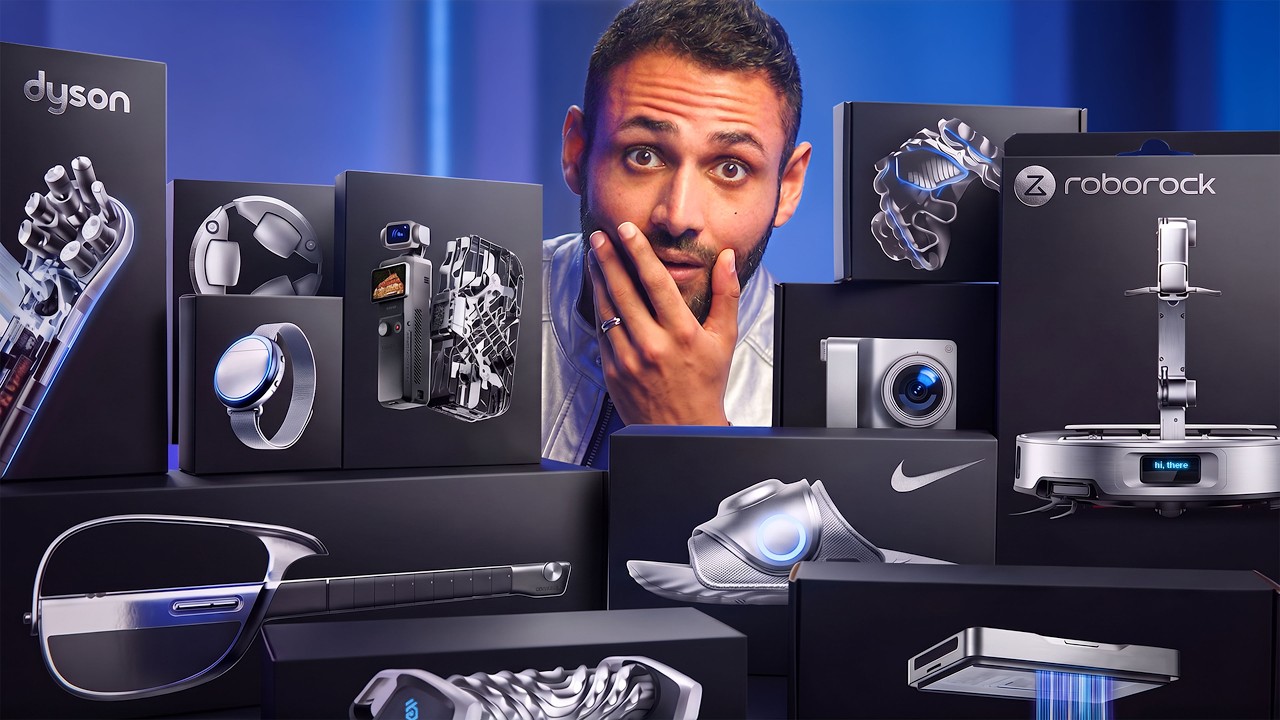
A robotic arm reached down, grabbed a shoe by the toe box with 93% confidence, and carried it across the room to a designated shoe zone. Nobody touched it. Nobody prompted it beyond a single tap. That moment, somewhere inside a testing session three months in the making, is where the line between gadget review and science fiction quietly dissolved. Arun Maini spent a quarter of a year sourcing what he believed were the most genuinely futuristic consumer devices on the planet, ranging from things that feel like 2030 to things that, by his own reckoning, should not exist until 2050. The question driving all of it: are these companies actually building the future anyone asked for?
From solar hats to modular PCs that almost work
The journey starts on top of his head. A solar-panelled hat redirects the energy that would otherwise cook your scalp into charging your phone. The physics are real: where a standard hat reflects about 10% of incoming sunlight and absorbs the rest as heat, the solar cells convert 24% of that energy into usable electricity. Left plugged in for just under two hours, it charged a phone from 1% to 42%. Maini had gone in pessimistic about solar charging. The hat proved him wrong.
The Cadas Mind Pro modular PC is a more complicated story. A computer the size of a thick credit card, cramming a high-end laptop chip, 64 gigabytes of RAM, and 2 terabytes of storage, it snaps via a proprietary high-speed interface onto a laptop shell, a desk dock with USB and HDMI ports, and a module containing a desktop-class RTX 5060 Ti graphics card. Each transition is instant, because a tiny internal backup battery keeps it in standby while you move between workstations. Everything works. The problem is arithmetic: buying all three workstation setups runs to roughly 4,500 dollars, at which point a single powerful laptop starts looking more rational. ‘The modular curse continues,’ Maini concluded, with genuine affection for what the engineers pulled off.
The gadgets that got genuinely strange
The Liberia C2 stringless guitar replaces strings with buttons and Guitar Hero-style paddles, lets you change the key with a wheel, and can impersonate a warm electric guitar or a full piano. Used with its app to play along to a guided song, with the neck lighting up in the colours you need to hit, it produced a rendition of Twinkle Twinkle Little Star that Maini described as ‘the greatest rendition… you have ever heard.’ Whether it teaches real musicianship is a separate question the device does not pretend to answer.
The Ember Wave 2 temperature wristband sits backwards on your wrist, over an area of unusually thin skin packed with thermo-receptors, and uses a thermoelectric heat pump to push warmth toward or away from those nerve endings. It does not cool your whole body, but it makes a measurable difference, and a visible cool patch remains on the skin afterward.
The Hover Air Versa is a pocket action camera that takes on a set of magnetic propellers and flies. It navigated through a narrow gap in a fence on its own, tracked a subject without a controller, and performed a slow rotating orbit at a radius and speed set by the user. ‘I love the future,’ Maini said, hand extended, as the drone landed on his palm.
The Roborock Saros Z70 robotic vacuum carries a retractable robotic arm. When a shoe appeared in its path, it identified the object with 93% confidence, oriented itself, gripped the shoe at exactly the right point, and deposited it in a pre-assigned shoe zone. The number of times a robot vacuum has stopped because something blocked it and simply waited is, as Maini put it, ‘uncountable.’ That arm solves a genuinely real problem in a genuinely strange way.
One mouth, two hands free
The Mouthpad is a retainer-shaped device that turns the roof of your mouth into a trackpad, controlled entirely by tongue movement. Left-clicking is a tap. Right-clicking is a micro-suck. Head tracking from built-in gyro sensors moves the cursor as you turn your head. Maini used it to navigate a full desktop, browse tabs, and play a video game, all without touching a keyboard or mouse, and estimated the precision at about 95% of a finger trackpad. The immediate use case for people with physical disabilities is obvious. The secondary use case, for anyone who wants to bring an extra appendage into a productive workflow, is something he found himself genuinely considering.
The leg that moved on its own
A pre-production robotic leg massager expanded to its maximum diameter, contracted until it gripped the leg, and then travelled upward under its own power, adjusting its clamping pressure in real time based on where it was on the limb. Maini told it to stop. It stopped. He told it to reduce strength. It reduced strength. He described it as ‘someone hacked the timeline and brought something back that wasn’t even meant to exist right now.’
The full-circle wrap: the shoe is in the shoe zone, the hat charged a phone to 42%, and the leg massage robot is waiting for its next command. Three months of sourcing produced one clear answer: a lot of companies are, in fact, building something.
 Wake up to Only Happy News!