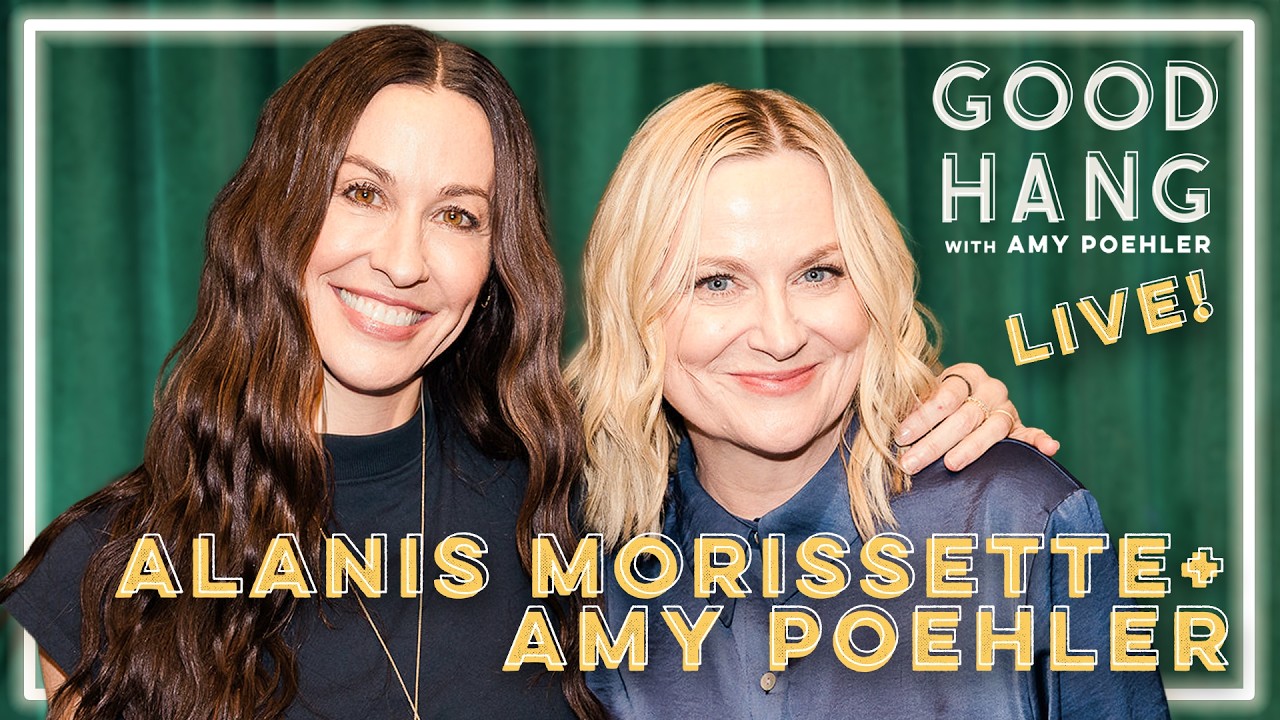
At the Vic Theatre in Chicago on a rare sunny afternoon, Alanis Morissette leaned across a table and quietly refilled Amy Poehler’s cup mid-conversation, prompting Poehler to immediately announce to the audience that it was straight vodka. It was not the kind of moment that gets planned. It was the kind that makes a live show worth attending, and it set the temperature for everything that followed: two people thinking out loud together, in public, without a net. For anyone who grew up feeling spoken for by Morissette’s records and wondering what she is like when the music stops, this afternoon at the Vic was the answer.
Poehler opened the show by welcoming the packed house to what she called a 2 p.m. show, noting with evident satisfaction that the audience could still catch some sun, get into pajamas by 6, and fit two cultural events into a single day. Chicago, she said, was chosen because Good Hang fans voted for it, and she credited the city with giving her the beginning of her comedy career, including a stretch waitressing at a restaurant she remembered as Carluchi. Before bringing out Morissette, she sat down with Kelly Croyer, a 42-year-old born-and-raised Chicago native and former hotel hospitality professional who described first hearing Morissette on the radio around 1998 as a freshman in high school. ‘I felt like somebody was holding my hand for the first time,’ Croyer said, calling the song Uninvited specifically. She had seen Morissette perform at an outdoor venue north of Chicago about 15 years earlier, worked her way from the lawn to a corner near the front, and said she would not have cared if she had gotten squished. Croyer closed her portion of the afternoon by asking the question she wanted Poehler to put to Morissette: is there a song you wrote early in your career that you understand differently now, not because the lyrics changed, but because you did?
The poodle inside the black stallion
Morissette answered that question eventually, pointing to Not the Doctor as the song she hears differently now. When she wrote it, she said, it was about keeping emotional distance and managing your own healing separately. Years into long committed relationships, she now reads the same lyrics and thinks the ideal is active participation in each other’s healing. She looked back at the lyric and said plainly: ‘Oh, Alanis.’
Before getting there, the conversation moved fast and without obvious seams. Morissette described her inner temperament as ‘a scared, tiny, shaky poodle’ and her outward presentation as ‘a black stallion,’ and said the two are frequently at odds. She talked about the survival strategy she calls the fawn response, the one that gets labeled clingy or needy, and defended it as the only one of the five that reaches for connection. She described starting a record label at 10 or 11 because nobody was signing children at the time, her joke being that the industry now ‘crawl up the vagina into the uterus to get the signature real quick.’ On anger, she was precise: ‘That’s the actings out of anger. That’s not what I’m talking about.’ What she meant was the current that moves through you when a boundary has been crossed, which she described as information, not destruction.
Poehler brought up Taylor Hawkins, and Morissette said he had been an instant soul brother from the audition onward, someone whose playing was ‘reverent and respectful but also wildly bombastic.’ She said that up until just before he died, all she received from him was ‘regailings of kindness and mirroring and validation.’ On the subject of Brandi Carlile, a collaborator on her new Christmas album, she called her simply ‘the greatest person in the world.’ Steve Martin plays banjo on the record, a pairing Morissette said she had promised herself at 22 would happen someday. Martin Short is also on it, and the two of them share an obsession with Judy Garland that has apparently already produced a vision for a frame-by-frame recreation of something involving Marty and Judy, details still forming.
The marathon she will not be running again
Morissette has run more than one marathon, she confirmed, all of them for the National Eating Disorders Association as a way of framing her body publicly as an instrument rather than an ornament. She said she would not be doing it again. The part she remembered most vividly was miles 20 through the finish line each time, and the weeping afterward in cold water. ‘Just sob,’ she said. Poehler noted that every single person who talks to her about running makes it sound worse, and confirmed she remains entirely uninspired to try.
On the topic of shyness, Morissette stopped the word cold: ‘I don’t know if the word shy is real.’ Her replacement: ‘Shy is just pausing to check if the person is safe.’ Several people in the back of the Vic applauded.
The brush, the product, and the hair privilege
Poehler, who described herself as ‘hanging on by a thread’ in the hair department, pressed Morissette on her post-shower routine with the urgency of someone settling a long-standing personal grievance. Morissette confirmed she air-dries, uses a ‘super overpriced brush,’ and applies no product. None. Poehler’s response: ‘The hair privilege is unbelievable.’
Morissette, who is an Enneagram Eight with a Nine wing, said she dresses like a 14-year-old boy and relies on her hair to handle what she called ‘the fem stuff’ on her behalf. She said it has been a security blanket since her earliest touring days, useful for hiding under stage lights she described as ‘slightly ceaseless.’
Poehler asked what was making Morissette laugh these days. Morissette looked at her and said: ‘You right now.’ Then, without much pause, she named collaboration as her real answer, the unsung intimacy of writing with someone and laughing the entire time, harder when the material is harrowing. ‘The 1 plus 1 equals 14,’ she said. Poehler told her she really liked her. Morissette said she liked her too. The sun, per the opening promise, was still up.
 Wake up to Only Happy News!