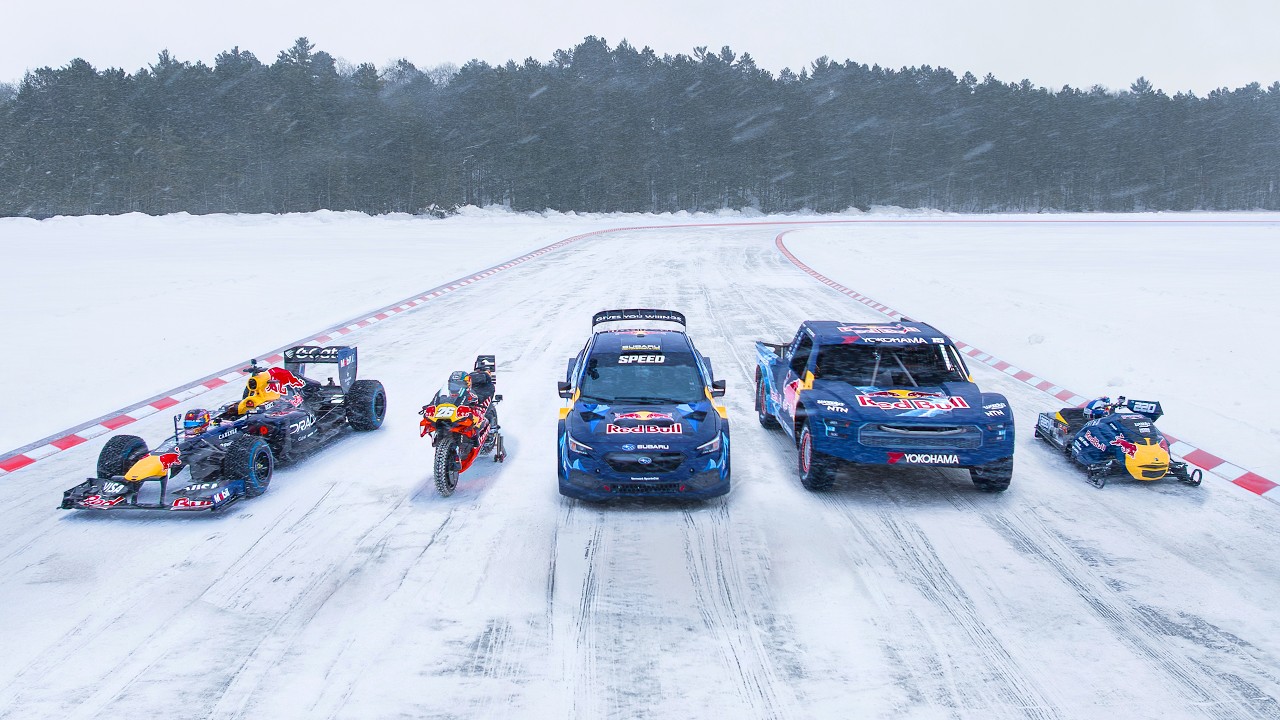
At minus 15 degrees Celsius on the surface of a frozen lake, Danny Pedrosa climbed onto a MotoGP bike fitted with 507 metal spikes and tried something nobody watching entirely believed was possible: could he beat an F1 car? The question that launched this entire frozen experiment was whether the fastest vehicles on earth could translate their speed onto a surface that gives almost nothing back, and the answer turned out to be far closer and far stranger than anyone predicted. Five machines, five drivers, one hand-built ice circuit, and calibration laps separated by just two seconds set up a final race that nobody could call with confidence.
Five machines and what it took just to get them rolling
Gunnar went first on his Pro Champ 440cc Ski-Doo, purpose-built for exactly this surface. The snowmobile carries roughly 400 studs underneath its track and two razor-sharp carbide blades up front. ‘Real fast and real left,’ Gunnar said plainly. ‘No right turns, though.’ Zero to 60 in under two seconds, a top speed of 105 miles an hour, and a calibration lap of 1:12 that set the early benchmark.
Andrew followed in a Pro 4 truck running a V8 with 950 horsepower, its Yokohama tires hand-spiked at 700 studs per tire, each one drilled and hot-glued by real people. The added weight, usually a liability, pressed those studs hard into the ice and gave Andrew serious traction. His calibration lap came in at 1:13, half a second behind the snowmobile.
Scott’s Subaru rally car arrived needing zero modifications beyond its ice-rally spike tires and standard all-wheel drive. It had, apparently, run an ice rally the weekend before. Around 300 to 400 horsepower, lighter than the truck, it matched Andrew’s 1:13 but sat nearly a second behind Gunnar.
Patrick brought the RB7, Sebastian Vettel’s 2011 world championship-winning F1 car, lifted slightly for clearance and fitted with studded tires. At low speed the downforce that makes an F1 car extraordinary on asphalt is essentially useless, so the first few corners demanded extraordinary wheel work just to stay pointed forward. ‘Look at how much work Patrick has to do behind the wheel,’ one observer noted. That effort produced a 1:11, the fastest calibration lap of the day.
Then came Danny on the MotoGP bike: 207 spikes on the front tire, 300 at the rear, modified suspension travel, a steel brake disc replacing the usual carbon unit, and cold-weather engine mapping. Two wheels on ice, one-wheel drive, full leather suit in sub-zero air. His calibration lap matched Gunnar at 1:12, within one second of the F1 car.
When all five lined up and the ice decided everything
The final race reshuffled what the calibration times suggested. Patrick pushed the F1 car hard through the corners. Gunnar and his snowmobile separated from the pack early, but the snowmobile’s course was the longest of any vehicle on the circuit. Danny looked visibly more composed in the race than he had in his calibration run, finding his lines through the tight corners where leaning a MotoGP bike is barely possible at low speed.
Heading into the final stretch, the snowmobile and the MotoGP bike were the last question. Coming out of the final corner, Danny crossed the line first. By only a second. Gunnar’s snowmobile took second. The F1 car came third, the Pro 4 truck fourth, and the rally car fifth.
The winner of Red Bull‘s ultimate winter race: Danny Pedrosa.
The last thing anyone expected to outlast the F1 car
The MotoGP bike, its spike tires locked into the ice, sits at the finish line in full leathers on a frozen lake. Five hundred and seven hand-modified metal points between it and the surface beneath.
An F1 car with pedigree going back to 19 of 20 pole positions came to a frozen lake and found that grip, the one thing it commands on asphalt, was the one thing the ice refused to give. The snowmobile was home. The truck was immovable. The rally car needed nothing extra to show up. And a MotoGP rider in full leathers, exposed to minus 15 degrees, navigating tight corners on two wheels with no ability to lean, found enough of an edge to win a race where almost every expert watching assumed he was competing just to survive it.
 Wake up to Only Happy News!