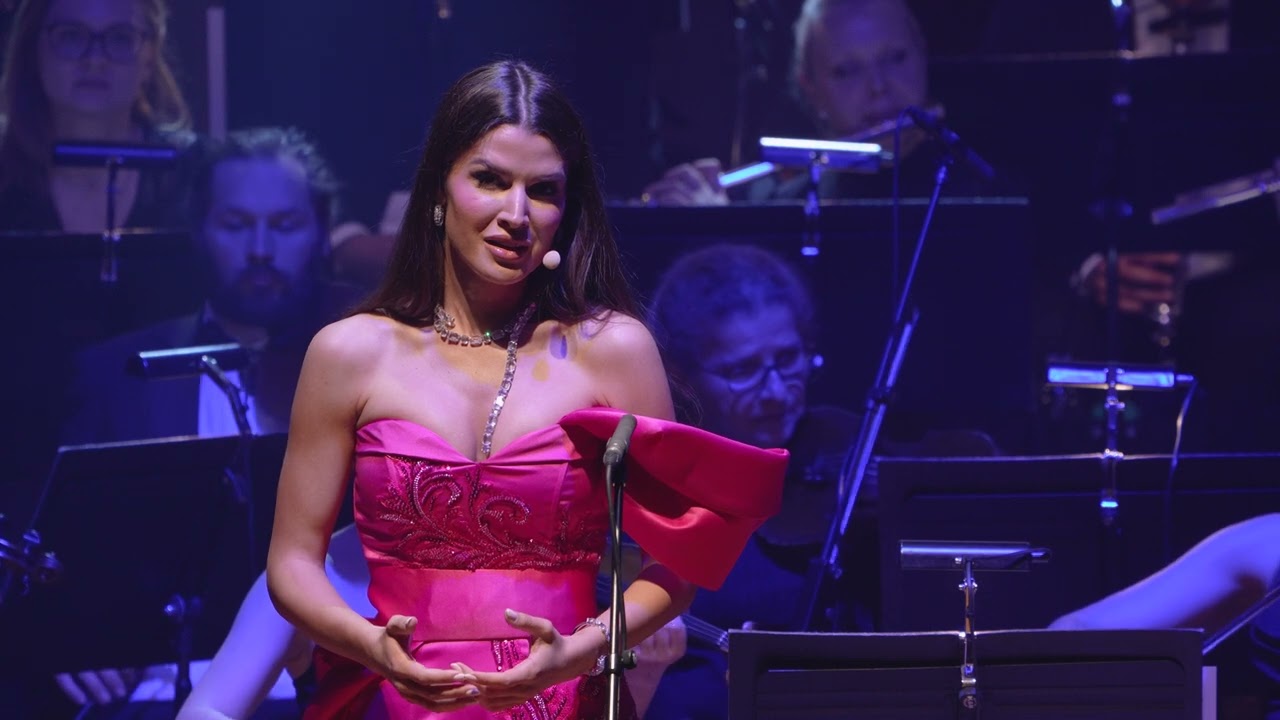
Tamara Radjenovic opens with a single image: being alone, dreaming at the horizon, with no words left to reach it. That image, drawn straight from the opening lines of ‘Con Te Partiro’, is not a dramatic pose. It is the emotional logic of the entire performance, and within the first few phrases it is clear she understands the song from the inside out. The piece, famously about departure and reunion rendered as a kind of impossible longing, finds in Radjenovic a voice that treats its lyric weight with absolute seriousness.
What the song is actually asking of a singer
‘Con Te Partiro’ is one of the most demanding vehicles in popular classical crossover. Its architecture requires a performer to hold stillness in the verses, where the language turns inward, and then release something much larger in the chorus without letting the transition feel mechanical. Radjenovic navigates that shift cleanly. The verse lines, ‘lo so che non c’e luce in una stanza quando manca il sole’, land with quiet conviction. The room-with-no-light-when-the-sun-is-absent metaphor is not illustrated with vocal gymnastics. She simply states it, and the plainness of the delivery makes the eventual chorus swell feel earned rather than manufactured.
The chorus, built around the repeated ‘con te partiro’, is where the performance opens up. Radjenovic lets the vowels carry the duration they need without pressing for volume as a substitute for feeling. The phrase ‘tu, mia luna, tu sei qui con me’ arrives gently, almost conversationally, before the final movement reasserts the full emotional scope. It is a structurally intelligent reading of a song that lesser performances turn into pure crescendo.
When the room responds
The applause arrives twice in the closing section, audible and immediate both times. It is not polite end-of-performance applause. The first wave comes before the music has fully resolved, which is its own kind of verdict. Audiences interrupt only when something has genuinely moved them past the point of waiting for the official moment to respond.
Radjenovic put the song’s stakes plainly in her own phrasing during the performance: ‘io lo so, sono piu sei quando sei lontana’, the admission that distance is not absence but a different kind of presence. That line is the emotional pivot of the piece, and she does not rush past it.
A voice in the final phrase
The last repeated ‘con me, con me, con me’ trails into something quieter than the peak that preceded it, a choice that resists the easy finish and leaves the song still breathing when the music stops.
The applause that follows is already in the air before the final note settles. It is there not because the performance was large, but because it was precise in the right places and generous in exactly the ones that mattered.
 Wake up to Only Happy News!